
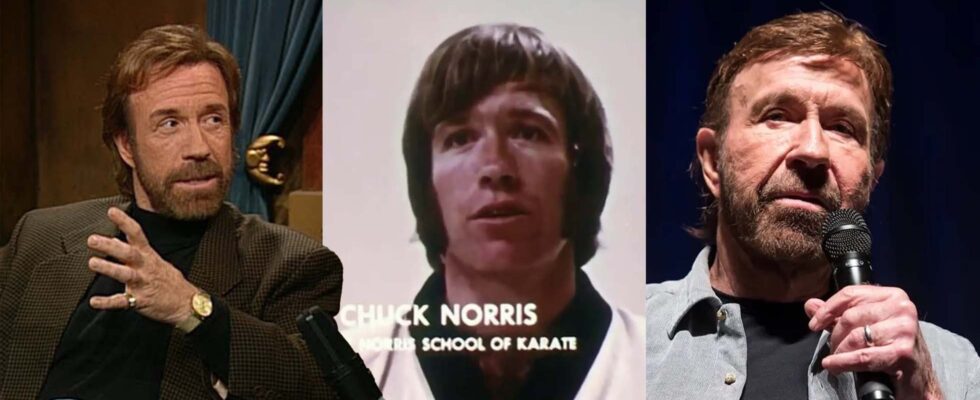
Chuck Norris was rushed to a hospital on the Hawaiian island of Kauai following a medical emergency that reportedly unfolded within the past 24 hours. The news caught many by surprise, given that just one day before the incident, Norris had been actively training on the island and by all accounts seemed perfectly fine.
A friend who spoke with him by phone during that time described Norris as sounding completely like himself, upbeat and even cracking jokes with no hint that anything was wrong. Despite being hospitalized, sources close to him say he is alert, in good spirits and not visibly distressed. No official medical statement has been released and the specific nature of his condition has yet to be disclosed. TMZ confirmed that he was taken to the hospital.
The timing drew considerable attention. Just days earlier, on March 10, Norris celebrated his 86th birthday by posting a video of himself sparring with a trainer, a nod to a lifelong dedication to physical fitness that has defined him as much as any of his films. In a birthday message to fans, he reflected with gratitude on his health, his longevity and his ability to continue training, noting that he feels like he is still progressing rather than slowing down. It was the kind of message that reinforced the image millions have held of him for decades, a man seemingly immune to time.
That image has roots going back more than half a century. Norris built his martial arts credentials the hard way, earning black belts in judo, karate and Taekwondo before becoming one of the most recognizable action stars in Hollywood. In the early 1970s, he channeled that expertise into creating his own martial arts system called Chun Kuk Do, which translates to “Universal Way” in Korean. The style drew from an eclectic mix of disciplines, including Korean-style kicking, traditional karate techniques, boxing, kickboxing and eventually Brazilian Jiu-Jitsu. He also founded the United Fighting Arts Federation to promote and teach the system.
One of his Chun Kuk Do instructors once described the organization’s approach:
Chuck Norris was my instructor. He came up with the idea back in the early ’70s to put together an organization that could unite all martial arts, and that’s how the United Fighting Arts Federation came about. What we do is structure our program around our own basic forms. We practice Korean-style kicking along with traditional karate hand techniques. We also incorporate boxing, some kickboxing, and the Machado jujitsu system, making it a well-rounded organization. We try to cover all aspects, from standing to ground.
Despite Norris’s stature in the martial arts world, Chun Kuk Do never gained significant traction and today remains largely a footnote, overshadowed by his other accomplishments.
Among the most celebrated of those accomplishments is his role in introducing Brazilian Jiu-Jitsu to American audiences, a contribution that took shape through a remarkable encounter with Helio Gracie in Rio de Janeiro during the 1980s. Norris had traveled to Brazil on vacation, heard about the Gracie family and their exploits in Jiu-Jitsu and arranged for a private session.
According to legendary BJJ practitioner Rickson Gracie, recounting the story in his autobiography “Breathe” and later on the Jocko Willink podcast, his father Helio, then in his seventies, asked Norris to mount him and attempt to throw a punch during the session. Norris recalled the moment vividly:
Mr. Gracie’s about this big [gesturing that he is short with his hand]. So we started working out, and I mounted him. And he says, ‘Okay, Chuck, punch me.’ And I said, ‘Mr. Gracie, I’m not going to punch you.’ And he said, ‘No, no, no. Punch me.’ So I brought my hand back [to punch him], and that’s the last thing I remember.
Rickson filled in what Norris left out:
After I grappled with him, my dad told Norris to mount him. And when he did, my dad said, ‘Okay, Chuck, punch me.’ The American hesitated, but my dad was in his seventies by then, but Helio kept insisting. Finally, Norris drew back his arm to punch, but before he could throw one, the old man had choked him out.
Far from being put off by the experience, Norris left Brazil deeply impressed.
Chuck left Brazil impressed by the Gracie family, invited us to come to America and hold a seminar for his students,
That seminar became a pivotal moment in the growth of Brazilian Jiu-Jitsu in the United States.
Norris has long spoken candidly about his well-rounded background, once reflecting on how it might have translated into the modern era of Mixed Martial Arts:
I feel I would have done very well in the MMA arena because of my judo training. I was a black belt in judo, and plus I had multiple black belts in karate, Taekwondo, Tong sudo and so forth, and plus I’ve studied jiu-jitsu with Gene LeBell back in the early ’60s and ’70s. So I felt I was pretty well-rounded.
For now, updates on Norris’s condition remain limited. His family and representatives have yet to make a public statement and questions about his diagnosis, the severity of his condition and the expected length of his hospital stay remain unanswered.
