
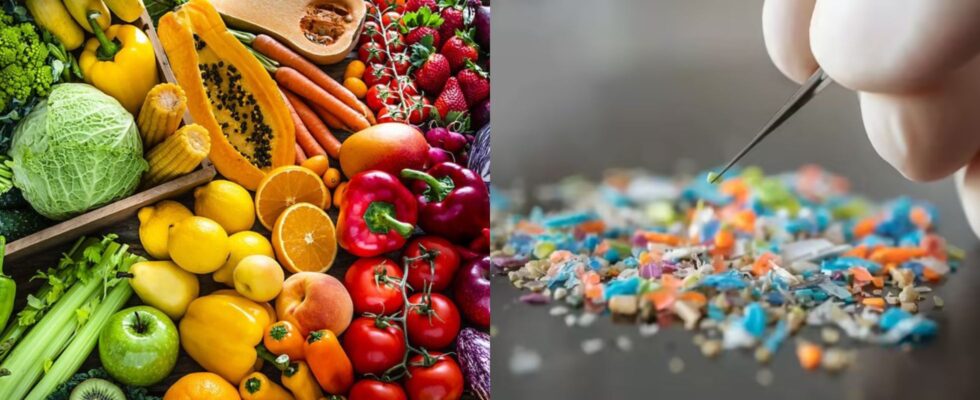
For years, seafood has been portrayed as the primary source of microplastic contamination in the human diet. A comprehensive new analysis published in the Journal of Hazardous Materials challenges this assumption, revealing that fruits, vegetables, and grains, not fish or shellfish, account for the vast majority of microplastics consumed by humans.
The systematic review, conducted by researchers Maria Hayder, Maud M. Laan, and Annemarie P. van Wezel, analyzed data from 193 studies documenting microplastic concentrations in food products worldwide. Their findings suggest a dramatic reassessment of dietary microplastic exposure is needed.
According to the research, fruits, vegetables, and grains contribute approximately 99.5 percent of total estimated daily microplastic intake. The median daily consumption was calculated at 721 microplastic particles per 154 lbs (70 kg) of body weight per day. This is a figure 50 to 500 times higher than previous estimates.
“Although most works so far have focused on seafood as a probable major source of MPs in our diet, we point out the relevance of fruit and vegetables and grains, which yield the highest estimated daily intake,” the researchers stated.
The disparity stems from consumption patterns. While seafood may contain notable microplastic concentrations, the average person consumes approximately 326 lbs (148 kg) of fruits and vegetables annually—nearly ten times more than the 35 lbs (15.7 kg) of fish consumed per year globally.
Research Bias Toward Seafood
The study revealed a significant imbalance in microplastics research. Over one-third of the papers analyzed focused on fish and shellfish, despite these foods representing a small fraction of the typical diet. Only six studies examined grains, four investigated meat, and four looked at fruits and vegetables.
“The number of papers does not reflect dietary habits, with papers on seafood being overrepresented,” the authors noted. This research bias likely stems from the expectation that filter-feeding marine animals would accumulate higher microplastic numbers, as well as historical focus on marine pollution.
The geographical distribution of samples also showed limitations, with most studies conducted in Southeast Asia and Europe. Central Asia, South America, and parts of Africa remain largely unstudied, limiting the ability to make accurate global assessments.
Contamination Pathways
The high microplastic content in plant-based foods appears to result from multiple contamination routes. Soil acts as a long-term repository for microplastics, which can be absorbed by plant roots or deposited on crop surfaces from the air. Agricultural practices, including the use of plastic mulch films and biosolids as fertilizers, contribute additional contamination.
“Soil being a long-term sink for MPs [microplastics], through which MPs might be transported to plants, being additionally enriched by usage of biosolids as fertilizers,” the researchers explained. “The high MP abundance in this food category may also stem from plastic particle adsorption to the crop surface without extensive penetration into the tissues.”
For comparison, fish contamination occurs primarily through consumption of microplastic-containing prey or direct ingestion from water, representing a different exposure pathway.
Methodology and Detection Challenges
The researchers addressed a critical challenge in microplastics research: the varying detection methods used across studies make direct comparisons problematic. Different analytical techniques measure different particle size ranges, potentially overlooking certain microplastics.
To standardize the data, the team extrapolated all measurements to a common size range of 1 to 5,000 micrometers, covering the full spectrum of microplastic particles. This approach allowed for more accurate cross-study comparisons.
The analysis found that detection methods significantly influenced results. Visual microscopy often yielded higher particle counts in fruits and vegetables compared to spectroscopic techniques, while results for simpler matrices like salt and water showed more consistency across methods.
Quality Control Concerns
A quality assessment of the collected studies revealed substantial methodological variations. Papers were scored on ten criteria, including sampling strategy, contamination controls, and polymer identification accuracy. The average quality score reached only 11.4 out of 20.
Notably, positive controls, which verify that microplastics are not lost during sample processing, were absent in most studies. “The lack of positive controls is well-known and questions the reliability of results as during sample treatment plastic particles can be lost or degraded,” the authors cautioned.
Polymer Types and Sources
The most common polymers detected in food samples were polyethylene (PE), polyethylene terephthalate (PET), and polypropylene (PP). The prevalence of these materials roughly corresponds to global plastic production volumes, with PE and PP being the most abundantly produced polymers.
Interestingly, PET appeared more frequently in food samples than its production volume would suggest. The researchers hypothesized this could result from higher degradation rates, increased migration from food packaging, or contamination during laboratory analysis.
“The migration of PET MNPs [micro- and nanoplastics] from food contact materials and during food processing should be investigated in detail in the future,” they recommended.
A smaller subset of 12 studies provided mass-based concentration data, offering a different perspective on microplastic exposure. These measurements indicated a median daily intake of 70.3 micrograms per 154 lbs (70 kg) of body weight, totaling approximately 4.92 milligrams consumed daily by an average person.
This figure substantially exceeds a previous estimate of 583 nanograms per day, though the researchers noted the mass-based estimate carries significant uncertainty due to limited data and analytical challenges with pyrolysis-gas chromatography-mass spectrometry techniques.
Implications for Dietary Guidance
The findings suggest current assumptions about microplastic exposure sources may be fundamentally flawed. While concerns about seafood contamination have driven consumer anxiety and research funding, the actual dietary risks appear more closely tied to commonly consumed plant-based foods.
This revelation complicates public health messaging. Unlike seafood, which some consumers might choose to limit, fruits, vegetables, and grains form the foundation of recommended healthy eating patterns.
The research team emphasized the need for additional studies on understudied food categories. “We strongly recommend that the research spotlight is moved to these food categories, as well as to meat, rather than seafood, and the inclusion of food types totally absent so far, e.g. oils and eggs,” they wrote.
Future Directions
The authors identified several critical knowledge gaps. Nanoplastics, which are particles smaller than one micrometer, remain largely unstudied in food despite their potential to penetrate biological barriers more easily than larger microplastics.
Standardization of analytical methods emerged as another priority. The wide variation in detection techniques, quality control measures, and reporting standards makes it difficult to compare results across studies or assess overall exposure trends.
Regional dietary patterns also require attention. The current dataset cannot account for local food preferences, farming practices, or contamination levels in different geographic areas. More comprehensive sampling across regions would enable targeted risk assessments.
Contamination Control Recommendations
Based on their analysis, the researchers provided recommendations for improving future microplastics studies. These include implementing rigorous contamination controls, using orthogonal analytical techniques to confirm results, clearly reporting size detection limits, and ensuring polymer identification accuracy exceeds 70 percent.
They also called for expanded food categories in research portfolios. “Due to the current gaps in data, attempts to estimate the overall MP exposure from food are extremely challenging, and the current estimates should still be seen as preliminary,” the authors acknowledged.
The findings underscore an uncomfortable reality: microplastic contamination pervades the food supply in ways that differ substantially from initial expectations. While the health implications of microplastic consumption remain under investigation, understanding accurate exposure pathways represents a necessary first step for risk assessment and potential mitigation strategies.
