

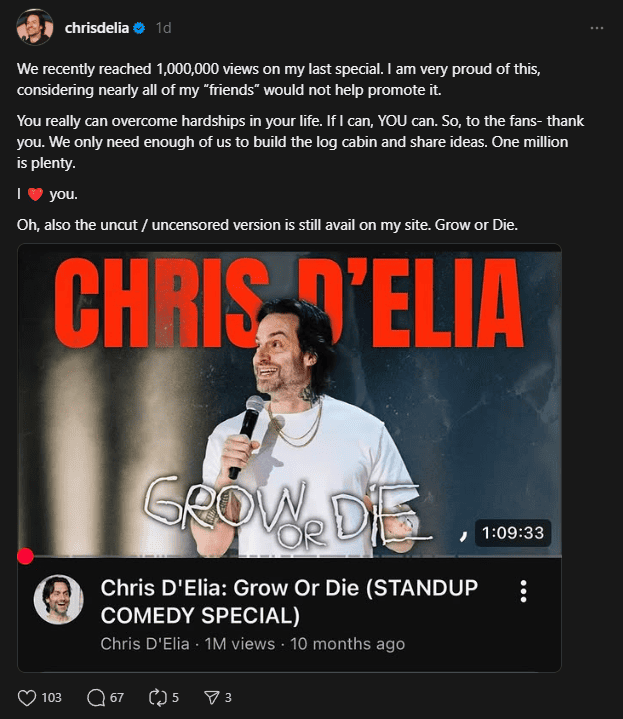
Chris D’Elia took to social media recently with a message about his latest comedy special. “We recently reached 1,000,000 views on my last special. I am very proud of this, considering nearly all of my ‘friends’ would not help promote it,” the comedian wrote in a post.
Along with fellow comedian Bryan Callen, D’Elia was effectively pushed out of mainstream entertainment in 2020 after accusations emerged that he had been sending inappropriate messages to teenage girls. Callen faced separate allegations stemming from an older incident.
The fallout was swift: Netflix cancelled a reality series that had both comedians attached, and the professional bonds they had built over years began to quietly dissolve.
Despite having co-hosted a podcast together, Callen at one point publicly acknowledged he had not been spending time with D’Elia at all, a notable admission that pointed to just how thoroughly the two had separated.
But raw numbers do not always follow the industry’s preferred narratives. According to our analysis, D’Elia’s special crossed 11 million views in 11 months, with the overwhelming majority of that traffic arriving in the first ten days following its premiere.
The momentum suggests a loyal audience was ready and waiting, regardless of institutional support or co-signs from former colleagues.
“You really can overcome hardships in your life. If I can, YOU can. So, to the fans, thank you. We only need enough of us to build the log cabin and share ideas. One million is plenty. I love you,” he wrote in the post.
The comparison between D’Elia’s trajectory and that of his former collaborator Callen is difficult to overlook. Callen’s own comedy special, released on YouTube this past October alongside an appearance on The Joe Rogan Experience, has managed 277,000 views in four months.
For a comedian who had access to one of the most-listened-to podcasts in the world on the day of his release, those numbers tell a complicated story about the current state of comedy promotion.
According to sources, the once-reliable power of a JRE appearance, long referred to in comedy circles as the “Rogan bump,” has been eroding for some time. VidIQ data shows the podcast now averaging between 550,000 and 1 million views per episode over typical windows, a notable drop from the 10 million-plus averages it regularly posted during the pandemic years.
Spotify, which initially signed Rogan to a deal valued at well over $100 million, reportedly halved the contract upon renewal, a signal about how the platform reassessed his reach. Callen’s JRE appearance translated to just 1,000 new subscribers, a figure that would have seemed almost impossible to predict at the platform’s peak.
Callen’s own words captured the frustration with unusual openness. “I put out this special and nobody, it doesn’t matter right? Like in a way it doesn’t matter. Specials aren’t special anymore,” he said during a candid podcast conversation.
He continued: “That medium of like specials used to be special, well now they’ve just lost their significance.” The emotional toll was not left unspoken either. “It hurts my feelings so bad. I felt so terrible for the past like two days, like terrible,” he admitted.
