
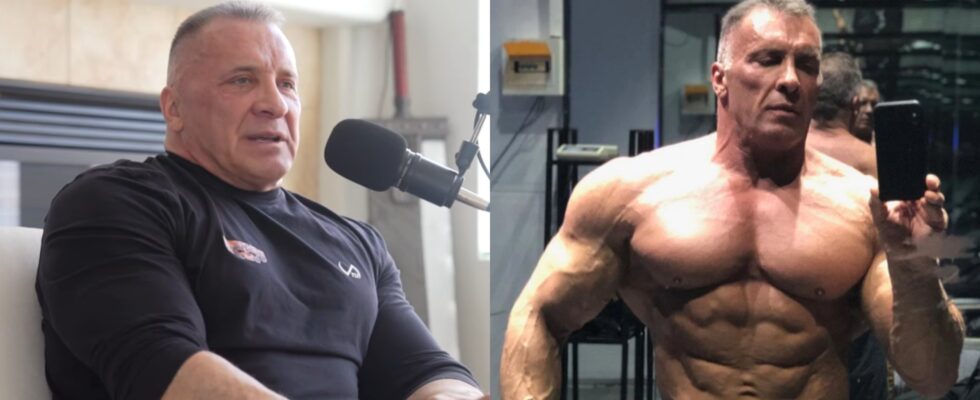
Bodybuilding veteran Milos Sarcev sat down with Nyle Nayga on the Trensparent podcast to discuss his current approach to peptides, his history with IGF-1, and what he believes genuinely works versus what he considers overhyped in bodybuilding circles.
Sarcev explained that despite initially being skeptical about peptides, he approached them with an open mind and experimented extensively before forming conclusions.
“I was very open-minded to say ‘okay let me try it,’ so I tried pretty much everything,” he said. “Tesamorelin. I would always say that there’s no possible growth hormone releasing peptides that can compete with that hormone and I still stand behind it. But did I feel any effect? Yeah.”
While he still believes pharma growth hormone is far more potent, Sarcev acknowledged that most recreational users would likely notice meaningful benefits from peptides alone.
“Most of regular clients they would never go to the GH but they use peptides, they feel the difference,” he said.
When the conversation shifted to stuff like BPC-157, TB-500, and KPV, Nyga was especially positive about their recovery benefits for bodybuilders.
“I just feel like utilizing BPC, TB and KPV in injectable is an effective way for bodybuilders to kind of keep on their joint health nowadays,” he explained.
Sarcev agreed and stated, “99% of the people that use them can tell us same thing that we are saying. It’s very powerful and recommended to use for sure.”
At the same time, Sarcev cautioned that many users complicate their protocols so much that they no longer know which PED is actually producing results.
“I asked them, ‘Tell me how did you feel different?’ and they can’t really determine,” he said. “And then usually you find out they don’t use one or two, they use five different things.”
The veteran coach also reflected on his early experience with IGF-1, revealing that he had been experimenting with it since the late 1990s.
“I use IGF-1 in 97, I put the label of it, you know, it was for research purposes back in the day only, you know, it was super hard to find,” he recalled.
Sarcev explained that the original dosing standards were dramatically smaller than what many bodybuilders later adopted.
“It’s actually originally it came in nanograms,” he said. “And I have actually labels of that too, not micrograms. Nano is a thousand times less. And yeah, I agree 10, 20 micrograms would be more than enough. But people start using 100 and then more than that. It’s just that stup idity in bodybuilding that always if one is good, 10 times is 10 times better.”
Discussing localized use, Sarcev described how he would target specific muscle heads during use.
“I would do sometimes long head, sometimes short head and outer triceps, long triceps,” he said.
However, the conversation took a more serious turn when Sarcev addressed the potential cancer risks associated with IGF-1 use.
“I knew at that time 12 pro bodybuilders that they got liver cancer and they were all using IGF-1,” he revealed.
Because of those experiences, Sarcev said he now recommends far more conservative use.
“Four weeks limit. And then at least four weeks off,” he explained. He added that while he still appreciates the effects, the risks remain concerning. “I like IGF for what it does, but not for what it stands for because if side effects are so scary, that can end with the cancer,” he said.
Sarcev noted that he now limits IGF-1 use with his athletes to only a few short cycles per year. “I have my guys maybe twice or three times during a year maximally on shorts, four weeks spans,” he explained.
He also confirmed that he personally experimented with stuff like CJC-1295 and Ipamorelin. “I use CJC of course Ipamorelin because I want to experience it,” he said. “But once you experience a real thing, pharmacological strength of something and then there is compared, you realize if I didn’t use this one I would probably feel it.”
