
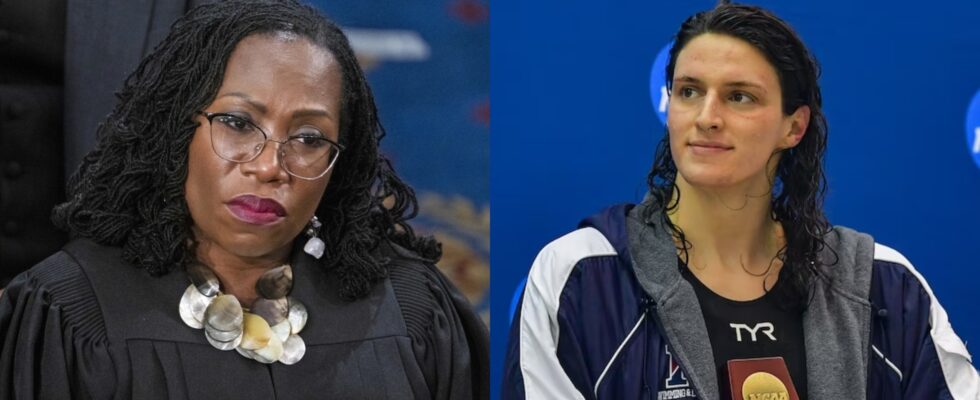
A tense exchange during Supreme Court oral arguments this week highlighted the central constitutional question at the heart of laws protecting women’s sports from biological male participation.
According to sources, the moment came as Justice Ketanji Brown Jackson pressed an attorney defending state bans on transgender athletes in female competition, suggesting that preventing biological males who identify as female from competing on girls’ teams amounted to discrimination based on gender identity.
The attorney’s response cut through the theoretical framework with surgical precision.
“It’s not the gender identity that’s keeping him off the girls’ team, it’s his biological s*x,” the lawyer argued. “His gender identity is wholly irrelevant to it.”
The attorney illustrated the point with a hypothetical scenario that exposed the flaw in Jackson’s reasoning. Consider a biological male who identifies as male but still wanted to play on the girls’ team, perhaps because he was “a very unathletic boy.” That individual would likewise be barred from female competition, the attorney explained, demonstrating that s*x, not gender identity, forms the basis of these policies.
“I agree with you, there’s a very significant disparate impact on transgender individuals by this law, because they’re the boys who are most likely to want to play on the team,” the attorney conceded, before pivoting to the legal crux of the matter.
The lawyer argued forcefully that Title IX, the federal law prohibiting s*x-based discrimination in education programs, simply doesn’t extend to disparate impact claims based on gender identity. In fact, the attorney contended that Title IX doesn’t cover disparate impact theory at all.
🚨 BREAKING: Attorney EXPERTLY PUMMELS SCOTUS Justice Ketanji Jackson’s argument in favor of men in women’s sports in the name of “transgender rights”
JACKSON: “But they are being prevented from playing on the team that matches their gender identity, correct?!”
ATTORNEY:… pic.twitter.com/4covfatkYO
— Eric Daugherty (@EricLDaugh) January 13, 2026
The Supreme Court heard challenges to state laws in Idaho and West Virginia on Tuesday that ban biological males from competing in female athletics. More than two dozen states have enacted similar protections in recent years.
Outside the courthouse, former NCAA swimmer Riley Gaines addressed the stakes for women and girls nationwide. The mother of a three-month-old daughter said she felt “irritated” that she had to travel to Washington to advocate for “the truth.”
“Even with a favorable ruling, I will tell you that it’s not enough. We must continue to act,” Gaines told supporters. She called on Congress to codify President Donald Trump’s executive order protecting single-s*x sports and demanded accountability from institutions that “put in direct harm’s way” the women and children “they were entrusted to protect.”
Gaines competed against Lia Thomas, a biological male who won a Division I national championship in women’s swimming in 2022.
The Supreme Court’s decision is expected this summer.
