

A recent social media exchange has drawn attention to the safety concerns surrounding popular peptides BPC-157 and TB-500.
The discussion began when researcher Cremieux raised alarms about these compounds, stating they are “incredibly dangerous” and noting that “unlike GLP-1RAs (=weight loss) or melanotan-II (=tanning), the anecdotal evidence for efficacy is just not there.”
Huberman responded by reaching out to physician Abud Bakri, asking him to address the concern about tumor vascularization.
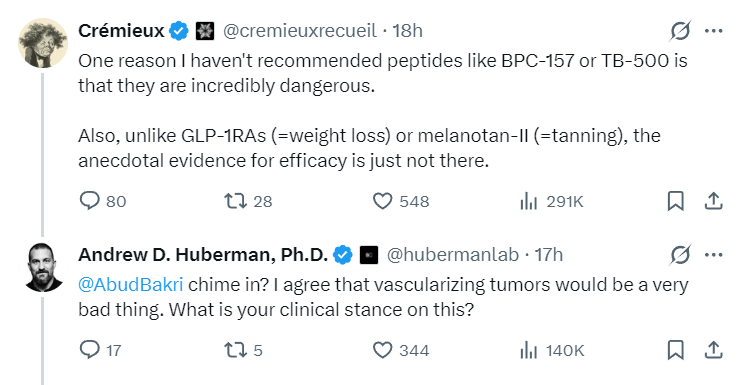
“I agree that vascularizing tumors would be a very bad thing,” Huberman wrote. “What is your clinical stance on this?”
Dr. Bakri provided a detailed analysis that revealed the complexity of these peptides’ effects on the body.
Regarding BPC-157 and its relationship with vascular endothelial growth factor (VEGF), a protein involved in blood vessel formation, he explained: “BPC-157 and VEGF is a tricky subject because in some studies it promotes VEGF and in others in lowers VEGF, such as in a melanoma cell line model.”
The physician emphasized that current research limitations make definitive conclusions difficult. “Given we don’t know the true extent of BPC long term for VEGF, especially not in the injectbale form, and the data isn’t super useful, I’ve settled on the following in a frank risk/benefit discussion with patients with limited insight,” he stated.
Dr. Bakri outlined specific clinical recommendations. First, he advised that “BPC-157 should not be used in active cancer or in people at high risk of cancers.”
However, he suggested that brief therapeutic use might be acceptable under certain circumstances: “A short course of BPC-157 for an acute injury, even if it was a uniform VEGF promoter would not be concerning for oncogenesis given it takes years even for the greatest carcinogens to take effect, but the patient should be educated about these risks.”
Regarding TB-4 and TB-500, Dr. Bakri noted somewhat clearer but still limited evidence. “In some cancers, TB4 levels are elevated. Given that these promote cell migration, would strongly oppose using them unchecked for long term, especially in active cancers or cancer prone individuals,” he explained.
Despite the concerns, Dr. Bakri identified potential therapeutic applications: “The most interesting ptoential use case of all of these compounds is short term, targeted uses, like BPC-157 for an acute MSK injury or TB4 in the post stroke setting.”
He also corrected a fundamental misunderstanding about BPC-157’s mechanism: “BPC is not a VEGF analog. Sometimes it raises VEGF. Sometimes it lowers. In fact, in some situations BPC actually lowers VEGF, such as in this mice melanoma model.”
Recent research published in biomedicine journals has explored BPC-157’s complex relationship with angiogenesis and the nitric oxide system. Scientists examining the peptide’s cytoprotective properties found that it demonstrates context-dependent effects on blood vessel formation, maintaining healing functions while potentially counteracting pathological processes.
Limited human clinical data exists for these compounds. One multicenter, randomized, double-blind, placebo-controlled study evaluated BPC-157 in 53 patients with mild to moderate ulcerative colitis.
Participants received either 80 mg of BPC-157 enema once daily for two weeks or placebo. The treatment group showed statistically significant improvements in Disease Activity Index scores, stool frequency, and consistency compared to placebo, with no difference in adverse events between groups. Notably, BPC-157 was not detected in any plasma samples.
Safety studies in animals have shown remarkable tolerability, with researchers unable to establish a lethal dose at levels exceeding 4409 lbs (2000 mg/kg) through oral or intravenous administration in mice. Comprehensive toxicology studies spanning multiple species and administration routes reported no adverse effects.
A Phase 1 clinical trial involving 42 volunteers established that oral BPC-157 administration at doses ranging from 1 to 9 mg daily for two weeks was safe and well-tolerated, with no quantifiable amounts detected in plasma or urine samples.
Additional small clinical studies have examined BPC-157 for various conditions. One retrospective review of 16 patients receiving intra-articular injections for knee pain found that approximately 92% experienced significant improvement lasting between six months and one year. Another study involving 12 women with interstitial cystitis reported complete symptom resolution in 10 patients and substantial improvement in the remaining two, with no adverse events.
According to survey data collected by a task force ahead of Pharmacy Compounding Advisory Committee meetings in late 2024, compounding pharmacies filled over 500,000 prescriptions for BPC-157 between 2018 and 2024, with no side effects reported to these pharmacies.
Dr. Bakri concluded his analysis with a note of cautious optimism: “More research is needed. (My team discussed this this am and we may have some good news soon)”
