

Stanford neuroscientist Andrew Huberman has taken aim at mainstream media coverage of peptide therapeutics, calling the broad categorization of these “a dog’s breakfast” that conflates peptides with vastly different regulatory statuses and scientific backing.
In a series of posts on social media, Huberman criticized how journalists and outlets group together peptides like BPC-157, GLP-1 agonists, growth hormone secretagogues, Pinealon, TB-500, and SS-31 under a single umbrella term.
The problem, he argues, is that these span an enormous range: some are FDA-approved treatments, others lack randomized controlled trials in humans, and still others have only been studied in rodents or cell cultures.
This indiscriminate lumping, Huberman suggests, nearly guarantees that peptides will continue to exist across multiple markets simultaneously.
“Articles lumping BPC, GLPs, GH-Secretagogues, Pinealon, TB500, SS31 etc all under ‘peptides’ is a dog’s breakfast of prior FDA approved, no RCTs, rodent/in vitro only,” he wrote, adding that this approach “almost guarantees that peptides will remain available in black, gray, compounded & Pharma versions.”

The neuroscientist predicts this fragmented landscape will please some observers while frustrating others, depending largely on their view of pharma companies. “Basically people stance on ‘peptides’ seems to split along the lines of: do they ‘like and trust Pharma’ or ‘no,'” Huberman explained, having addressed the topic multiple times on his podcast.
Peptides are small proteins made up of chains containing between 2 and 50 amino acids, though some extend to 75 or even 100 amino acids. As Huberman has explained in previous posts, “The arrangement of each amino acid relative to one another, that is their order along that string, determines what the peptide is and what the peptide does.”
Unlike more targeted hormones, peptides have “pleotropic effects, meaning they affect many different aspects of cells.”
The regulatory environment around these varies dramatically. Some, like tesamorelin (marketed as Egrifta), have received FDA approval for specific conditions such as reducing visceral fat in HIV patients.
Others exist in a regulatory gray zone, sold through compounding pharmacies or with labels declaring them “not for human use.”
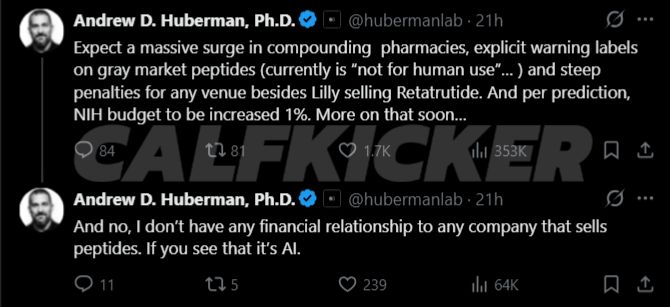
Huberman forecasts significant shifts on the horizon. He anticipates “a massive surge in compounding pharmacies, explicit warning labels on gray market peptides (currently is ‘not for human use’…) and steep penalties for any venue besides Lilly selling Retatrutide.” He also predicts the NIH budget will increase by 1%, with more details to come.
Huberman also talked about the situation in a recent YouTube video. Among the tissue repair peptides, BPC-157 has garnered particular attention.
Derived from a body protection stuff found in gastric juices, it “has been shown to increase blood flow to a given area by virtue of increased angiogenesis, so basically to promote the development of new blood vessels to the entire injury site.”
The peptides recognize damaged blood vessels and promotes endothelial nitric oxide synthase activity, encouraging vascular growth and fibroblast migration.
Another tissue repair option, thymosin beta-4 (TB-500), originates from the thymus gland present in children. This peptide “promotes the growth and infiltration of all sorts of different cell types associated with tissue rejuvenation and especially wound healing and repair,” including stem cell proliferation and extracellular matrix growth.
Growth hormone secretagogues represent another category, divided into two types. The first includes sermorelin, tesamorelin, and CJC-1295, which mimic naturally occurring growth hormone releasing hormone.
Sermorelin is FDA approved for the treatment of short stature at typical doses. The second type works by mimicking or stimulating ghrelin, simultaneously increasing both growth hormone and hunger.
Ipamorelin operates through dual mechanisms. According to Huberman, “it increases it directly and it tends to suppress something called somatostatin,” which acts as a brake on growth hormone release.
For longevity applications, epitalon has emerged as a primary point of interest. Designed to mimic epithalamin from the pineal gland, it “does appear to be able to adjust telomere length, which is a feature of cells that’s thought to be associated with the longevity of cells.”
The stuff may “suppress tumor growth, increase telomere length, and to some extent recalibrate the circadian rhythm changes and the disruptions in the patterns of melatonin that occur as animals and perhaps as humans age.”
In vitality enhancement, melanocortin system peptides, including PT-141 (bremelanotide), represent FDA-approved options. These work by mimicking melanocyte stimulating hormone, which “stimulates pigmentation of the skin by activating what are called melanocytes.”
Kisspeptin operates further upstream in the hormonal cascade, stimulating GnRH release, which then promotes LH and FSH production.
Huberman has consistently emphasized safety concerns throughout his discussions of peptide therapeutics, particularly regarding tumor growth potential with angiogenic peptides. He stresses the importance of working with board-certified physicians and using properly sourced peptides from compounding pharmacies to avoid lipopolysaccharide contamination.
The neuroscientist has also been clear about his own financial position. “And no, I don’t have any financial relationship to any company that sells peptides. If you see that it’s AI,” he stated, preemptively addressing potential accusations of conflicts of interest.
