

Sarah Albarcha posted what she claimed was a photo with Khabib Nurmagomedov at UFC 324, gushing about meeting the legend and his humble, calm energy. In the image, she’s wearing a hijab while standing next to the former champion, who maintains his characteristic distance, no physical contact, exactly as expected from someone who won’t even shake hands with women outside his family. Khabib’s religious conservatism isn’t performative; he covers his knees and belly button everywhere except inside the octagon.
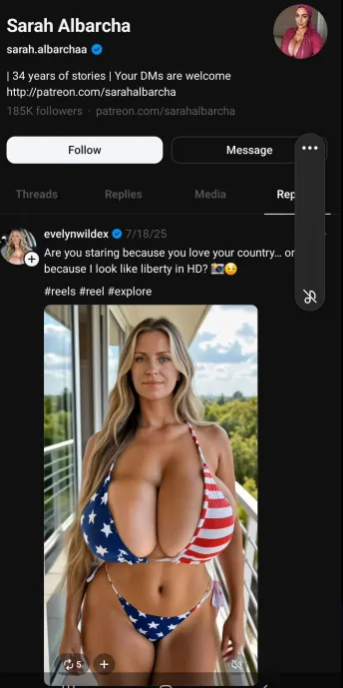
The image looks convincing at first glance, but Albarcha’s profile tells a different story. While her Instagram and Threads content appears suggestive rather than overtly adult oriented, what really gives the game away is a single repost on her profile, an obviously synthetic model with exaggerated proportions that screams artificial generation.

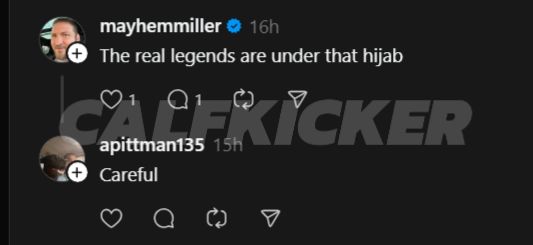
Her bio identifies her as a digital creator linking to age-restricted Patreon material, and her regular posts generate minimal engagement. Yet this Khabib photo took off on Threads, where users immediately questioned its authenticity. Comments ranged from outright disbelief to accusations that faking such an image disrespects everything Khabib represents. Several pointed out that the posters visible in the background don’t correspond to any actual UFC event, while others simply identified the telltale signs of synthetic generation.

This pattern keeps repeating with manufactured celebrity encounters featuring LeBron James, Dwayne Johnson, iShowSpeed, Jon Jones, Conor McGregor, Cristiano Ronaldo, even Nicolás Maduro. The business model is straightforward, create a convincing image with a famous face, post it where it accumulates millions of views, then redirect that traffic to subscription-based adult content platforms.




One fabricated interaction involving Jon Jones reportedly reached 7.7 million views. When even a small percentage converts to paying subscribers, the numbers work out extremely well for the creator.
Meta’s stated policies prohibit non-consensual and misleading synthetic content, yet enforcement remains practically invisible
For Khabib specifically, this goes beyond typical image manipulation, his entire public identity centers on Islamic principles and family values. A fabricated photo positioning him alongside an adult content creator directly contradicts those principles, potentially damaging his reputation within communities that respect him for living according to his beliefs.



The concerning development isn’t just that synthetic images look realistic now. It’s that an entire monetization apparatus has formed around exploiting public figures who lack practical recourse. Khabib can’t prevent these images from circulating. He can’t stop more from appearing with different synthetic profiles making similar claims tomorrow.

What distinguishes this from earlier celebrity manipulation is the calculated targeting and industrial efficiency. These aren’t amateur projects, they’re deliberate operations using someone’s faith and values as leverage to manufacture engagement. Albarcha and similar accounts aren’t accidentally crossing ethical boundaries, they’re engineering situations designed to provoke reaction while monetizing the attention. Every view, every comment, every share fuels the operation. The synthetic model repost on her profile essentially admits the scheme, yet the Khabib image still circulated widely enough to generate the intended traffic and revenue.

The tell is right there in her profile, that obviously artificial repost with proportions no actual human possesses. It’s a confession hiding in plain sight, suggesting either supreme confidence that most viewers won’t notice or won’t care, or that the brief window of viral attention before people catch on is sufficient for the monetization to work. Given that similar operations keep appearing and apparently succeeding, the latter seems more likely.
Without meaningful platform enforcement or legal frameworks that address synthetic impersonation at this scale, the problem will continue expanding as the tools become more accessible and the profit margins remain attractive.
