

UFC CEO Dana White recently expressed his views on men’s mental health, advocating for a more traditional approach to masculinity. During an interview with Time Magazine, White doubled down on his belief that men should refrain from publicly discussing their mental health struggles.
“As a man, there’s all this talk about men’s mental health — I can’t stand that,” White stated. He continued, emphasizing his perspective that life’s challenges should be met with stoicism: “Yes, guess what? Life is hard. It’s a nasty, ugly world out there. It’s not perfect. And you can’t afford to be a man and talk publicly about ‘Oh, my mental health.'”
White’s comments have ignited a heated debate within the sports community and beyond. Some, like ADCC champion Gordon Ryan, have voiced support for White’s position previously. Ryan took to social media to expand on the UFC CEO’s remarks, criticizing those who seek therapy or share their emotional struggles publicly.
However, not all UFC stars align with this viewpoint. Paddy Pimblett, for instance, has been a vocal advocate for men’s mental health awareness. Following a personal loss, Pimblett used his platform after a victory to encourage men to seek help when needed, resulting in a reported increase in men reaching out for mental health support.
The discussion has extended beyond the sports world, with various public figures weighing in on the topic. Journalist Abigail Shrier, during an appearance on the Joe Rogan Experience, argued that therapy might be detrimental to men’s resilience. However, mental health professionals counter that quality therapy aims to provide practical tools for coping with life’s challenges rather than promoting endless discussion of feelings.
Critics of White’s stance argue that acknowledging emotional struggles and seeking support is a sign of strength, not weakness. They emphasize that resilience doesn’t mean suppressing emotions but rather developing healthy coping mechanisms to navigate life’s difficulties.
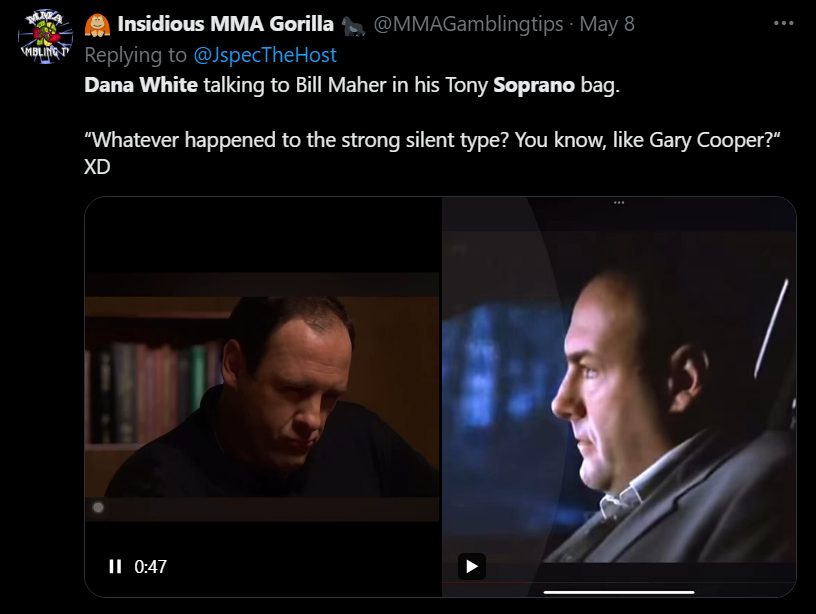
Meanwhile some fans pointed out the funny similarity between Dana White’s talking point and an infamous quote from the season 1 of the cult show The Sopranos:
“Let me tell ya something. Nowadays, everybody’s gotta go to shrinks, and counselors, and go on “Sally Jessy Raphael” and talk about their problems. What happened to Gary Cooper? The strong, silent type. That was an American. He wasn’t in touch with his feelings. He just did what he had to do. See, what they didn’t know was once they got Gary Cooper in touch with his feelings that they wouldn’t be able to shut him up! And then it’s dysfunction this, and dysfunction that, and dysfunction vaffanc*l!”
