

MMA journalist Ariel Helwani has sharply criticized UFC President Dana White’s recent comments regarding Ronda Rousey’s decline in the sport. White suggested that Rousey’s efforts to grow women’s MMA made it “impossible” for her to evolve as a mixed martial artist, a claim Helwani dismisses as revisionist history.
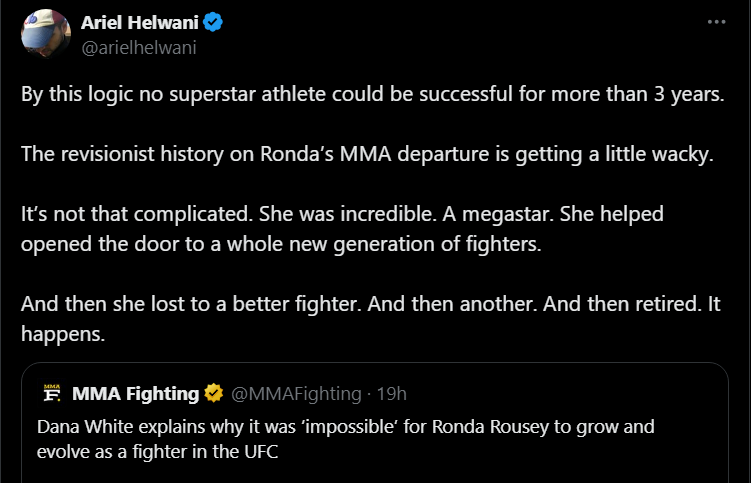
In a pointed tweet, Helwani wrote: “By this logic no superstar athlete could be successful for more than 3 years. The revisionist history on Ronda’s MMA departure is getting a little wacky.”
Helwani acknowledged Rousey’s significant impact, calling her “incredible” and “a megastar” who “helped opened the door to a whole new generation of fighters.” However, he offered a more straightforward explanation for her career trajectory:
“And then she lost to a better fighter. And then another. And then retired. It happens.”
This blunt assessment stands in stark contrast to White’s more elaborate justification, which framed Rousey’s decline as an unavoidable consequence of her trailblazing role. White had argued that while Rousey was busy promoting women’s MMA, her opponents were solely focused on training to defeat her.
Helwani’s critique highlights a broader debate about how to interpret Rousey’s legacy. While her importance to the sport is undeniable, the reasons for her abrupt fall from dominance remain a point of contention among MMA analysts and fans.
By challenging White’s narrative, Helwani advocates for a more straightforward view of athletic careers – one where even the biggest stars can simply be outperformed by emerging talent. This perspective frames Rousey’s story not as a unique tragedy, but as part of the natural evolution of any competitive sport.
