
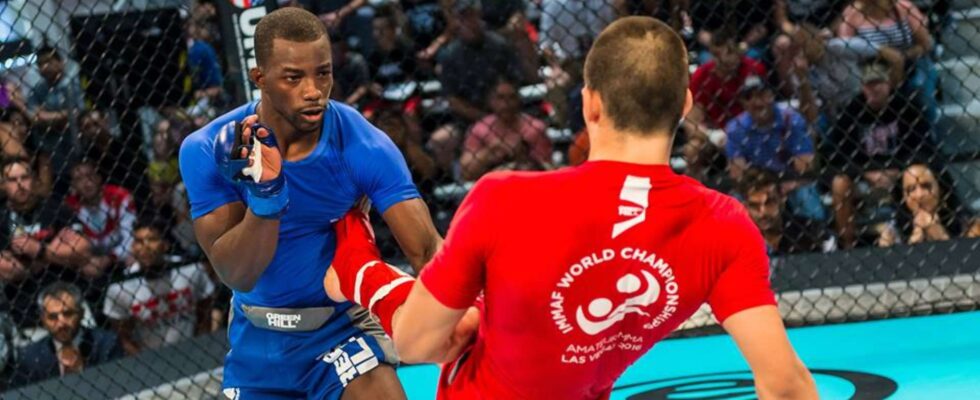
The world of mixed martial arts has reached a historic turning point in its quest for mainstream sporting legitimacy. The International Mixed Martial Arts Federation (IMMAF) has successfully completed the SportAccord membership assessment process, bringing the combat sport closer to potential Olympic inclusion than ever before.
On November 19, 2026, the SportAccord Executive Committee confirmed that IMMAF had satisfied all applicable membership criteria, approving the advancement of its application to the AIMS General Assembly for consideration. According to sources, the decision marks an unprecedented achievement for an international governing body dedicated to mixed martial arts, demonstrating its legitimacy, international representation and governance standards in accordance with established international sporting community requirements.
SportAccord, a global sports event organization based in Lausanne, Switzerland serves as a gateway for Olympic and non-Olympic international federations seeking formal recognition within the structured world of international sport.
IMMAF President Kerrith Brown, Vice President Wissam Abi Nader and Chief Executive Officer Densign White MBE announced the milestone on behalf of the IMMAF Board of Directors. The achievement consolidates IMMAF’s position as the leading global authority for amateur MMA, reaching a level of formal international sporting endorsement unmatched by any other dedicated MMA federation to date.
The breakthrough reflects years of engagement, dialogue and cooperation between IMMAF, SportAccord and AIMS, and most recently with United World Wrestling (UWW). In November 2026, IMMAF and United World Wrestling co-signed a Letter of Intent while meeting in Kazakhstan, establishing a framework for closer cooperation between the two organizations.
Signed by both IMMAF President Kerrith Brown and UWW President Nenad Lalović, the agreement provides a foundation for both federations to support the development of mixed martial arts within their respective sporting structures, under the exclusive recognition of SportAccord. The partnership creates opportunities to explore complementary sporting pathways, with IMMAF continuing its international development of MMA in the cage and UWW developing MMA on the mat within its respective sporting framework. Athletes will be enabled to pursue either or both pathways.
AIMS President Stephan Fox formally welcomed the decision and extended his congratulations to IMMAF’s leadership and the wider federation. The membership application is now set to be presented at the 2027 AIMS General Assembly in Baku, Azerbaijan, during the SportAccord Convention.
Brown emphasized the broader impact of this accomplishment: “IMMAF has created opportunities for many thousands of amateur athletes to represent their countries on the international stage, developing pathways from grassroots participation and youth development through to elite amateur competition and professional mixed martial arts.”
The IMMAF president acknowledged the difficult path toward recognition: “The journey towards international sporting recognition has not been without its challenges, requiring considerable sacrifice, resilience, patience, financial commitment and an unwavering belief in the future of the sport. Despite these challenges, IMMAF has remained steadfast in its commitment to athletes, national federations and the wider MMA community.”
Brown stressed the importance of collaboration moving forward: “We firmly believe that mutual respect, constructive dialogue and international cooperation are essential to building a sustainable future for combat sports. Our focus now is on the future and exploring opportunities that will benefit our respective organizations, national federations and, most importantly, our athletes.”
The significance extends throughout IMMAF’s global network of national member federations. These organizations can now identify themselves as national affiliates of the most officially recognized international sport body for MMA governance and development. This strengthens their legitimacy and standing in engagement with governments, national Olympic committees, sporting authorities and other institutional stakeholders, providing a stronger foundation to pursue domestic recognition and access new development opportunities.
Meanwhile, the debate over MMA’s Olympic future continues among prominent figures in combat sports. UFC CEO Dana White has publicly supported the idea, stating, “I think it should be an Olympic sport already.”
While the promotional frontman would like to see MMA included, he clarified his position: “It’s not my job. It’s not what I’m looking to do. I’m not pushing to turn this thing into an Olympic sport. I agree with whoever said that, yes I’d like to see it added.”
White believes the addition could address one of the Olympic movement’s current concerns. “And not to mention the fact that one of the big problems the Olympics is having right now, is viewership. You want viewers? Put MMA in the Olympics,” he said.
The ratings for the 2024 Olympics showed signs of improvement compared to previous games. Through the first five days of the Paris Games, NBCU averaged approximately 33.8 million viewers across all TV and streaming platforms, marking an improvement of 79 percent compared to this stage of the 2021 Summer Olympics in Tokyo.
Brazilian jiu-jitsu legend Renzo Gracie has expressed confidence that Olympic inclusion will eventually happen. He believes that growing interest in MMA at the grassroots level, fostered by platforms like IMMAF, will prove important for the sport’s Olympic aspirations.
However, not everyone in the grappling community shares enthusiasm for Olympic participation. Roger Gracie, a 10-time IBJJF world champion, has voiced concerns about what Olympic involvement could mean for martial arts.
Speaking about Brazilian jiu-jitsu’s potential Olympic path, he offered a cautionary perspective: “If you ask me, I think I don’t think it’s a good thing to go to the Olympics. You will end the sport.”
Gracie pointed to other martial arts as examples of what can happen with Olympic inclusion. “Look at karate. Look at taekwondo. When you look that in the Olympics, do you think that’s a martial arts? Like taekwondo, you cannot even strike your opponent. You strike too hard, you’re disqualified. Is that a martial arts? You cannot strike hard. Your opponent can just touch.”
He explained his view on how Olympic participation transforms combat sports: “It becomes 100 percent commercial. All the rules they adapt to make them more popular. That’s it.”
Gracie raised technical concerns about match duration, noting that traditional BJJ black belt world championship matches last 10 minutes, allowing technique to overcome pure strength.
“Any less than 10 minutes is less technical. Power counts a lot. 10 minutes, they don’t because you get tired. And then it becomes the technique.” However, he acknowledged that Olympic television demands would likely never accommodate such lengthy matches, forcing rule changes that favor athleticism over technical mastery.
Interestingly, when discussing MMA’s relationship to the Olympics, Gracie suggested mixed martial arts might be better suited than single discipline martial arts, though he acknowledged that competitive combat has evolved. “Now the mixed martial arts like the single discipline it doesn’t exist anymore.”
The Olympics currently include five martial arts disciplines: Judo, Taekwondo, Karate, Wrestling (both Freestyle and Greco-Roman styles), and Boxing. MMA fans have long advocated for their sport’s inclusion in the international multi-sport event, which dates back to 1896 in Athens, Greece.
The achievement represents a defining moment in IMMAF’s 15-year history, bringing the federation closer than ever to securing a place for mixed martial arts within the international sporting community.
