
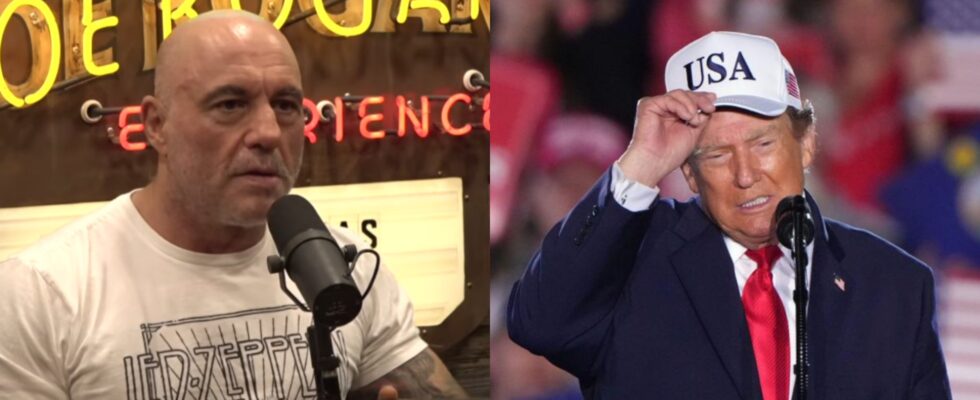
Joe Rogan has criticized Republicans for losing ground in the recent midterm elections, arguing that the party’s failure to deliver on campaign promises, particularly its pledge to avoid foreign wars, contributed to voter backlash.
During a conversation with former Navy SEAL Jocko Willink, Rogan discussed the factors behind the Republican losses, pointing to what he described as a growing disconnect between campaign rhetoric and actual government decisions. He argued that voters shouldn’t blindly support a political party simply because they identify with it, especially when its representatives fail to follow through on their promises.
“You can’t just want your team to win always,” Rogan said. “If your team does things that are not right and says a bunch of things that they were going to do but didn’t do, says they’re never going to do that, but then they do it. You break a bunch of promises. Yeah. You have a bunch of chaotic people that are running everything. They get corrupted. There’s a lot of chaos going on. People are supposed to vote it out. That’s supposed to happen.”
One of the biggest issues Rogan identified was the administration’s foreign policy, particularly its involvement in another sustained military conflict after campaigning on a promise to keep the United States out of foreign wars.
He argued that the decision had consequences beyond foreign policy, contributing to rising oil prices and making everyday expenses more expensive. More importantly, he believed it undermined public confidence in the administration’s decision-making.
“The war, which I think is the biggest,” Jocko stated when discussing the midterm results. “It drove the price of everything up. Oil went up. When oil goes up, everything goes up. It’s not a good move.”
Rogan agreed, replying, “It’s also people lost faith in the decision making. They’re like, ‘This is not the right track. This is not what you said you were going to do. This is not what you ran on. This is not what you promised. This is not what we signed up for.'”
Willink, drawing on his own military background, admitted that he was also surprised by the direction of the administration’s foreign policy. He explained that he initially expected limited military action rather than an extended involvement that could lead to unpredictable consequences.
“I thought the first one, okay, drop some stuff but there’s no sustained effort. And then this one, as soon as you go into some kind of a sustained effort, now you’re relying on what is the other person’s reaction going to be? And we don’t know. So yeah, I was surprised. I was definitely surprised, especially because the continued talks of, ‘Hey no more foreign wars,’ right? Which everyone was on board with.”
Willink added that veterans who spent years fighting overseas had particular reasons to be skeptical of another prolonged military engagement.
“Especially like my generation who we look back and we’re like, hold on a second. What did all me and all my friends do for 20 years? Oh yeah. What do we get out of it? Oh, we didn’t get anything out of it. Okay, let’s not do that again. So you have a whole generation thinking that way. And it seemed like that was where the administration was. So then to turn around and be like, ‘Oh, no, we’re actually going to do this.'”
Rogan also brought up domestic policy as another reason Republicans lost support, specifically efforts in Texas to restrict THC products.
He criticized Texas Lieutenant Governor Dan Patrick’s push to make certain weed products illegal, arguing that the effort represented a return to outdated anti-marijuana policies.
“They tried to make weed products not legal and bring it back to like the 1950s,” Rogan explained.
Rogan also mocked Patrick’s public presentation of weed products, describing a video in which the lieutenant governor appeared to demonstrate the supposed dangers of THC-infused products.
“There’s a wild video of him like boxing up all these, ‘This is harming people’s minds’ and ‘Would you want to take one of these and chill?'” Rogan said. “Like yeah that’s what people do. Like just don’t eat the whole bag. Like he’s got a whole bag of them.”
According to Rogan, the issue was significant enough to push some traditionally Republican voters toward Democratic candidates in Texas.
“I know a lot of Republicans have voted blue down the line in right here in Texas because they were discouraged by it. They’re discouraged by this situation with THC. They’re discouraged by the war.”
For Rogan, these developments reflected a broader problem with political accountability. He argued that voters have more access to information and public discussion than ever before, making it increasingly difficult for politicians to ignore dissatisfaction with their decisions.
“That’s normal. That’s how people react when you don’t give them what they want. Especially in this day and age where people are so much more informed and misinformed, but so much more like there’s so much more talk. At least if you’re paying attention, there’s enough to at least the like real issues like the war, all this stuff. There’s enough things to know I don’t like this. So I’m going to vote and I’m going to change it.”
The two also touched on the unreleased documents surrounding Jeffrey Epstein, another issue that has generated frustration among voters who expected greater transparency. The failure to deliver on promises surrounding high-profile investigations and disclosures added to the perception that the administration wasn’t following through on its commitments.
Willink agreed that the consequences of the administration’s decisions were reflected in the election results, particularly when it came to the economic impact of rising oil prices and the resulting loss of public confidence.
“No doubt. No doubt. The factor in the midterms, I think it’s the factor in the midterms. Because if you think about what it did is it you know drove the price of everything up. Oil went up. When oil goes up, everything goes up. It’s not a good move. It’s also people lost faith in the decision making.”
Rogan ultimately argued that Republicans should view their electoral losses as a consequence of their own decisions rather than something inherently unfair or unexpected.
“If you’re a Republican and you’re like, ‘I can’t believe we lost. Can’t believe.’ That’s how it’s supposed to be. And you’re supposed to go back to the drawing board, find better candidates, find better policies, realize the American people, they’re not going to tolerate this anymore.”
He further stressed that political parties cannot expect to retain support indefinitely while breaking promises and failing to address voters’ concerns.
“You can’t just mess everything up and expect to keep winning. You can’t be dishonest with everybody or at least break promises and expect to keep winning. It’s that’s not what this is supposed to be about.”
