
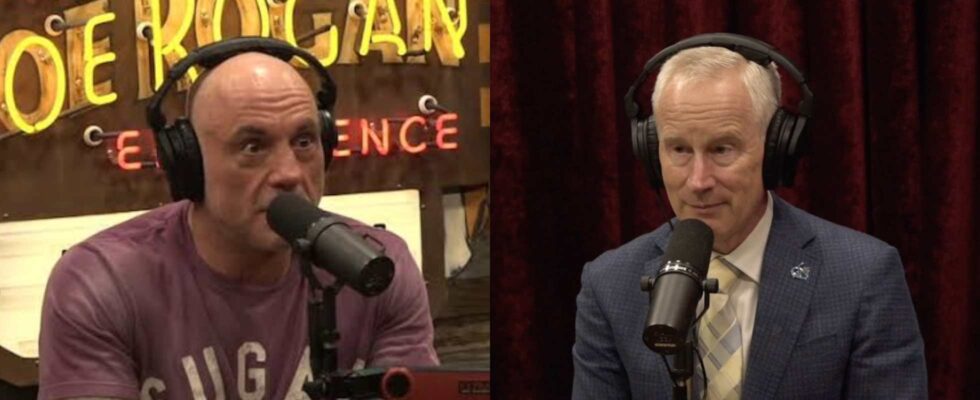
Joe Rogan is facing renewed criticism after hosting Peter McCullough, a former cardiologist who has become a prominent voice in anti-vaccine and pandemic conspiracy circles. In a new response video, Professor Dave Explains argues that Rogan’s interview gave McCullough an enormous platform to repeat claims that conflict with established medical evidence.
During the conversation, Rogan reflected on the backlash he received for discussing COVID-19 treatments and public-health measures. “When they all came down on me, it was your misinformation that all turned out to be true,” Rogan told McCullough.
When McCullough said he was sorry to put Rogan through a tough time, Rogan pushed back. He said, “Don’t be sorry at all. It was great. Turned out well for me.”
Professor Dave sharply rejected that assessment, arguing that Rogan treated major claims with little scrutiny while allowing his guest to present speculation as fact.
Dave stated, “No, literally none of it turned out to be true. It was all transparently false in the moment to anyone educated. And it’s all trivially false in retrospect to anyone with internet access and the courage to Google things. You are the premier platform for disseminating medical misinformation, Joe.”
The critique focuses on McCullough’s assertions about vaccines, masks, public-health agencies, and early COVID-19 treatments. McCullough claimed that global health institutions were coordinated through a “biopharmaceutical complex,” while questioning the motives of organizations including the World Health Organization, the CDC, and the FDA.
He also suggested that countries acted in lockstep during the pandemic. McCullough stated, “The world doesn’t agree on anything. Can’t agree on currency, can’t agree on policy, can’t agree on anything. How can they completely agree on this pandemic response?”
Professor Dave counters that pandemic policies varied substantially across countries and that international scientific agreement does not itself establish a conspiracy. He argues that public-health agencies and researchers reached many similar conclusions because they were assessing the same rapidly developing evidence.
The video also challenges McCullough’s claims about vaccines and mRNA technology. Professor Dave says McCullough mischaracterized how mRNA vaccines function, including the claim that their components remain in the body indefinitely or alter human DNA. The response emphasizes that mRNA is broken down after delivering instructions to produce an immune response and does not enter the cell nucleus.
Another major point of contention involves claims that certain repurposed treatments were unfairly suppressed. Professor Dave argues that early observational studies were later outweighed by larger randomized clinical trials that found no meaningful benefit for COVID-19 outcomes. He also criticizes Rogan for not asking follow-up questions about the quality of the studies McCullough cited.
The discussion also turned to how the pandemic affected Rogan’s broader outlook on institutions and information.
Rogan admitted that his experience during COVID-19 had made him question things he previously accepted without much doubt. He said, “Before pandemic I thought vaccines were the most important invention in human history. After pandemic, I was like, I don’t think we went to the moon because I was like, I think there’s so much lies and so much propaganda. Like, I don’t believe anything anymore.”
Professor Dave mocked the apparent connection Rogan made between his views on vaccines and the historical moon landing, arguing that skepticism in one area had spilled over into an entirely unrelated subject.
Dave responded, “Leave it to Joe to get so dumb so fast that he let his brainwashing in one area leak into other totally unrelated areas. Vaccines are bad because he says so. Therefore, we didn’t land on the moon. Astounding. Well, I would suggest that he watch my content debunking every dumb thing that moon landing deniers say, including on his show. But something tells me he wouldn’t be up for that.”
The concern is not merely one guest appearance. Professor Dave portrays the interview as part of a recurring pattern in which Rogan presents contrarian medical voices as persecuted truth-tellers without applying the same level of skepticism reserved for public-health experts. In doing so, critics argue, the show can make unsupported claims appear credible to a vast audience.
