
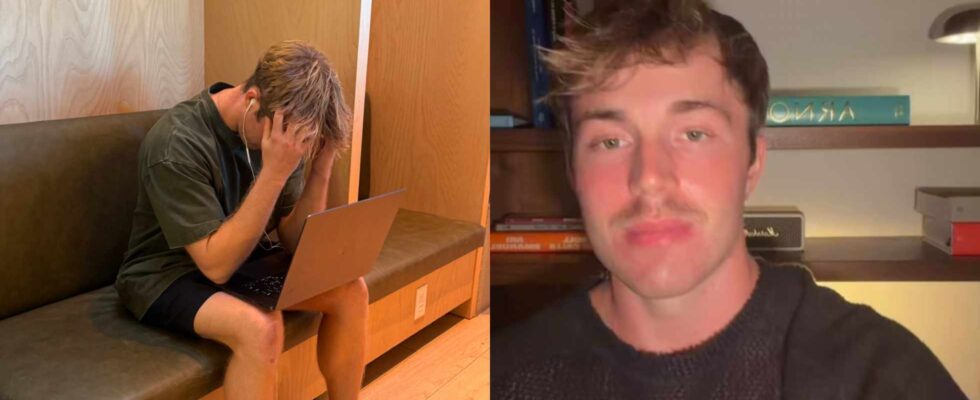
Cormac Hayden says he has thought about quitting every day for the past 30 days. But somehow, he keeps showing up.
Hayden is the founder of Oasis, a consumer health app that rates food and supplement products based on independent lab testing. Since April, the company’s revenue has dropped 85 percent, month over month.
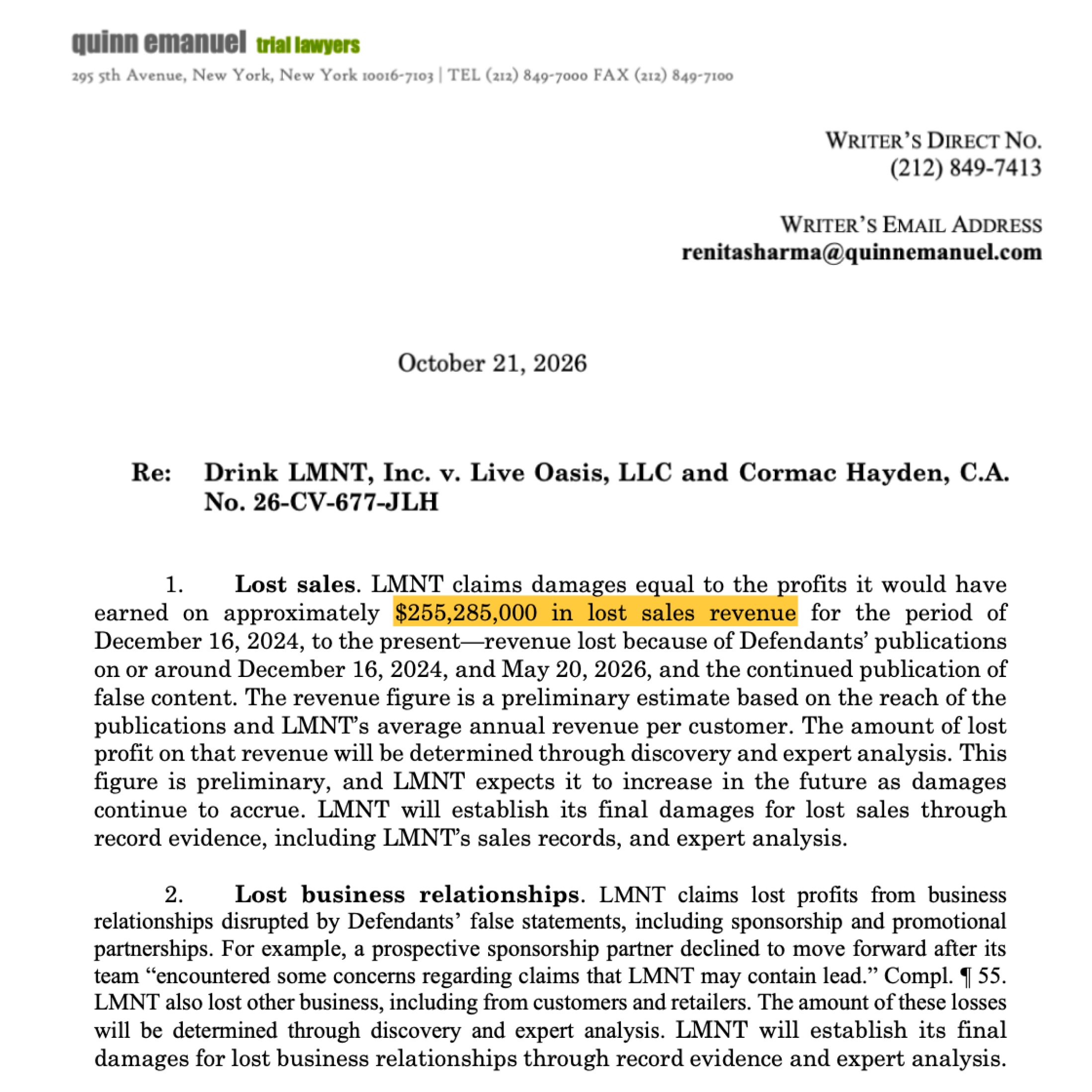
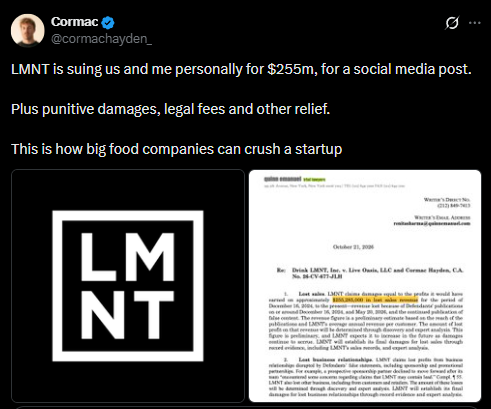
At the same time, its legal bills have moved in the opposite direction. The cause of both is a single lawsuit filed in June 2026 by electrolyte brand LMNT, which is seeking $255 million in damages, plus punitive damages, attorneys’ fees, and other relief, over a social media post.
“To be honest, every day for the past 30 days I’ve thought about quitting,” Hayden said in a recent video. “I’ve never believed more in my startup.”
The case centers on posts published December 16, 2024, across five social media platforms, in which Oasis claimed LMNT products contained roughly seven times the recommended limit of lead. The posts reached a large audience quickly and, according to the complaint filed by Drink LMNT, Inc. against Live Oasis, LLC and Hayden personally, caused immediate and lasting damage to the brand.
The core problem was a math error. Oasis had used a bulk concentration figure measured in micrograms per kilogram of powder and applied it as though it represented the amount of lead in a single serving. By February 12, 2025, Hayden himself confirmed in writing that LMNT Raw Unflavored actually contains 0.0945 micrograms of lead per serving, roughly 19 percent of California’s Proposition 65 Maximum Allowable Dose Level. That standard already builds in a 1,000-fold margin of safety below levels shown to cause harm.
The parties reached written agreement on the corrected figures by February 21, 2025. What followed is now central to the lawsuit. Despite that agreement, Oasis left its original posts online and kept LMNT’s score at 3 out of 100 for another 15 months. The retraction did not come until May 21 and 22, 2026, following viral public comments from LMNT’s CEO about the false claims.
Hayden’s account of the timeline is different. “We corrected it within 24 hours and offered to boost the correction to reach the same audience that the original post did,” he said. “But their legal team said they were not interested when we made the offer.”
The complaint tells a different story, documenting four separate attempts by LMNT to flag the error before legal action began: a public Instagram comment correction on December 16, 2024, direct messages on X, a one-hour Zoom call on January 21, 2025, and formal communications from LMNT’s general counsel beginning January 24, 2025. According to the lawsuit, Hayden made three written commitments and two verbal commitments to correct the record but did not follow through until over a year later.
When the correction finally came in May 2026, Oasis acknowledged that “a calculation error inflated the heavy metals” and that “our product grew faster than we could scale our QC process.” But the retraction reached approximately one percent of the audience that had viewed the original posts, according to the complaint.
The lawsuit also points to what it describes as a broader pattern. Mountain Valley Spring Water and the parent company of Celsius energy drinks both sent cease-and-desist letters over comparable posts. When Mountain Valley demanded a correction, Hayden displayed the letter on camera and framed the demand as an effort by “big water” to silence him.
Days before retracting the LMNT claims, Oasis published posts stating that Premier Protein contained “3,116% lead” and Transparent Labs contained “461% lead.” Both figures reflected the same underlying calculation error. Consumer Reports data that Oasis itself cited showed both products actually tested below California’s lead threshold.
The human cost described in the lawsuit is specific. Pregnant women and nursing mothers reportedly reached out to LMNT after seeing the original posts. One breastfeeding mother wrote: “I drank these everyday all throughout my pregnancy and after while breastfeeding and I’m quite anxious and worried about it now.” A health practitioner who had recommended LMNT to clients during her own pregnancy said: “I feel completely betrayed.”
The complaint also highlights some unusual scoring comparisons. LMNT received a 3 out of 100 on the Oasis platform, placing it below Cheeto Puffs at 58, Oreos at 40, and Lucky Charms Sugar Cookie Dough at 52. LMNT’s direct competitor Re-Lyte Hydration, which has a nearly identical ingredient profile, scored 52, seventeen times higher. The lawsuit also notes that on December 15, 2024, the day before the LMNT posts went live, Hayden shared analytics showing a 66 percent spike in app downloads attributed to controversial content. On May 20, 2026, the day after publishing posts listing LMNT among the worst-rated supplements of 2026, Hayden celebrated an “oasis record day” with the app ranking in the top 10 health apps.
The complaint describes Hayden as an AI software developer with no scientific training, operating as the sole managing member of Live Oasis, LLC. By Oasis’s own disclosures, the app had reached more than one billion impressions, accumulated over 700,000 members, and generated approximately $442,000 in monthly revenue by April 2026.
LMNT is represented by Quinn Emanuel, a law firm known for high-stakes commercial litigation on behalf of large corporations. Hayden acknowledged the difficulty of facing that kind of opposition as a small company. “This law firm is used by billionaires and billion-dollar corporations to do their bidding,” he said. “And going after a very small bootstrap company like us, this firm can be very successful. Our defense costs tens of thousands of dollars a month and could reach six or seven figures if the case continues without settlement, of which we don’t control.”
As of the lawsuit’s filing, some content about LMNT remained on the Oasis platform, including language describing lead levels as “toxic to multiple organ systems” and flags for “4 Harmful substances,” despite the product testing well within safety limits.
For now, Hayden says the team is continuing to build without pay, putting the company’s remaining resources into engineering, lab testing, and product development rather than legal reserves or marketing. He framed the moment as one of purpose over practicality.
“I’m not sharing this to ask for pity,” he said. “Hopefully maybe this video can reach the right person or people that can help get us through this and continue on our mission, which is empowering consumers with transparent information and raising the health standard for everyone.”
