

When Tainara Lisboa stepped out of the octagon at UFC Vegas 123 on October 31, 2026, she was dealing with more than just a painful third-round TKO loss to undefeated newcomer Lucia Szabova. Within hours, a firestorm erupted on social media targeting her husband and head coach Bruno Polengo for his aggressive cornering between the second and third rounds.
Three days later, Lisboa decided she needed to speak up.
“It’s so natural for me because that’s my life in there,” Lisboa told, addressing the intense criticism her husband faced after the match at the Meta APEX in Las Vegas.
The backlash centered on Polengo’s profanity-laced instructions delivered in Portuguese before the final round. With Lisboa trailing on the scorecards and facing what could be a career-defining moment, Polengo shouted at his wife and athlete, demanding she wake up and finish Szabova.
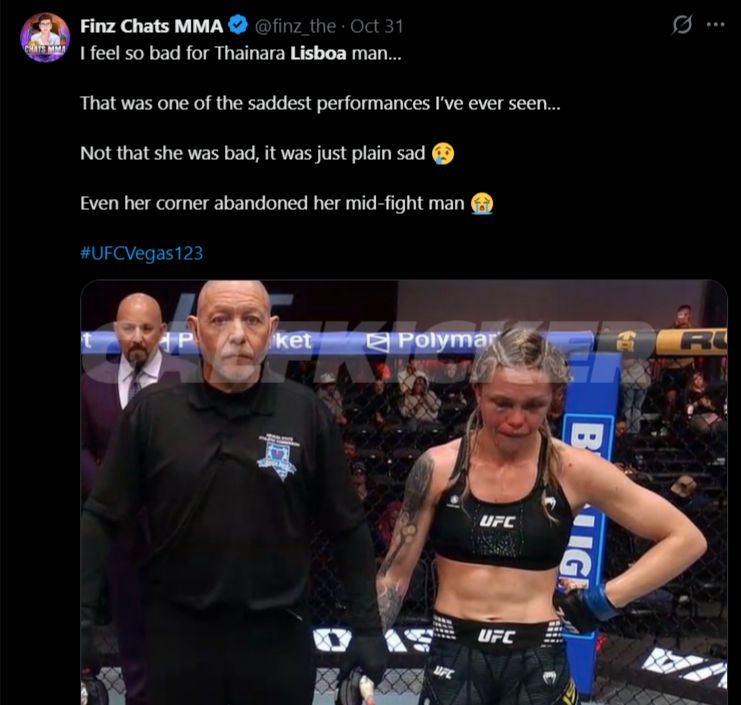


UFC commentators Daniel Cormier and Laura Sanko criticized his approach during the broadcast, with Cormier stating, “It’s not an emotional problem. She’s competing the best that she can.”


But Lisboa sees the situation very differently. For her, understanding Polengo’s corner work requires understanding their nine-year relationship and the psychological challenges she has faced throughout her athletic career.
“We’ve dealt with depression a few times, with him alongside me, wanting to give up everything, wanting to end my life,” Lisboa revealed in the interview. “We’ve been through that, with my insecurities, with my fears, which are things we athletes don’t talk about, don’t bring up, but they happen to many high-performance athletes.”
The 35-year-old explained that her mental health struggles date back to her early days in Muay Thai and intensified after a serious knee injury that sidelined her for more than a year. Following surgery after her second UFC match, she had to relearn how to walk. The rehabilitation process was agonizing, both physically and mentally.
“I’ve been in sports since I was 13, I went through a lot during my Muay Thai days, so unfortunately, my weak point is my mental game,” Lisboa said. “And Bruno, ever since we met nine years ago, has helped me face things and seek treatment.”
Lisboa described Polengo’s aggressive approach as part of her “modus operandi,” explaining that she performs better when pushed in this manner. She emphasized that before the match, she specifically asked him not to let go of her hand in the locker room, regardless of what happened.
“There’s someone trying to take your head off, someone trying to take your dreams away, so there’s no way it can be any different,” she explained. “I was embarrassed by what I did, by what I failed to do, by what I know my coaches and I prepared to deliver regardless of the result. That embarrasses me. And him trying to rescue me, yelling and trying to wake me up, is actually a huge proof of love.”
The stakes surrounding the match amplified the emotional intensity. Coming off two consecutive UFC losses, Lisboa understood that another defeat could mean the end of her promotional tenure. Meanwhile, Szabova entered as an undefeated three-time Oktagon champion making her UFC debut, with everything to gain and little to lose.
“It wasn’t a good match, it was a match that already carried a huge weight,” Lisboa said. “We were coming in against someone who had no pressure, undefeated, excited about making her UFC debut, while I was carrying a piano on my back.”
The financial and professional pressure weighed heavily on her mind. “Am I going to get cut? I need to win this match. We need this money. I need to show I deserve to be here. I had to perform,” she said.
Polengo also addressed the controversy, acknowledging his explosive personality while firmly rejecting accusations of abusive behavior.
“I cursed at her because the way I have to wake Tainara up is by becoming explosive,” Polengo told. “Explosive is the word. Anyone who knows me knows that’s how I am. When I shake Tainara up, she wakes up.”
He emphasized that his relationship with Lisboa extends far beyond the traditional coach-athlete dynamic. “My relationship with Tainara isn’t just coach and athlete. We have a life together, and our life is very tough. We gave everything up over these nine years to be here,” he said.
Watching his wife struggle in the octagon while knowing what was at stake pushed him to his breaking point. “But I knew that wasn’t Tainara in there anymore. Man, this is our life. If we know we’re going to lose and we know the UFC is going to send Tainara home, our life is on the line in there,” Polengo explained.
The abuse allegations particularly stung him. “When it comes to abuse, you have to be very careful. Very careful,” he said. “Tainara and I have a husband-and-wife relationship. We’re very happy together. Anyone who knows us knows I would never do anything bad to Tainara, or to anyone else.”
He described his coaching philosophy at the gym: “The motto at my gym is don’t take me away from home if you’re not going to give your best.” He holds his athletes accountable for their performances and expects the same dedication from them that he brings himself.
“I can be an energetic person, but I’m not abusive. My athletes are held accountable,” Polengo said. “Talking about abuse is very dangerous, you have to be very careful, because millions of people are watching.”
Despite all the preparation and Polengo doing exactly what they had planned, the outcome Lisboa hoped for never materialized. Szabova dominated the third round, landing 31 strikes in a ground-and-pound sequence that forced the referee to stop the contest.
“Unfortunately, I didn’t do my part, I couldn’t wake up, I couldn’t respond, but he did what we had agreed on,” Lisboa acknowledged.
For Lisboa, the conversation about her husband’s cornering style misses the broader context of mental health in professional sports. She pointed out that many high-performance athletes deal with psychological challenges that remain hidden from public view.
“It’s an incredible privilege to be at an event like the UFC, living what you dreamed of, and having the chance to build a life because they pay you to work,” she said. “But it’s also a lot of pressure because you think about everything you could lose, everything you might not be able to achieve, all the injuries that get in your way, all the fears, and the team you want to honor. There are so many things inside one little box.”
Lisboa and Polengo both stressed that their approach may not work for everyone, but it reflects years of working together and understanding each other’s needs. What appears harsh to outsiders represents, in their view, a system developed through experience and mutual understanding.
“We worked so hard to belong in that place, we went through a super complex surgery after my second match. I had to learn how to walk again, I felt a lot of pain, trying to rehabilitate myself, find myself again, and that caused me a lot of mental problems. I had to deal with depression, I took medication, so being there is really a chance for a future, it’s how we pay our bills,” Lisboa said.
As Lisboa faces an uncertain future with the promotion following three consecutive losses, she remains steadfast in defending the man who has been by her side through the highest highs and lowest lows of her career.
