

Andrew Huberman’s new book “Protocols” hit the top of the New York Times, USA Today and Amazon bestseller lists within a day of hitting shelves. Nobody in publishing seemed surprised. Pre-orders had been stacking up since June 2024, and the release itself had been pushed back a full year for reasons nobody at Simon & Schuster or Huberman’s camp ever bothered to explain.
When the book finally dropped on September 15, 2026, that backlog alone was enough to send it rocketing up the charts.
What came next was a predictable blitz, a media tour that ran through manosphere podcasts, morning show couches and late-night sets. What never materialized was a single independent review.
Journalist Scott Carney says that gap was by design. According to Carney, Simon & Schuster enforced a media blackout ahead of release and turned down requests for advance copies, including one from Carney himself and another from a host at an NPR affiliate.
With no galleys to work from, Carney went through the finished book line by line, and what he found raises uncomfortable questions about how it actually came together, and about whether the man on the cover ever truly sat with his own manuscript before it went to print.
A leak from inside the process
Carney says a source inside Huberman’s team told him that Huberman did not actually read the book until April 2024, well after the manuscript had already taken shape. When it finally landed in front of him, he reportedly submitted at least 4,000 edits on the first chapter alone.
He also wanted illustrations added to the book but never got around to supplying them, a stall that according to the source became one of several bottlenecks that dragged the project out.
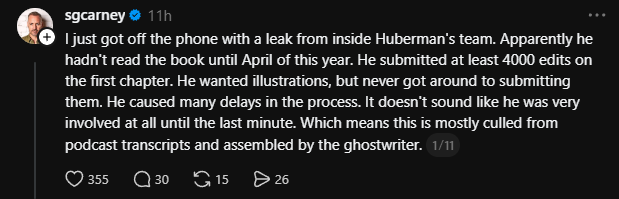
If that timeline holds up, it means Huberman was largely absent from the writing process until the eleventh hour, and that the bulk of “Protocols” was most likely stitched together from his own podcast transcripts by his ghostwriting team before he ever weighed in.
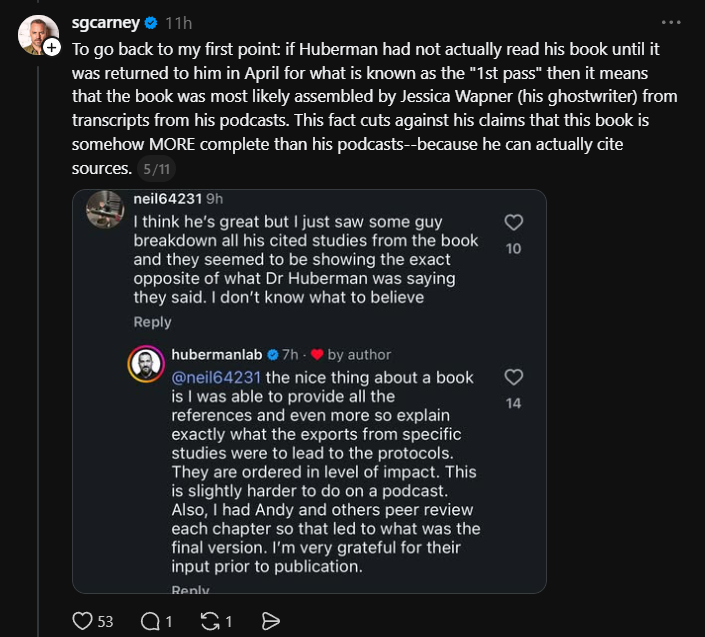
That detail cuts against the pitch Huberman has made on his press tour, that the book represents something more rigorous and complete than his podcast because it comes loaded with citations. If the source is right, those citations were assembled and sourced well before Huberman himself reviewed the content, and there is little indication anyone ran a genuine check on them before the book went to print.
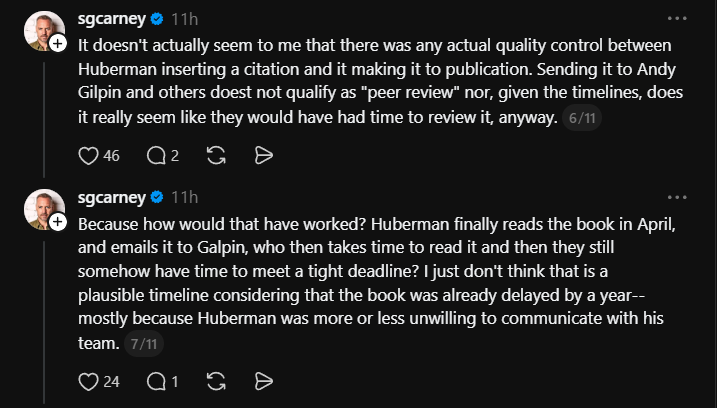
Sending chapters to outside experts for a look does not amount to peer review, especially on a schedule already squeezed by a year of delays largely attributed to Huberman’s own difficulty staying engaged with his team.
Eleven sponsors, hiding in plain sight
Whatever role Huberman played in writing it, the finished product reads a certain way to Carney, and the pattern he has documented is hard to miss once pointed out. The book opens with a disclaimer listing five companies Huberman has financial ties to: AG1, Eight Sleep, Function Health, Reveri and Whoop.
That disclaimer Carney found only scratches the surface. His count turned up 25 named commercial brands across the book, and 11 of them come with a disclosed financial relationship to Huberman. Among them are a mattress company, wearable health trackers, a functional health service, a hypnosis app, a diet app, a sleep supplement, an electrolyte powder, and a pair of brands he co-owns outright, a yerba mate company and a sunscreen line. Roka’s wind down glasses show up more than once as well.
Reading through the protocols themselves, Carney counted 11 inline mentions of Huberman-linked companies, each trailing a brief disclosure. The front matter states that he is a paid scientific advisor to AG1, Eight Sleep, Function Health, Reveri and WHOOP, and that he also receives compensation from Huberman Lab podcast sponsors more broadly, directing readers to hubermanlab.com/sponsors for the complete roster.
Oddly, AG1 itself never gets an inline promotional push in the body text Carney reviewed, appearing only in that opening disclosure. However, its sleep product AGZ gets its own pitch in Sleep Protocol 9.
Five other relationships that surface inline, Carbon, Mateina, Le Rub, JOOVV and LMNT, are not among the five companies named up front. Readers only find out about those ties if they happen to reach the specific protocol where they appear.
Carney points to one passage as a clean example of the pattern. In the chapter covering sleep supplements, Huberman runs through 11 ingredients for a recommended stack, tells readers to check with a physician before taking them, and then just sentences later pivots into a pitch for AGZ, the $99-a-month sleep powder from AG1 with discount code included.
“Where sponsorships show up in the text, it appears to correspond with a general weakness in his mechanistic descriptions and protocol recommendations,” Carney said. “While he often says that many of his protocols are free, somehow there is also a product mentioned just a few sentences later.”
He put it more bluntly elsewhere: “Every single one of those companies serves a critical role in the book as a shortcut purchase for getting around a deluge of sometimes incoherent scientific information. It transforms the whole project away from a scientific endeavor into a 500-page ad.”
Carney notes that in actual scientific publishing, the kind of disclosure Huberman includes up front is typically flagged as a conflict of interest, a signal to readers that the findings attached to it might be shaped by financial incentive rather than pure research.
A morality clause that never got invoked
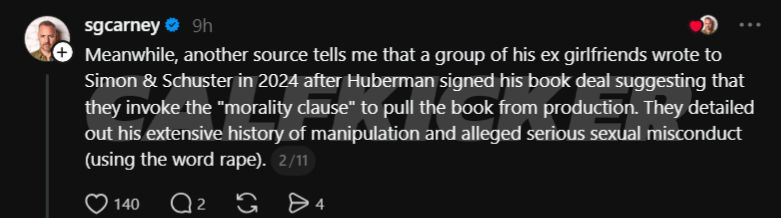
Carney’s reporting also touches on a chapter of this story that predates the book’s writing entirely. According to a separate source, a group of Huberman’s former partners wrote to Simon & Schuster back in 2024 not long after he signed the book deal, urging the publisher to invoke a morality clause and pull the project.
Their letters reportedly laid out a pattern of manipulation and alleged serious misconduct, with some descriptions reportedly serious enough that the women used the word [ ].
Simon & Schuster has shown it is willing to walk away from an author over conduct concerns before. The publisher pulled Milo Yiannopoulos’s book in 2017 saying the manuscript was not fit for print, despite having no formal morality clause to lean on in his contract.
It also chose not to move forward with Josh Hawley’s book following his role in the events of January 6. With Huberman the publisher apparently drew a different line, treating his personal conduct as separate from the subject matter of his book and allowing the project to proceed.
That decision raises the same question Carney keeps circling back to. If someone has a documented pattern of manipulation and bad faith in their personal relationships, does that history deserve to inform how critically their scientific claims get read?
It is not a rhetorical exercise for Carney. Last week, nine women who had dated Huberman but were not part of the original New York Magazine piece on him held an open question session on Reddit. Carney asked them directly whether they believed his science could fairly be judged through the lens of his relationships. Their answer, posted in that thread, became part of his ongoing case.
Alongside their answer, the group shared an infographic mapping out the timelines of Huberman’s relationships, including overlapping commitments and proposals, plus references to him spreading UTIs and HPV to partners.
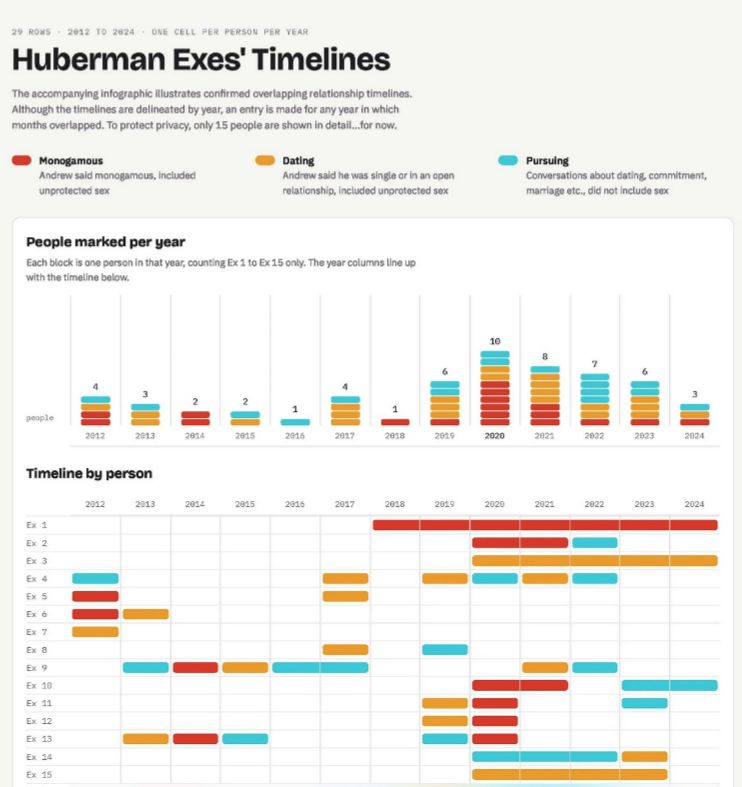
The graphic names 15 women outright, but beneath that list sit another 15 entries that have been blurred out, their color coding still faintly visible. Carney says he has heard the fuller list may run into the 40s, made up of women who came forward after the original magazine story ran, and that the graphic circulating online appears to be just one page pulled from a much longer document.
