
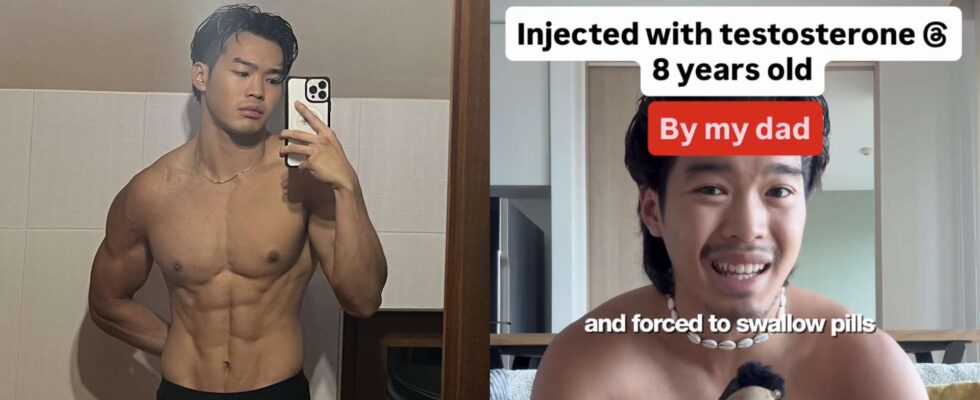
Samuel Kwan learned early that his father’s love came with conditions, and sometimes with side effects. The fitness influencer has spent the past few weeks unpacking his childhood in a video series called “Side Effects,” and the latest installment has pulled in far more attention than the rest.
In it Kwan reveals that his father, a doctor, began giving him testosterone at the age of eight. It was a decision Kwan says was meant to help him grow taller and stronger, but instead left him grappling with the opposite outcome.
“I was injected with testosterone and forced to swallow pills at eight years old by my dad who’s a doctor,” he said.
According to Kwan, his father was determined to make sure his sons grew taller and believed he could use his medical knowledge to achieve that. “My father couldn’t stand the idea of my brothers and I being garden gnomes so he decided to beat Mother Nature,” Kwan explained.
Kwan explained that his father wanted his sons to tower over him. Standing at five-foot-nine (175cm), his father reportedly believed that starting testosterone treatment early would give his boys a physical edge as they grew up.
He said his father had access to several treatments, including growth hormone, testosterone and estrogen patches, and would use them on his children in an attempt to influence their growth. Kwan also recalled being given a pill that made him and his brothers “puke for an entire morning.”
“He basically treated my brothers and I as guinea pigs. Inject this, swallow that, just to make us grow taller,” Kwan said. He recalled that the approach appeared to work initially. “And it worked for a bit. I was one of the tallest kids in my class.”
However, Kwan believes the treatment ultimately had the opposite effect on his final height. “Giving testosterone to a kid actually speeds up how fast their bone develops but it reduces their final height,” he explained. Kwan says he eventually reached 1.69 meters (5-foot-6), and believes he would have been taller had he not received the treatment as a child.
According to the wave of commenters responding to the video, including some who claimed medical or personal knowledge of hormone therapy, introducing testosterone into a prepubescent body can speed up bone maturation. That process can cause growth plates to fuse earlier than they normally would, cutting a child’s growth window short rather than extending it.
Some followers pointed out that his father despite his medical background, appeared to have overlooked basic science: that human growth hormone and not testosterone is the treatment more commonly associated with increasing height in children. Critics also stated that pairing any hormone therapy with something like an aromatase inhibitor might have prevented the very outcome he was trying to avoid.
This is not the first time Kwan has used the series to revisit difficult chapters of his childhood. In an earlier episode he described his father’s obsession with restricting food, a rule enforced with physical punishment.
“My dad used to hit me for eating ice cream and a lot of people assume that’s why I look like this today, but they actually did the complete opposite,” Kwan said. He went on to explain the strict household he and his brothers grew up in. “Growing up with a very strict and sociopathic doctor as a father, if my brothers and I were caught even nibbling on things like Oreos, donuts, cakes, chocolate, ice cream, you name it, he would hit us because he believed those kinds of foods would shave off years of our lives.”
That environment Kwan says backfired the moment he gained independence.
“So when I left his house at the age of 17, guess what? I ended up binge eating all those same foods he told us not to eat. And as a result, I actually gained a lot of fat.”
He has since built a coaching philosophy around that experience, encouraging clients to stop treating food as forbidden.
“You need to understand that excessively restricting yourself from eating foods only leads to you disliking your life and actually failing your diet. That’s why 95% of diets fail,” he said, adding that finding healthier versions of favorite foods tends to work better than cutting them out altogether.
He has spoken candidly about how that pressure shaped his relationship with competition, admitting that success in the sport never came from enjoyment.
“I didn’t train out of love for the sport, but out of fear and anxiety. I was so stressed as an athlete that I would constantly cry during competition prep and have complete mental breakdowns because I felt like I was going to be punished. Not by my dad, but by my own set of expectations.”
His father’s approach to education followed a similar pattern, according to Kwan, who says he was homeschooled and disciplined harshly over mistakes.
“He would tell me I’m lazy, entitled, stubborn, and that I would never make it anywhere in life. You hear that enough as a kid and you start to believe it.”
Kwan has said he turned to the gym as a way of reclaiming a sense of control during that period, describing it as the one part of his day that belonged entirely to him.
Today, Kwan runs an online coaching business from Bangkok, where he works with busy professionals trying to get in shape without falling into the all-or-nothing patterns he grew up with. He often reminds his audience that motivation built on fear rarely lasts.
