

Neuroscientist Andrew Huberman took his whole body MRI campaign to Joe Rogan’s microphone, and along the way he left out a detail that had already gotten him in trouble once this year: the financial relationship tying him to the very industry he was championing.
The segment started with Huberman recounting the backlash from a tweet he had posted earlier.
“I put out a tweet the other day, and I only half regret doing it,” he told Rogan. “I said, you know, people contact me all the time saying that physician friends with people coming in who identified tumors from whole body MRIs. And I think as the cost comes down I think it’s going to be a very interesting tool. And the neurosurgery and other communities dogpiled me.”
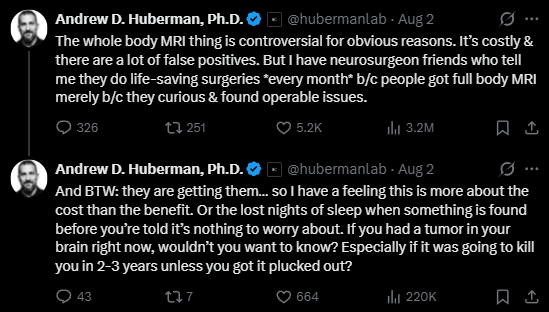
That “dogpiling” had been swift and specific. When Huberman first posted the thread in question, he leaned on secondhand stories to make his case, writing that physician friends told him they perform surgeries that save lives “every month” because someone got curious, booked a scan, and found something operable.
“If you had a tumor in your brain right now, wouldn’t you want to know? Especially if it was going to k[]ll you in 2-3 years unless you got it plucked out?” he asked his millions of followers.
Neurosurgeons were not moved. “Neurosurgeon here. This is hogwash,” one wrote back. Another put it just as plainly: “I have never once operated on any incidental ‘life saving’ lesion found on a whole body mri.”
Even a cancer surgeon with a PhD in health outcomes and policy, someone whose caseload would arguably grow if more people went looking for tumors, rejected the premise outright: “Surgeon who takes out cancer for a living, whose PhD is actually in health outcomes & policy here. Just stopping by to say this is objectively + categorically wrong. Stats>anecdotes that likely didn’t happen.”
Rather than let the matter drop, Huberman used the Rogan platform to reframe the whole dispute as a turf war, casting himself as the reasonable outsider and the medical establishment as territorial gatekeepers.
“They want control. They want control over the flow of data,” he said of the doctors who pushed back. He argued that people should simply be allowed to get scanned if they want to, likening the pushback to old arguments over genetic testing.
“You should be able to choose it,” he said. “The gatekeeping on this is real. Very real.”
To drive the point home, he told Rogan’s audience about a woman he says was saved by a whole body scan after her own doctor tried to talk her out of getting one, a story that fit neatly into his argument that an entrenched medical establishment is standing between ordinary people and potentially life saving information.
He went further still, telling Rogan that neurosurgery contacts had confided to him privately that “in 20 months, this is going to be standard practice for people to just get whole body MRI.”
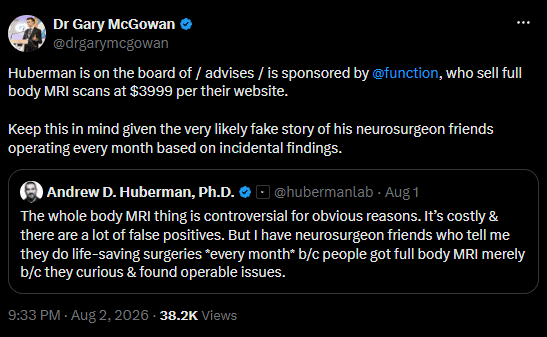
What never came up during any of it was Huberman’s own stake in the outcome. Dr. Gary McGowan had already flagged that connection publicly after the original tweet went out.
“Huberman is on the board of / advises / is sponsored by @function,” McGowan wrote, referring to Function Health, a company that sells whole body MRI scans through its website for $3,999. “Keep this in mind given the very likely fake story of his neurosurgeon friends operating every month based on incidental findings.”
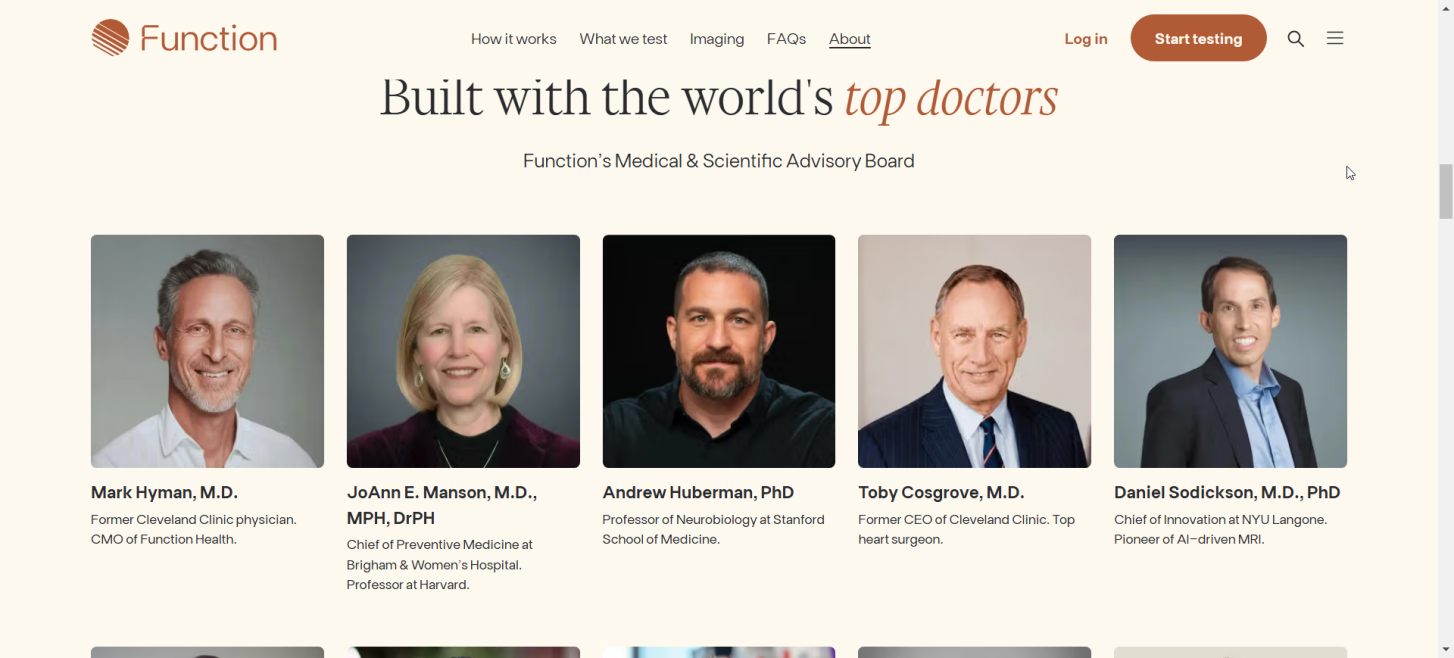
Dr. Shariq Shamim raised the same concern in blunter terms, questioning how someone could sit on the board of a company selling these scans and then make sweeping medical claims in its favor without saying so.
“Imagine sitting on a board for a company that promotes whole body MRI then making tall claims like this without disclosing that COI or how he gets paid for promotional posts,” he wrote. “Why do most of these ‘Longevity Gurus’ turn into Grifters?”
That framing sidesteps what most medical organizations actually say about the practice. Screening asymptomatic people with full body scans is not broadly recommended, largely because false positives tend to trigger unnecessary follow up procedures, unwarranted anxiety, and added costs, without the kind of large-scale evidence backing more established screening tools.
None of that nuance made it into the Rogan conversation. What listeners got instead was an extended, confident case for a $3,999 elective scan, delivered by a voice they have come to trust on matters of health and performance, with no mention that the man making the case has a seat at the table of the company selling it.
