

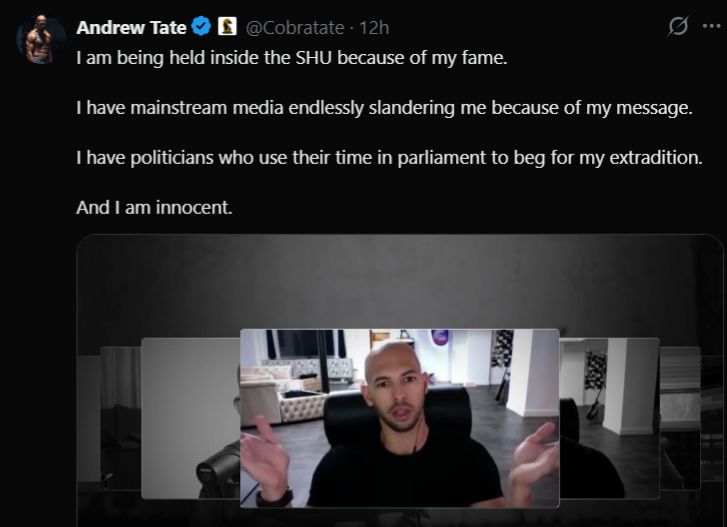
For weeks, Tate has cultivated an image of himself as a man isolated in a cell, cut off from the outside world and even from his own brother, painting his detention as something closer to punishment than a routine part of the extradition process. A federal court filing made public this week says otherwise, and the gap between the narrative and the record is hard to miss.
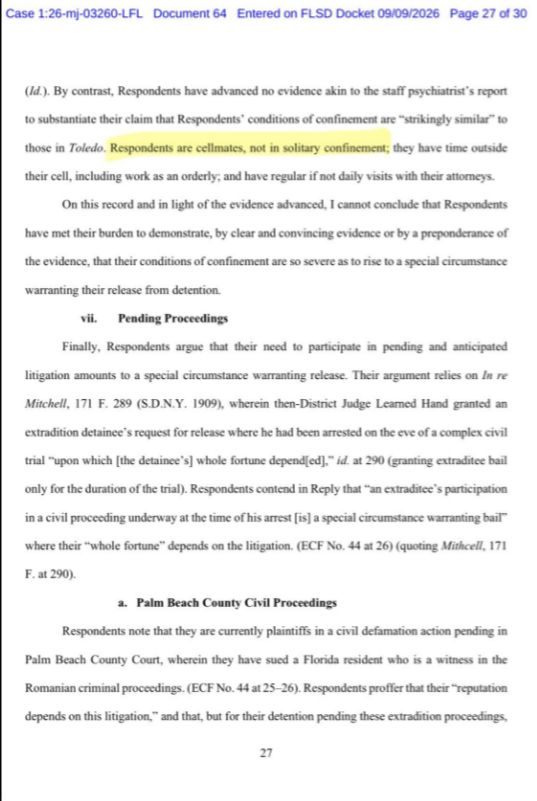
According to the document from the U.S. District Court in the Southern District of Florida, dated September 9, Andrew and Tristan Tate are not isolated at all. They share a cell. The filing notes they “have time outside their cell, including work as an orderly,” and that they see their attorneys on a near-daily basis.
The court used those facts to reject an argument that their living conditions were harsh enough to justify releasing them from custody, pointing out that the brothers had failed to produce evidence comparable to a prior case where a psychiatric report backed up claims of extreme isolation. Without that kind of documentation, the judge found no basis to treat their situation as unusually severe.
That finding lands just days after Magistrate Judge Lauren Louis ruled that Andrew and Tristan Tate will stay behind bars while they argue against extradition to the United Kingdom. The decision, issued Wednesday, closed out a legal round that began with an August 27 bail hearing, one where both brothers made the unusual choice to testify on their own behalf.
Louis wasn’t persuaded. She concluded the pair had “failed to meet their burden to demonstrate that they do not present a risk of flight or danger to the community, or that special circumstances warrant their release.”
The brothers, who carry both American and British citizenship, have been in custody since July 18, when U.S. Marshals took them into custody in Miami after Britain filed provisional arrest warrants. They’ve stayed there ever since, waiting out what could turn into a long-running legal battle. British officials still have until September 16 to file the formal extradition request with the U.S. State Department, and there’s no scheduled date yet for a hearing on the matter.
The allegations driving the case are substantial. UK prosecutors have filed 42 charges against Andrew Tate and 17 against Tristan. Neither brother has entered a formal response to the UK allegations, and both continue to say they’ve done nothing wrong.
Romania has since added its own layer to the situation, with prosecutors there indicting Andrew Tate earlier this month and naming Tristan for complicity. The brothers have technically been under investigation in Romania over trafficking-related allegations since December 2022, a case that has run in parallel with their rise to online notoriety.
At the August bail hearing, the Tates appeared in public for the first time in weeks, restrained and dressed in matching tan jail jumpsuits, flanked by four U.S. Marshals. Their attorneys described the decision to have them testify personally as a rare move, one meant to underscore how much they felt was riding on the outcome.
Defense attorney Joe McBride pushed back hard on the structure of the proceedings. “Detention first. Evidence later, maybe,” he said. He went further, arguing the deck was stacked against them from the start: “Every burden in that courtroom falls on Andrew and Tristan. None of it falls on the government that wants Andrew and Tristan handed over.”
McBride summed up his frustration by describing his clients as “two American citizens, on American soil, ordered to prove a negative against a case that does not yet exist on paper.”
For now, both brothers remain in custody as their legal team keeps pressing the extradition challenge. The next real test comes September 16, when the UK’s deadline to submit its formal extradition paperwork arrives and the case moves into its next phase.
