
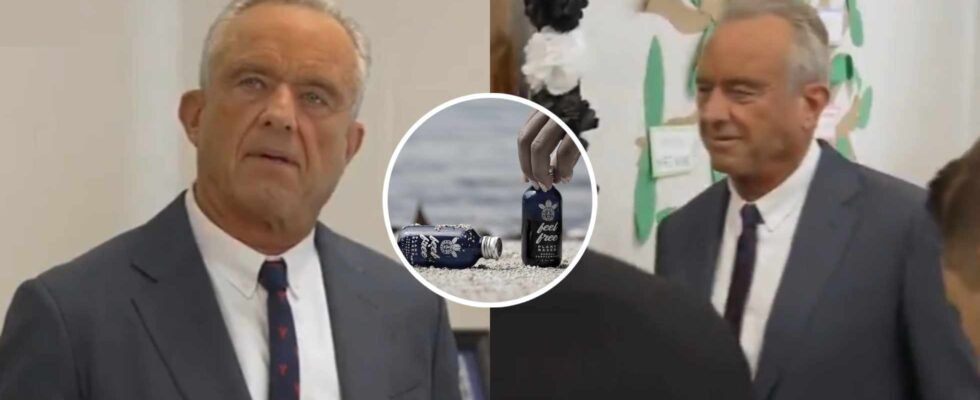
Health Secretary Robert F. Kennedy Jr. reportedly cut short an appearance at a MAHA event after being pressed by a Sky News reporter about his alleged connections to companies that stand to benefit from the regulation of kratom products.
The exchange began with questions about 7-hydroxymitragynine (7-OH), a concentrated compound derived from kratom that Kennedy has supported restricting.
“You f0ught very hard to get a ban on 7-OH. People also say that natural leaf kratom is ad*ictive. What are you doing to fi*ht that scourge?” the reporter asked.
“Well, FDA is looking at that issue right now,” Kennedy replied.
The questioning then turned to the Department of Justice’s decision to drop its case against Feel Free, a kratom-based beverage produced by Botanic Tonics. The reporter also brought up a reported $1 million donation involving Botanic Tonics founder Jerry Ross and a political committee associated with the MAHA movement, asking whether the donation had any connection to the DOJ’s decision.
“But the Justice Department dropped its case against Feel Free, and MAHA received a $1 million donation. Does that have anything to do with the DOJ dropping [the case]?” the reporter asked.
Kennedy denied having any knowledge of the matter.
“I don’t know anything about either of the things that you just said. I have no idea who [made] the million-dollar donation,” he responded.
When the reporter identified the donor as Jerry Ross, Kennedy reiterated that he was unaware of the donation and distanced himself from the Justice Department’s decision.
“I don’t know anything about that. And I don’t make decisions for the Justice Department,” Kennedy said.
The reporter followed up one final time, asking, “So you have no knowledge of that $1 million donation?”
The exchange ended shortly afterward, with Kennedy walking away from the questions.
Sky News reported that it contacted the Department of Health and Human Services, Botanic Tonics and Jerry Ross for comment but had not received a response.
Sky News pressed Robert F. Kennedy Jr. face to face over money trails connecting a leading brand to members of Donald Trump’s cabinet
by
u/ReallyNotAnExpert in
popculturemix
The questions raised at the event are also explored in a documentary examining the growing battle over kratom regulation and the financial interests surrounding the industry.
“[Jeremy Ross] His connection to RFK Jr. is really interesting because Feel Free is the number one retail product in the kratom industry, with annual sales estimated at $250 million,” the documentary states.
Feel Free is produced by Botanic Tonics, a company founded by Jeremy Ross. According to the documentary, Ross previously served time in federal prison for fraud. Botanic Tonics also came under investigation by the Department of Justice before the case was ultimately dropped in 2025.
The documentary claims that, weeks after the case was dropped, Botanic Tonics contributed $500,000 to the MAHA PAC, followed by another $500,000 contribution, bringing the reported total to $1 million.
The film also highlights the financial interests of Secretary of Homeland Security Mark Wayne Mullin, who is described as one of Botanic Tonics’ primary investors. Mullin has appeared alongside Kennedy and former FDA Commissioner Dr. Marty Makary while warning about the potential dangers of 7-OH.
That has prompted questions from some in the kratom industry about whether the push against 7-OH could have broader financial implications for competing products. People interviewed in the film suggested that companies selling other forms of kratom could benefit if 7-OH products were removed from the market.
“If anybody stands to benefit from the disappearance of 7-hydroxy products, it’s the next tier of kratom products,” one interviewee said, pointing to companies such as Feel Free and OPMS, as well as kratom seltzers, as businesses that could potentially gain market share.
That is where the documentary’s conflict-of-interest questions become more pointed. If concentrated 7-OH products are restricted while other kratom-based beverages and extracts remain available, companies operating in those other segments could potentially face less competition.
