

Long before Ozempic became a punchline or a punch line delivery system for late night monologues, one activist named Da’Shaun L. Harrison argues, the modern diet industry was already doing something far more calculated than helping anyone get healthy.
In a video that has begun circulating widely, they lay out a case that connects body mass index charts, celebrity weight loss headlines, and the language of national borders into a single argument: that the treatment of fatness in America, and Black fatness in particular, functions as a form of body fascism.
“Black fatness is made meaningful through suffering, through surveillance and through control, and the policing of that Black fat flesh anchors entire systems of governance,” they say. “Without a population to discipline, there would be no BMI, no obesity epidemic, and no medical or scientific institutions organized around managing fatness.”
Their argument does not stop at government agencies. They point directly at the commercial ecosystem built around weight loss, describing it as a coordinated structure rather than a loose collection of companies chasing the same market.
“The diet industry reflects this logic,” they say. “It operates through what I once defined as formal and informal relationships among major food corporations, the medical industrial complex, and individual wealthy benefactors to sustain a social order in which fat people are monitored, restricted, guilted, stolen from, and punished.”
They trace that dynamic back to how food itself gets moralized, arguing that everyday phrases most people use without a second thought are actually doing ideological work.
“Diet culture has always linked food to morality, framing restraint as virtue and pleasure as danger through language like guilty pleasure,” they say. “Abstaining from pleasure becomes a way to train obedience, to train self-denial, and to train discipline in service of a broader political order.”
From there, Harrison widens the lens considerably, arguing that what looks like health policy is, in their framing, indistinguishable from older and uglier systems of control.
“Body fascism is not some relic of the past. It’s an active feature of modern imperial regimes,” she says. “Every time a government decides whose body must be protected and whose bodies must be erased for the sake of national imagery, this is body fascism. Every time there is a call for sovereignty by state powers with the intent to maintain borders, this is body fascism. Every time black flesh is wrangled, dismembered, abused, this is body fascism.”
The timeline Harrison builds starts in 2020, when a new class of weight loss treatments began reshaping public conversation around fatness and, in her telling, around Black celebrities specifically.
“Since 2020, the growing popularity of GLP-1s has been reflected in the public discourse surrounding black celebrities, such as Wolfie Goldberg, Lizzo, Serena Williams, Tracy Morgan, and Oprah, who have either been accused of using these dr**s or have publicly discussed or advocated for their use across media platforms,” Harrison says.
They describe the marketing arc as moving from targeted social media campaigns into the center of American spectacle. “These dr**s took our screens by storm, and what started as a target of social media advertising was eventually folded into the highest ritual of American mass culture, also known as the Super Bowl, and marked the dr**s’ full incorporation into the nation’s visual and moral values.”
She also connects the medications’ rise to the aftermath of the pandemic, noting they were championed as a fix for a condition long treated as unsolvable by medicine, policy and culture alike, and later promoted as a possible answer for long COVID symptoms as well. In her reading, the entire premise rests on a racialized foundation. “The fat problem these drugs promise to solve has long been framed as a threat to public health and national vitality, a framing that has always been blackened with black subjects positioned as its most visible and enduring violence,” she says. “By this I mean that fatness has always been marked precisely because of its inability to be divorced from blackness.”
It is worth sitting with how much institutional weight sits on the other side of that claim. The framework she is describing as controlling did not spring up overnight. Body mass index has been the default screening tool in American medicine since the 1970s, and health authorities have spent decades tying it to a long list of downstream conditions, from heart rhythm problems and blocked arteries to joint damage, liver disease, sleep-disordered breathing and certain cancers.
Public health agencies describe rising obesity rates in terms usually reserved for outbreaks, and the standard treatment model, built around physicians, surgeons, dietitians and behavioral specialists working in concert, is presented as neutral, evidence-driven care rather than the disciplinary apparatus the activist describes. That gap, between how the system explains itself and how she interprets its effects, is essentially the whole argument.
The conversation lands at a strange moment for that debate, given who currently sits atop the nation’s health apparatus.
Health Secretary Robert F. Kennedy Jr. recently told Lauren and Michael Bosstick on The Bossticks Podcast that he had spent months unaware his own organs were coated in fat, despite looking lean by any outward measure. He said the tip came from an unlikely mix of contacts.
“I had five different people over a two-week period telling me, ‘You got to see this Dr. Sean Kaufman, who’s a military doctor. He was a lieutenant colonel in the military,'” Kennedy said. “And they said, because he will get rid of your visceral fat. And I was like, I don’t think I have any visceral fat because I have a very low BMI, like under 10.”
A full-body MRI he had already completed ahead of taking his post at the Department of Health and Human Services told a different story once the doctor reviewed it.
“He then got on a Zoom with me and he showed me my heart was covered with visceral fat. My liver was covered with visceral fat. All of my visceral was covered with it,” Kennedy said. “And he said, ‘If you don’t already have atrial fibrillations, you’re going to have them.’ And I had had atrial fibrillations every day for four months.”
Kennedy said he committed to a strict overhaul of what he ate and tracked the results with another scan a month later.
“So I did the diet for 30 days,” he said. “Then I did another full body MRI and my visceral fat had gone down by 40%. In just 30 days, I also lost 20 lbs (9 kg), which I didn’t want to lose, but I lost a lot. And I was actually worried about the amount of weight I was losing.”
He said the doctor told him the loss was temporary and tied to muscle tissue rather than lasting damage. “He said, ‘Don’t worry. It’s all the interstitial visceral fat in your muscles that you’re losing and then your muscles will come back,'” Kennedy said. “And that’s what happened. I regained all that 20 lbs (9 kg) back in muscle.”
He credited the same plan with resolving his heart rhythm issue entirely. “My atrial fibrillations completely disappeared and I haven’t even skipped a heartbeat since then,” he said.
Asked to describe the regimen itself, Kennedy said it left little room for flexibility. “I eat grass-fed milk on top or cream on top yogurt and I have a very restricted diet that I’ve been on for about 250 days,” he said. “But it’s a carnivore diet with ferments. So it’s carnivore and then the only other thing I eat is ferments. Sauerkraut, kimchi, any kind of fermented vegetable, which there’s a huge selection in most grocery stores, and then a lot of yogurt.” Pressed on carbohydrates, his answer was short. “No carbs,” he said.
Whatever one makes of the diet itself, the optics are hard to ignore next to the activist’s argument. Here is the country’s top health official, presented in glowing terms across outlets for adopting one of the most restrictive eating plans available, framed as discipline rewarded with a healthier heart. It is the same restraint-as-virtue logic she describes, playing out in a body that the diet industry rarely, if ever, treats as a target for surveillance or blame.
Reaction to the activist’s video split almost immediately along predictable lines. Fitness figure Mike Israetel responded with blunt disbelief, and commentator Spencer Pratt argued that comfortable modern life has left people with too much spare time and too little to actually worry about, singling out university settings as the source of what he sees as manufactured grievances and calling for public funding to be pulled from higher education over it.
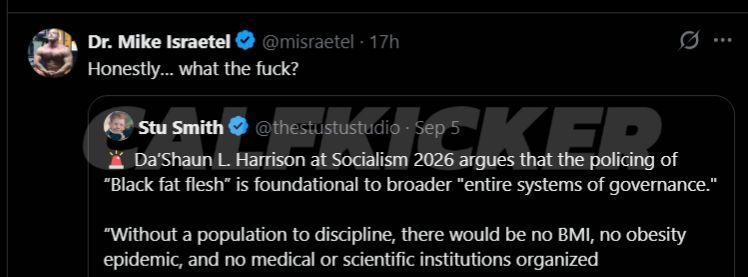

Actor Dean Cain was similarly unsparing, calling it among the least sensible arguments he had come across.


None of that pushback seemed to trouble the activist’s larger thesis, which was never really about whether any single celebrity took a weight loss treatment or whether any single official changed his eating habits. Her point is that the entire architecture around fatness, who gets praised for losing it, who gets blamed for having it, who gets studied and who gets sold to, was built to sort bodies long before anyone downloaded a health app or booked an MRI, and that the sorting has never been color-blind.
🚨 Da’Shaun L. Harrison at Socialism 2026 argues that the policing of “Black fat flesh” is foundational to broader “entire systems of governance.”
“Without a population to discipline, there would be no BMI, no obesity epidemic, and no medical or scientific institutions organized… pic.twitter.com/GP4foaTgUJ
— Stu Smith (@thestustustudio) September 5, 2026
