
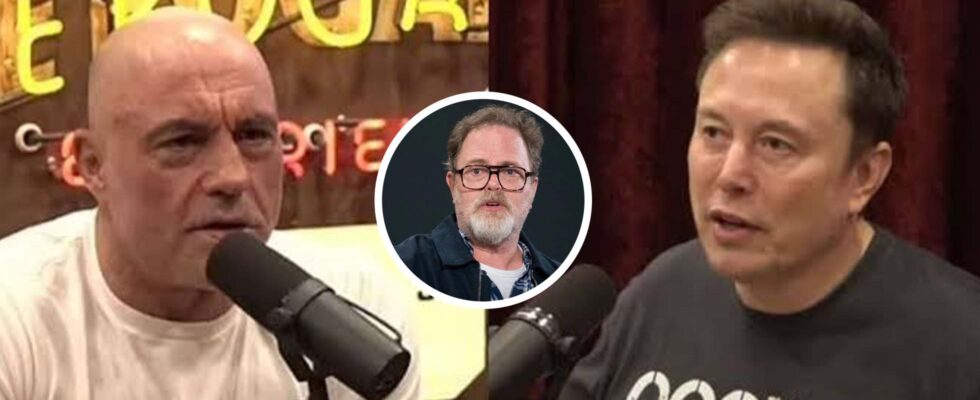
Rainn Wilson has criticized Elon Musk over his use of social media and his focus on culture war controversies, arguing that the billionaire’s influence can divert attention from the deeper economic and social problems affecting ordinary people.
The actor, widely recognized for portraying Dwight Schrute on The Office, discussed Musk during a recent episode of his Soul Boom podcast while speaking with Channel 5 journalist Andrew Callaghan about politics, media and the spread of disinformation.
Musk entered the discussion after Callaghan and Wilson examined how increasingly bleak or exaggerated views of society can make people more receptive to extremist ideas.
Wilson was particularly critical of Musk’s approach to cultural and political issues, arguing that his enormous online following gives him an unusually powerful platform.
“You have the richest man in the world who has obsessively fallen for every meaningless culture war issue under the sun. A person who needs a permanent underclass of people to provide him with his essential services. Who uses this massive platform as a megaphone to hypnotize and poison the minds of the public with this terrible useless negative s-t every single day.”
Wilson continued by arguing that Musk’s embrace of reactionary talking points makes the situation particularly troubling given his reach.
“And to have someone with that much power falling for just basic what used to be Fox News sloth that is now like within the online reactionary right echo chamber for him to be such an avid consumer of that and to propagate it is just a nightmare for all of the struggling people out there.”
The discussion then shifted toward why people experiencing economic hardship or social isolation may become attracted to culture war narratives. Wilson argued that individuals who feel increasingly alienated can be encouraged to blame particular groups instead of examining the larger structures contributing to their problems.
He suggested that immigrants, transgender athletes and even prominent filmmakers can become targets in this process, while broader economic issues receive less attention.
Wilson joked, “Or trans athletes or people like Christopher Nolan. He’s going to remake The Odyssey.”
The actor then cited one particular example that he believes demonstrates the reach of Musk’s ideas: his appearance on The Joe Rogan Experience. Musk has appeared on the podcast hosted by Joe Rogan, which has become one of the most prominent long-form interview programs in the world.
Wilson recalled Musk expressing his criticism of empathy during one of those appearances.
“In this dystopian future where he would go on the largest podcast, Joe Rogan podcast, and say, ‘The biggest problem with Western civilization is empathy.'”
Callaghan responded with a sarcastic remark of his own.
“Real alpha move there.”
Wilson ultimately framed Musk’s comments as part of a broader pattern in which cultural grievances can dominate conversations in communities dealing with significant economic challenges.
He pointed to coal country in West Virginia as an example, describing communities that have experienced unemployment and the decline of organized labor while arguing that political and cultural conversations can nonetheless become dominated by divisive social issues.
For Wilson, the concern is not simply about individual opinions on controversial subjects. He believes the larger problem is what happens when influential figures direct public attention toward cultural enemies while the economic and institutional forces affecting struggling communities receive comparatively less scrutiny.
