

Elon Musk woke up and decided the world’s oldest strategy game needed a lecture on futility. By the end of the day, it was Musk who’d been handed the lesson, and he’d learned it in front of a full audience of his own followers.
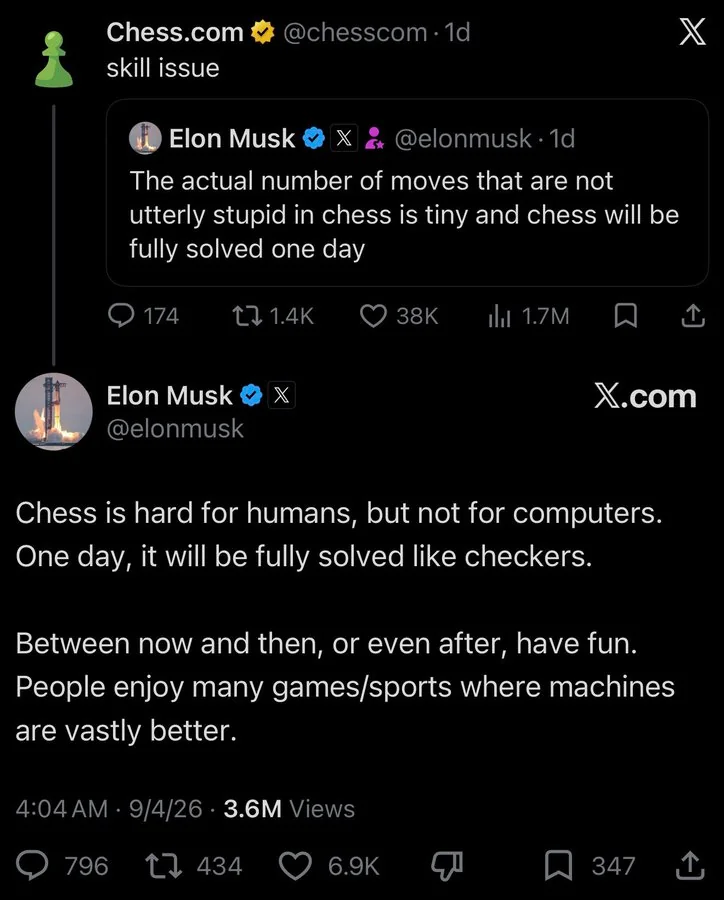
The billionaire opened with a post that read less like a challenge and more like a eulogy for a 1,500-year-old pastime. “Chess is hard for humans, but not for computers,” he wrote on X. “One day, it will be fully solved like checkers.”
He softened the blow with a shrug of generosity, adding, “Between now and then, or even after, have fun. People enjoy many games/sports where machines are vastly better.”
It read like the kind of post that vanishes into the feed unnoticed. Instead, it landed in front of the one account guaranteed to take it personally: Chess.com.
The official Chess.com handle didn’t bother with a paragraph. Two words did the job: “skill issue.”
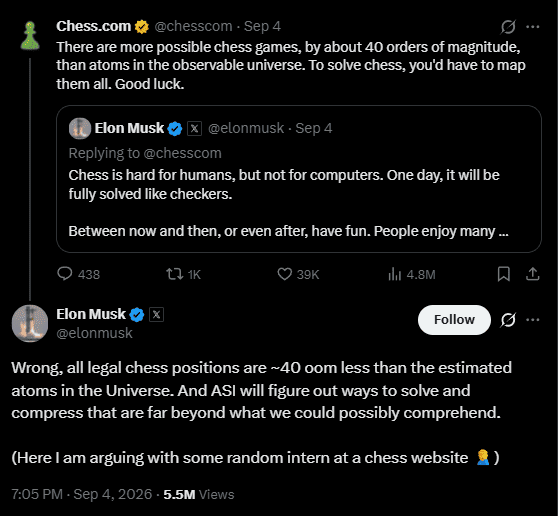
Then came the follow-up, the one that actually tried to engage with Musk’s math. “There are more possible chess games, by about 40 orders of magnitude, than atoms in the observable universe,” the account wrote. “To solve chess, you’d have to map them all. Good luck.”
Musk, evidently not willing to let a chess website have the last word on computation, came back hours later with a correction. “Wrong, all legal chess positions are ~40 oom less than the estimated atoms in the Universe,” he wrote. “And ASI will figure out ways to solve and compress that are far beyond what we could possibly comprehend.”
He tacked on a jab of his own, describing the whole affair as him “arguing with some random intern at a chess website.”
As Business Insider pointed out, this wasn’t really the knockout counter it looked like. Musk and Chess.com were technically discussing two different numbers. Chess.com was talking about the staggering count of possible games; Musk was talking about legal positions, a far smaller figure.
Both statistics can be true at once, which meant the “wrong” didn’t land the way Musk intended.
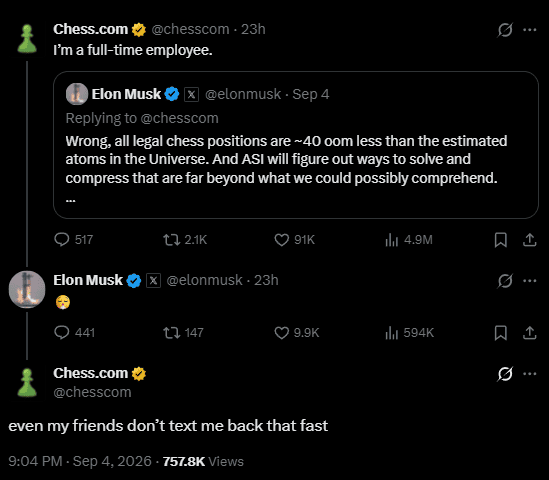
Chess.com wasn’t interested in untangling the math for him anyway. It went straight for the “intern” line. “I’m a full-time employee,” the account replied.
Musk’s response was a single emoji. That would have been a bruising enough exchange on its own, but Chess.com wasn’t finished. The account posted what amounted to a victory lap, marveling that Musk had replied so quickly. “Even my friends don’t text me back that fast,” it wrote.
The internet, naturally, treated this like a title match. Screenshots of the exchange spread fast, and the reaction piled on hard, much of it noting that this wasn’t the first time Musk has had a complicated relationship with the game.
Business Insider’s reporting dug up a 2012 episode where Musk actually shut down a chess tournament among his own Tesla employees, reportedly telling the outlet at the time, “Indeed, we do not have time for chess.” Whatever his history with the game is, it clearly isn’t a peaceful one.
There’s also the matter of Musk’s own AI venture and how it’s actually fared at the table. In a 2025 AI chess competition, xAI’s Grok 4 made it all the way to the final round, only to lose to OpenAI’s o3. So the company most closely tied to Musk’s vision of machine dominance over chess has, in practice, come up just short of the top spot.
Chess.com, for its part, wasn’t shy about declaring the whole saga a win. A spokesperson for the company later drew a sharp distinction between the two kinds of losing on display. “We understand losing a chess game can be frustrating, but losing a Twitter fig ht to a so-called intern must be maddening,” the spokesperson said.
