
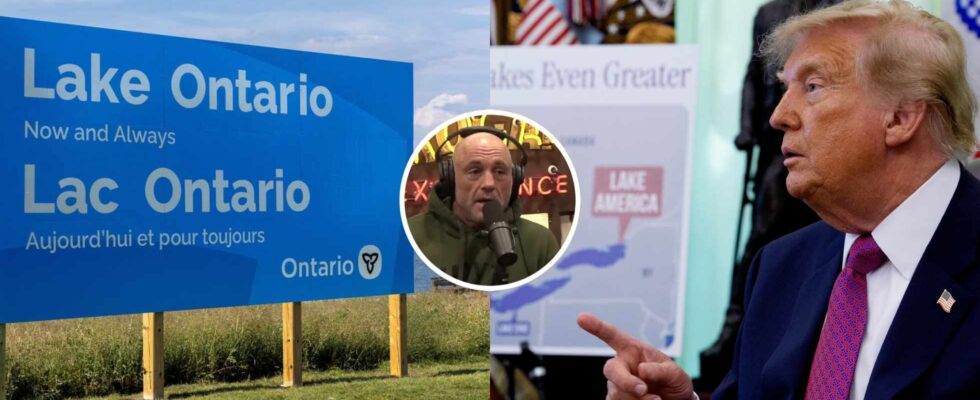
Joe Rogan spent a part of Tuesday’s episode of JRE puzzling over a piece of news with his guest, comedian Brian Simpson. Producer Jamie explained that the federal government had just renamed Lake Ontario.
“Did you know that we renamed Lake Ontario today?” Jamie asked. Rogan, catching the joke, shot back, “Yes. To Lake America.”
Rogan absorbed it for a second. He said, “Lake Ontario is no longer Lake Ontario. It’s Lake America.”
Guest Brian Simpson was visibly confused and asked, “Why did we do that?”
The exchange referenced an executive order Trump signed on August 27, directing federal agencies to use “Lake America” in place of Lake Ontario across U.S. federal geographic naming systems. The change is limited to how the American government refers to the lake.
Canada continues calling it Lake Ontario, and no international body has adopted the new name. Google has split the difference by showing “Lake America” to users searching from the U.S. while keeping “Lake Ontario” visible north of the border.
None of that made it feel any less absurd to Rogan and Simpson, who spent a few minutes riffing on where the renaming spree might end. “We might be doing Atlantic and Pacific,” Rogan said, referring to the oceans.
“What are we going to name them?” Rogan asked. Simpson jokingly replied, “The Ocean?”
Rogan kept circling back to the basic geography of the situation. Lake Ontario sits on the U.S.-Canada border, sharing its name with the Canadian province that borders it, which made the rebrand feel arbitrary to him.
“Lake Ontario has been Lake Ontario forever. Isn’t it connected to Ontario?” he asked. When Jaime confirmed the lake straddles both countries, Rogan wanted to know how the land split between them, a detail that underscored just how binational the body of water actually is.
When Simpson pressed him on the real motive behind the change, Rogan didn’t hesitate. “Could distract you from the fact that we’re in a war that we can’t win in Iran,” he said. He didn’t see any upside to the move.
He said, “Doesn’t make any sense. Like who cares? It’s Lake Ontario. It’s a good name. We’ve had that name forever.”
Simpson framed it as part of a familiar political habit. “It’s weird. Like these politicians now, they love to solve a problem. Like they love to make up a problem for themselves to solve. So you feel like they’re doing stuff,” he said.
Still turning the logic over, Simpson wondered aloud whether there was a more targeted intent behind it. “It’s like because I don’t understand what we get out of that. Or is that like messing with Canada? Is that what that is?”
White House spokeswoman Taylor Rogers defended the decision in a statement. “Canada has been a bad neighbor by ripping off our country for years,” she said. “President Trump promised voters that he would not allow our country to be taken advantage of anymore, which is why he is figh ting so hard to protect American industries and workers. Thanks to the President’s bold leadership, we are putting America back on the map.”
Polling suggests the public isn’t buying it. A YouGov/Economist survey released the same week found just 17 percent of Americans approve of the Lake Ontario renaming, against 68 percent who disapprove. The poll surveyed 1,592 U.S. adults from August 28 to August 31 and carried a margin of error of 3.5 percent. A separate Reuters/Ipsos poll put support even lower, at 14 percent, with 63 percent opposed. That survey polled 1,023 U.S. adults from August 28 to August 30, with a margin of error of 4 percent.
The renaming controversy landed against a backdrop of declining support for the administration’s approach to Iran, the very issue Rogan argued the lake story was designed to bury.
A University of Massachusetts Amherst poll released that Monday found 68 percent of Americans disapprove of how Trump has handled the Iran war, while 54 percent disapprove of the U.S. military actions themselves. Only 25 percent rated the administration’s handling as very or somewhat good, marking the lowest net approval the pollster has recorded across three surveys asking the same question.
That poll surveyed 1,000 respondents from August 21 to August 26, with a margin of error of 3.5 percent. A YouGov/Economist poll from the previous month told a similar story, putting Trump’s approval on Iran at 30 percent against 62 percent disapproval, with just 25 percent of respondents saying the war was the right call compared to 57 percent who called it wrong.
