
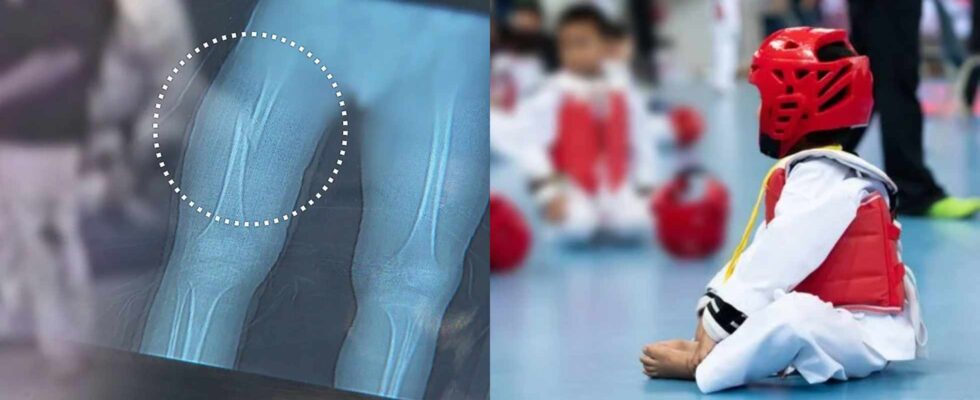
The Yong In Taekwondo Instructors’ Association is facing renewed scrutiny after a 7-year-old boy sustained a broken femur during a class session, an injury his parents say came from an instructor pinning the child’s legs into a forced split.
According to sources, the incident occurred June 18 at a Taekwondo academy in Yongin, Gyeonggi Province, when the instructor, identified only as A, allegedly restrained the boy on a training mat. According to the family’s account, A spread the child’s legs apart with both hands and then leaned his body weight down onto them. The boy struggled and signaled for the man to stop, but the pressure reportedly continued until his leg gave way.
Nearly two months on, the child still cannot walk normally.
His parents said they only grasped the severity of what had happened once a doctor examined the fracture in the emergency room.
“The emergency-room doctor said that a child’s bones bend rather than simply snapping like this,” the parent said. “If it broke to this extent, they said child abuse should be suspected.”
That distinction, doctors explained, comes down to basic pediatric physiology. Growing bones in young children tend to be more flexible than adult bone, often bowing or bending under stress rather than snapping outright. A clean fracture of the kind the boy sustained pointed to a level of force that alarmed medical staff enough to flag it as a potential abuse case.
For his part, the instructor has pushed back on the idea that he set out to hurt the child. He told the boy’s parents the incident happened while he was correcting the child’s behavior, saying the boy had not been focused during preparation for an upcoming belt promotion test.
“I did not force the child to do a split,” A said. “It happened in the process of holding the trainee’s legs when the trainee struggled during instruction.”
The explanation has done little to satisfy the family, who filed a complaint with police shortly after learning of the fracture. Investigators have since booked the instructor on suspicion of child abuse, and the case remains open.
What has troubled the parents most, though, is what their son told them once he felt safe enough to talk about it.
“When I asked how much and how often it had happened, the child said about 11 times,” his parent recounted, referring to earlier sessions in which the boy said he had been made to perform the same leg-stretching motion.
The boy also described a pattern of trying to avoid the exercise altogether.
“The child said they ran away because they were afraid they would be made to do the split,” his parent said.
Those repeated instances, if confirmed, suggest the June incident may not have been an isolated lapse in judgment but rather the culmination of a routine the child had come to dread.
The case has drawn comparisons to a 2024 incident in nearby Yangju, where a Taekwondo instructor was accused of leaving a 5-year-old upside down between mats for roughly half an hour, an incident that ended in the child’s d3ath. That earlier tragedy had already put Taekwondo academies under a harsher spotlight, and this latest case is reviving questions about how little oversight actually applies to them.
Unlike standard private academies, which can face suspension or closure through direct regulatory channels when abuse allegations surface, Taekwondo studios operate under a different classification, as sports facilities rather than educational institutions. That distinction leaves authorities with far fewer tools to act quickly.
Child-abuse attorney Jo Ki-hyun laid out the gap plainly. “There is no direct legal basis to forcibly close the academy or suspend its operation simply because an act of child abuse has occurred,” Jo said. “There isn’t.”
That loophole carries weight well beyond this single case. Taekwondo academies have become a fixture of daily life for working families across South Korea, often serving as an after-school stop where young children are dropped off for a few hours of supervised activity between the end of the school day and a parent’s return from work. For many households, it is less an extracurricular choice than a practical necessity.
That reliance is exactly what makes the regulatory gap so pressing, critics say. When a facility functions as de facto childcare for thousands of families, the absence of a straightforward path to suspend or shut down a location tied to abuse allegations leaves parents with limited recourse and children potentially exposed to instructors who face no immediate consequence beyond a police investigation.
For now, the boy is focused on recovery, still working to regain the ability to walk without pain nearly two months after the injury. His family is waiting on the police investigation to run its course, hopeful that it delivers accountability that the current system does not otherwise guarantee.
