

Larry Wheels, the powerlifter turned bodybuilder turned social media personality, faced a visibly gruesome arm injury during his boxing match against Vitaly on Saturday night. Dr. Brian Sutterer broke down the injury in a video and explained why the popular assumption, that Wheels would require immediate surgery, isn’t necessarily true.
Sutterer, who runs a channel focused on the medical side of sports, pointed to a specific punch where Wheels appeared to hesitate mid swing.
“That punch right there where he’s stretching out with that right arm, I suspect is going to be when the biceps was ultimately injured,” he said.
The mechanism, according to Sutterer, has less to do with Wheels’ bodybuilding background and more to do with boxing being an unfamiliar movement pattern for his muscles.
“His muscles, his tissues are not used to a lifetime, a career of boxing. And that means the moves that come along with boxing are going to be more likely to cause injury,” he explained. He compared the sudden force of landing a punch to “a sudden real heavy weight curl that you’re performing where there’s this unexpected, very sudden, very brief moment of time force that the muscle is having to withstand.”
Photos of the injury show what Sutterer identified as a “Popeye sign,” a telltale bulge where the biceps balls up near the elbow after the upper portion of the muscle tears free. He explained that the biceps has two tendons at the shoulder, the long head and short head, which merge into a single tendon at the elbow.
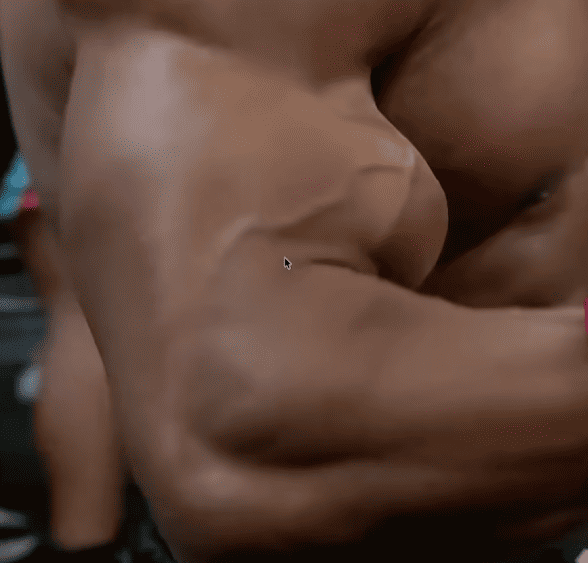
Most injuries like Wheels’ involve only the long head, leaving the short head still connected down to the elbow. That means some function remains intact.
This is where Sutterer’s most notable claim comes in.
“This is actually something like he could have continued competing. I mean, like, yeah, it’s going to hurt, but this isn’t like a dangerous, unsafe… this isn’t like a torn ACL, a dislocated shoulder. He very well could have continued competing if he really wanted to,” Sutterer said, adding, “I’m not saying he should have.”
Unlike distal biceps tears or ruptures of the pec, quad, or Achilles tendons, a proximal long head rupture is not automatically a surgical case.
“This is one of the few tendon ruptures in the body that you do not necessarily have to have surgery. And in fact, most patients do not have surgery for,” he said. Surgery may still be considered for cosmetic reasons or for athletes needing peak strength.
