
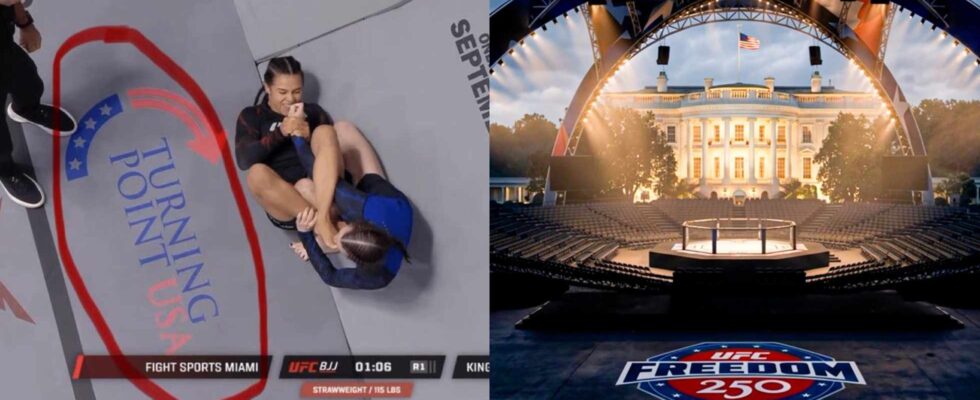
A screengrab spread across social media within minutes of UFC BJJ 10 airing on August 20. A wide still of the canvas, a giant Turning Point USA logo stamped across the mat, and a caption from journalist Andreas Hale that summed up years of frustration in a single line.
“When I try to tell people that combat sports has a way of making people like me feel unwelcomed and they say ‘Nah, you’re race baiting,’ I can just show them this,” Hale wrote.
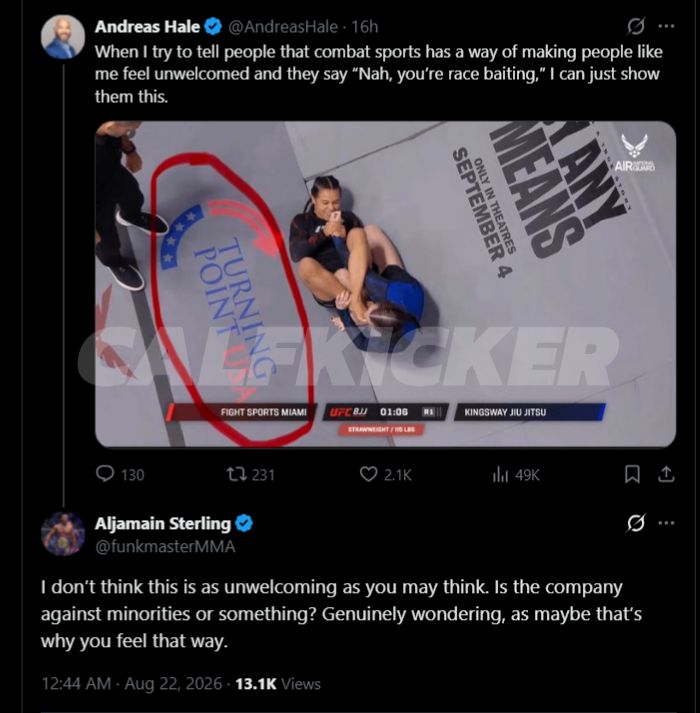
Former bantamweight champion Aljamain Sterling waded into the replies looking for a debate and found himself outmatched.
“I don’t think this is as unwelcoming as you may think. Is the company against minorities or something? Genuinely wondering, as maybe that’s why you feel that way,” Sterling posted.
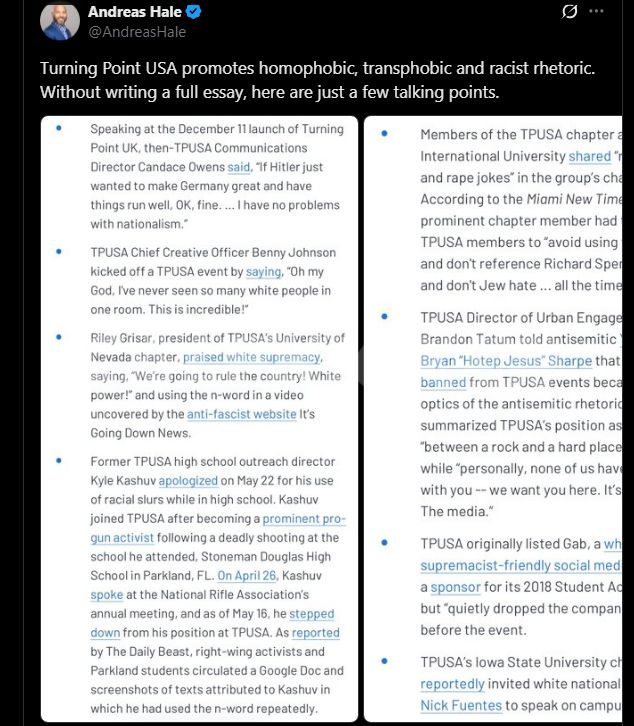
Hale answered with a rundown of Turning Point’s history, writing, “Turning Point USA promotes homophobic, transphobic and racist rhetoric. Without writing a full essay, here are just a few talking points,” before attaching a list of incidents tied to the organization’s chapters and staff over the years.
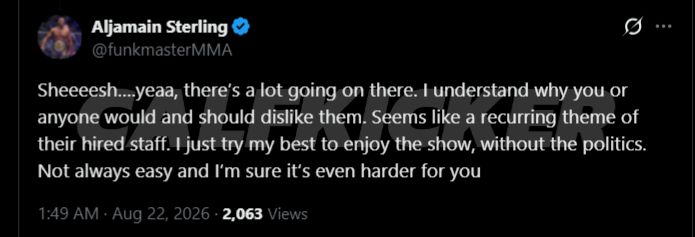
Sterling’s follow-up read less like a rebuttal and more like a concession. “Sheeeesh….yeaa, there’s a lot going on there. I understand why you or anyone would and should dislike them. Seems like a recurring theme of their hired staff. I just try my best to enjoy the show, without the politics. Not always easy and I’m sure it’s even harder for you,” he wrote.
The exchange framed the logo as some kind of new development, a fresh line UFC had crossed. It wasn’t. Turning Point’s own account pushed back on that read once the screengrab started circulating, noting that the arrangement had been locked in months prior.
According to sources, Charlie Kirk himself had gone on Fox News to announce it while he was still alive, a detail that barely registered at the time and only resurfaced once the canvas branding put it in front of a much wider audience.
That earlier chapter traces back to a UFC card in New York City, where Turning Point wasn’t just a sponsor but a presence on the ground. Benny Johnson, the organization’s chief creative officer, described the scene to Fox News host Lawrence Jones after his team handed out thousands of branded shirts outside Madison Square Garden to honor Charlie Kirk.
Johnson said the shirts were gone within an hour, claimed officers from the NYPD were grabbing them by the handful, and framed the giveaway as a statement about what he called freedom being alive and well in America. Whatever one makes of the framing, the anecdote shows Turning Point’s UFC footprint was already established well before the BJJ 10 broadcast made it impossible to ignore.
It also lines up with a bigger storyline that had been building around UFC and the White House for most of the year. The organization staged its championship card as the centerpiece of Freedom 250, the sprawling celebration marking the 250th anniversary of the country’s founding.
Dana White teased the plan well in advance, telling an interviewer that “we’re going to have fig ht night next July for the White House lawn,” and joking about the lengths he’d go to secure a good seat. “I don’t ask for a lot of favors of the White House. Every so often I’ll ask for something,” he said, before adding that he planned to bring his wife and treat the request like calling in a marker. He compared the anticipated spectacle to boxing’s biggest historical nights, predicting “it won’t be the rumble in the jungle, it’ll be something in the swamp.”
The buildup got considerably less lighthearted once House Natural Resources Committee Democrats released a report examining how Freedom 250 came together. Investigators alleged that organizers built what the report called a shadow organization after the official America 250 commission resisted pressure to make the anniversary about President Trump specifically.
According to the findings, that resistance led Trump allies to stand up a separate entity, Freedom 250 LLC, to run the celebration on their own terms, reportedly selling sponsorship packages priced between $500,000 and more than $10 million, some of them tied to access connected to the president.
Rep. Jared Huffman (D-Calif.) did not mince words describing what investigators found. He said organizers went through “a very elaborate set of machinations” to pull resources away from the official commission, accusing the group of “mixing taxpayer dollars and sketchy private donations” while keeping their operations away from public view. Asked who came out ahead, Huffman didn’t hesitate. “They profited from it,” he said, calling the arrangement “a feeding frenzy.”
The commercial side of the event matched the scale of the allegations. UFC’s White House card was built around a partnership between White and the Trump Organization, now run by Donald Trump Jr. and Eric Trump, which produced a commemorative coin line branded as the Trump Coins x UFC Freedom 250 collaboration and sold through realtrumpcoins.com.
The four medallions, two in silver and two in gold, all carry a PF 70 grade, the top mark in numismatic collecting, with prices running from $289.99 for a 1 oz silver piece up to $11,999.99 for a 1 oz gold piece.
Reporting also indicated organizers auctioned off leftover items from the event’s press conference, including name placards and signage that would ordinarily be tossed out, repackaging them as keepsakes tied to the anniversary. Some musicians who had been attached to the lineup reportedly stepped away once they learned more about how the event was being run.
Huffman summarized their reasoning plainly: “When the musicians found out it was a MAGA-aligned political operation, they wanted nothing to do with it.”
That backdrop is part of why the BJJ 10 canvas hit as hard as it did. MMA analyst Luke Thomas has spent recent months describing a steady drift among the fan base, one he attributes directly to the promotion’s political direction.
Speaking with Reese Waters, Thomas said the messages he receives from longtime viewers have become impossible to ignore. “I cannot tell you how many people have written me to tell me that they’re leaving the sport. They can’t take it anymore. They’re done,” he said.
Waters pointed to a specific tipping point, the moment political figures started appearing octagon side during broadcasts. “Once you start to bring not the president, but a candidate into events and parade him, you know, octagon side. Well, you’ve said f**k you to every fan that you may have had that has a difference of opinion… You’ve told me how you feel about me as a fan,” Waters said.
Thomas traced the shift back to the pandemic era, arguing the promotion consciously narrowed its target audience rather than continuing to chase the broadest possible viewership. “They basically said… we’re going to be kind of like a lifestyle brand. We’re going to be a brand for a certain kind of demo,” he explained, describing it as a deliberate trade of reach for loyalty among a smaller core.
He also pointed to viewership softness in markets including Russia, Brazil, and the United States, questioning how sustainable the current strategy looks even against the backdrop of UFC’s $7.7 billion media deal.
Seen against that timeline, the Turning Point branding on the BJJ 10 canvas wasn’t a sudden escalation so much as the most visible marker yet of a relationship that had been taking shape since before Freedom 250 ever aired. The coins, the sponsorship packages, the shirts outside Madison Square Garden, and now the logo under competitors’ feet all point to the same arrangement, just at different stages of public awareness.
