
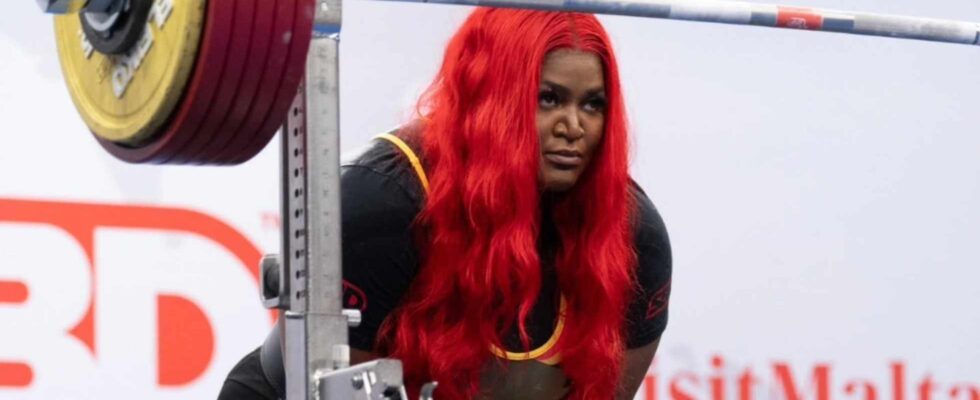
For five weeks, Sonita Muluh believed it was an accident. Now she is at the center of a criminal investigation, an international controversy, and a larger conversation about what it means to be a Black athlete in a sport that, until recently, considered itself above such tensions.
Muluh, 29, is a Belgian champion of Cameroonian descent and one of the most decorated powerlifters in the sport. In June, she traveled to Lithuania for the Powerlifting Championships with a specific goal: to squat approximately 738 lbs (334.5 kg), a weight no woman had ever successfully lifted in competition.
She did not get the chance. During her attempt, Ernestas Kusinas, a volunteer spotter positioned to help monitor the validity of the lift, made contact with the barbell using his knee. The attempt was ruled invalid.
Judges then disqualified Muluh on a separate technical infringement and denied her a reattempt. She left the competition without the record and without so much as an apology from the man who had been standing beside her.
“He did not reach out afterwards to apologise, but he is not obliged to. I thought it was a human mistake, that cost me a lot on the day. But there was no hatred from me. I didn’t lash out; didn’t curse at him. There was a video of it posted afterwards and I said: ‘I hope he does not get h*te.’ I believed it was an honest mistake.”
Then, five weeks later, Kusinas posted on Instagram: “I am racist, and I did it intentionally.”
“It’s sh*cking to wake up five weeks later and it’s all over the internet that he did it on purpose because of the colour of my skin,” Muluh told BBC Sport.
The post set off a sequence of consequences. Lithuanian police launched a criminal investigation, examining both the Instagram message and the events at the championship. A police spokesperson told Reuters the case carries a maximum penalty of two years in prison.
Kusinas has since sought to reframe his words, telling Reuters the post was written in anger after an unidentified social media user accused him of racism, and that it was intended as sarcasm rather than an admission.
The Lithuanian Powerlifting Federation was not persuaded. It issued him a lifetime ban and addressed the situation in a statement: “We would like to address the situation that unfolded on social media. We reviewed available information relating to Ernestas Kusinas and were deeply sh*cked by the views and activities addressed publicly which contradict the principles we stand for. The federation takes full responsibility for addressing this matter.” His social media accounts have since been switched to private.
For Muluh, the danger had never been theoretical. A spotter who interferes with a barbell loaded to 738 lbs (334.5 kg) is not a minor distraction. It is a genuine threat to an athlete’s physical safety.
“I feel unsafe and uneasy that this person is standing beside me with massive weight, with what can go wrong, with the amount of weight on your back. I was lucky when I realised [it hit his knee] and I could stabilise it. Not everyone could. It was the heaviest ever squat for a female.”
Kusinas told Reuters separately that his contact with the equipment was unintentional, a byproduct of fatigue after a long day of event duties. The explanation is difficult to square with his own public statement.
Muluh’s account of the atmosphere in Lithuania extended well beyond her individual lift. She described an environment in which Black athletes were made to feel unwelcome long before reaching the competition platform.
“People looked down on us in Lithuania in a very disgusting way. When I competed in Poland someone sneezed in my face at the airport. Some black athletes are booed in competition, we have to worry about our skin colour while competing.”
She also directed sharp criticism at the International Powerlifting Federation, arguing that the organization moved only once the story became widely known.
“I feel like the federation needs to do background checks. If you are going to put my life in someone else’s hands, at least make sure that person is well equipped to be able to protect me or keep me from harm. But they failed me [through] negligence and putting my life in danger.”
On Kusinas’ attempt to reframe his post as a joke, she was equally direct.
“[Kusinas] doubled down in his racist behaviour [afterwards]. Only now is he saying it was a joke. There’s nothing jokey about any of what he said. He put my life in danger. Nobody spots like that, with their knee. It’s never going to feel justified… I trained through injuries just to prepare. I’ve put my body through a lot for this to happen. There’s never going to be any real justice.”
The IPF issued a formal condemnation: “The IPF unequivocally condemns racism, discrimination, and h*teful conduct in all its forms. Such behaviour has no place within the IPF or the global powerlifting community.” The federation also announced plans to improve how volunteers are recruited, screened, and supervised at future events.
The silence from established names in the sport has not gone unnoticed.
“Powerlifting has been a very supportive niche sport, so far. But who is standing up for athletes against racism? This situation has changed my view a lot. There’s a lot of people who didn’t speak out about it. A lot of big names didn’t say a word about it. They didn’t reach out to me. All the black athletes reached out, so we all supported each other.”
For Muluh, the path forward requires concrete institutional action: a governing body that properly vets the people it places beside athletes bearing hundreds of pounds, and one that does not wait for public pressure before taking responsibility.
“I hope [the IPF] do things differently, that they consider the safety of athletes more and especially minority people. I feel that’s what has been missing. We have been made to compete in places we didn’t feel welcome.”
