
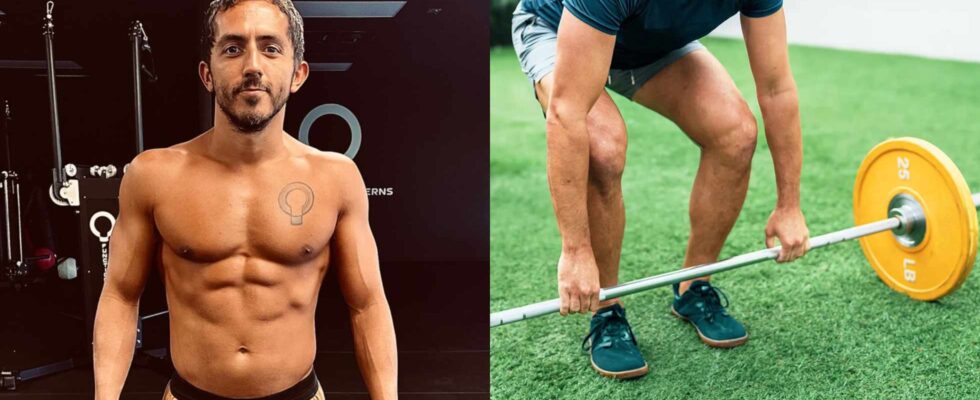
A fitness influencer has sparked controversy after declaring that squats and deadlifts are useless for athletic performance, prompting a sharp response from Dr. Layne Norton.
Naudi Aguilar, known for promoting functional patterns training, recently stated that his argument against deadlifts and back squats is straightforward: there is no long-term data backing them.
While he concedes these exercises can make someone contextually stronger, he questions how transferable that strength actually is, claiming the answer is “not much.” His solution involves doing something else in the gym, provided the alternative doesn’t compound imbalances.
Dr. Norton wasted no time dismantling these claims. “Allow me to translate. I am weak at squats and deadlifts and I don’t want to do them,” Norton said, taking direct aim at Aguilar’s reasoning.
Norton pointed to substantial evidence showing that people who perform squats and deadlifts jump higher, run faster, and often demonstrate better performance in sports.
The critique extended to the lack of evidence supporting alternative methods. Norton questioned what proof exists that unconventional movements with light weights and cables actually transfer to athletic performance. He emphasized a fundamental principle: contractile tissue is contractile tissue.
Sport-specific movements in the gym are not necessary for strength to transfer to athletic performance. When athletes develop stronger quadriceps, hamstrings, glutes, arms, back, and chest while continuing to practice their sport-specific skills, they will perform better.
Norton also addressed common concerns about injury risk associated with heavy lifting. He noted that resistance training actually decreases lower back pain over time when loaded progressively and performed properly.
Responding to critics who point to his own injuries, the 44-year-old acknowledged that high-level athletic performance naturally involves some injury risk. He noted that what the body can recover from and what might cause injury exist close together on the spectrum.
“They keep saying I’m going to be in a wheelchair, that I’m going to be frail. Well, guys, you’ve been saying this for 10 years. I’m 44 and I’m stronger than I was 10 years ago and have less pain,” Norton stated.
