
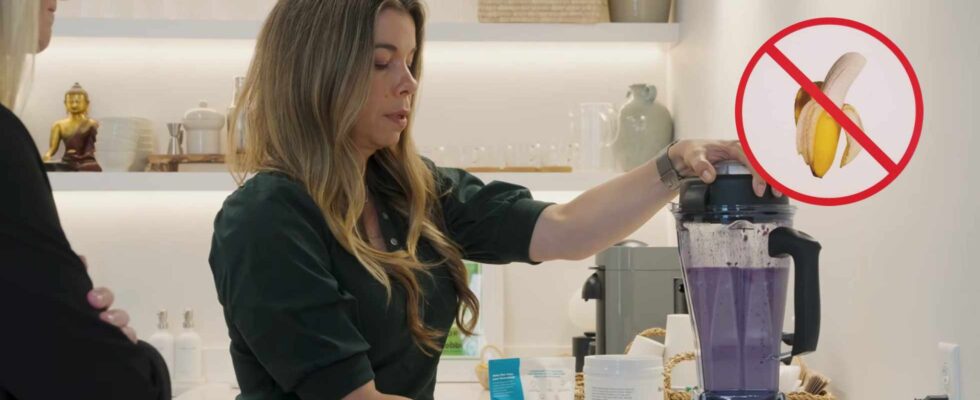
If you have been blending bananas into your blueberry smoothies, Dr. Rhonda Patrick has some news that may change your morning routine. The cellular and molecular biologist, known for her research on nutrition, aging, and longevity, recently demonstrated her daily smoothie recipe and explained why bananas are the one ingredient she deliberately leaves out.
During a live demonstration, Dr. Patrick revealed that bananas contain an enzyme called polyphenol oxidase, and that enzyme actively breaks down the polyphenols found in blueberries.
Studies have confirmed that adding bananas to blueberries significantly reduces the polyphenol content of the final blend. “If you add bananas to blueberries, you’re not getting as many polyphenols. In fact, it’s quite a bit lower,” she said.
This matters because polyphenols, specifically the anthocyanins found in blueberries, have been shown in randomized placebo-controlled studies to improve cognition in young adults, older adults, and those with mild cognitive decline. One cup of blueberries per day has demonstrated measurable cognitive benefits, making the loss of those compounds a real nutritional concern.
For those who rely on bananas to give their smoothie a creamy texture, Dr. Patrick has a direct swap: half an avocado. Beyond replicating the consistency that bananas provide, avocado brings its own science-backed benefit. The monounsaturated fat in avocado has been shown to increase the bioavailability of lutein and zeaxanthin, two carotenoids found in kale, by fourfold.
“Getting rid of the banana makes it where you’re getting all the polyphenols from the blueberries, and then adding the avocado gives you the creaminess, and it helps you super power and get those carotenoids that are in the kale,” Dr. Patrick explained.
Her daily smoothie builds from that foundation. Three cups of kale supply lutein for eye and brain health, along with magnesium, calcium, and vitamin K. Two and a half cups of frozen organic blueberries deliver the anthocyanins she is careful to preserve.
She also adds optional whey protein powder for days when meals are sparse, targeting a daily intake of around 1.2 to 1.6 grams per kilogram (approximately 0.54 to 0.73 grams per lb) of body weight. A newer addition to the recipe is a beta-glucan powder derived from barley, a prebiotic fiber she began including after studies showed it could lower LDL cholesterol and help reduce levels of PFAS, the so-called forever chemicals that can persist in the body for two to five years.
Dr. Patrick also flagged one practical concern during the demonstration: plastic blenders may shed microplastics due to friction during blending. She recommends switching to a glass or metal blender where possible.
