
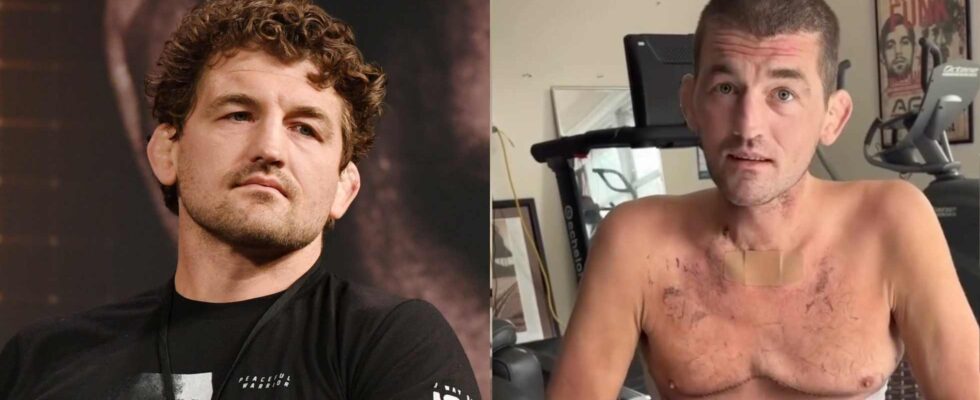
Ben Askren sat down with Chris Williamson on the Modern Wisdom podcast to discuss his double lung transplant, the road to recovery, and the statistics that come with the procedure. While he acknowledged the reality of the numbers, the former UFC star made it clear that he doesn’t believe they define his future.
Askren began by addressing the average survival rate for double lung transplant recipients.
“The median life expectancy is only six and a half years, which isn’t long,” he said.
Despite that statistic, Askren explained why he believes his circumstances are different from the typical transplant patient.
“A lot of them are older, unhealthy,” he said, pointing out that the data largely reflects patients with health profiles far removed from his own. Before the infection that led to his transplant, Askren had spent years competing as an elite athlete and had never smoked.
Williamson summed up the distinction, saying, “An ex-professional athlete who didn’t get it because he was smoking and was like in the midst of some of the best health of his life.”
Askren agreed, confirming that was exactly how he viewed his situation.
He then explained that the lower life expectancy isn’t solely because of the transplanted lungs. Instead, much of the long-term risk comes from the treatments patients must take to prevent organ rejection.
“When you destroy your immune system, you cause a whole bunch of other problems,” Askren said. He added that immunosuppressant d**gs are “a decent portion of the reason why life expectancy is not that high.”
Askren revealed that he currently takes prednisone and tacrolimus, treatments he expects to remain on for the rest of his life unless medical technology advances enough to provide another option. As more time passes following the transplant, his doctors have gradually reduced his dosage, something he said has noticeably improved his energy levels.
Rather than accepting the average survival rate as his ceiling, Askren has set his sights on something much bigger.
“The longest living person post double lung transplant is 38 years. So that’s kind of my goal. It’s 39, at least 39,” he said.
Reaching that milestone would put him at roughly 80 years old.
Askren also expressed optimism about future breakthroughs in regenerative medicine. He believes stem cell technology could eventually provide transplant recipients with organs grown from their own cells.
“They’re already starting to build organs with your own stem cells,” he said.
If that technology becomes widely available within the next 15 to 20 years, Askren said he would gladly undergo another transplant using organs created from his own stem cells. Doing so, he believes, would eliminate the need for lifelong immunosuppressants, removing one of the biggest obstacles to long-term survival.
His willingness to embrace new treatments is something he has already communicated to his doctors.
“You got any ideas that you think are going to work? Run them by me, because you’re not going to find anyone more disciplined, and I’m down for it,” Askren said.
Rather than viewing the six-and-a-half-year median as a prediction, Askren sees it as a baseline built from patients whose circumstances differ significantly from his own. His focus remains on taking his medication, continuing his breathing exercises, minimizing exposure to illness, and steadily improving his physical condition.
“My plan is to be the longest living double lung transplant person ever,” Askren said. “That is my goal.”
