
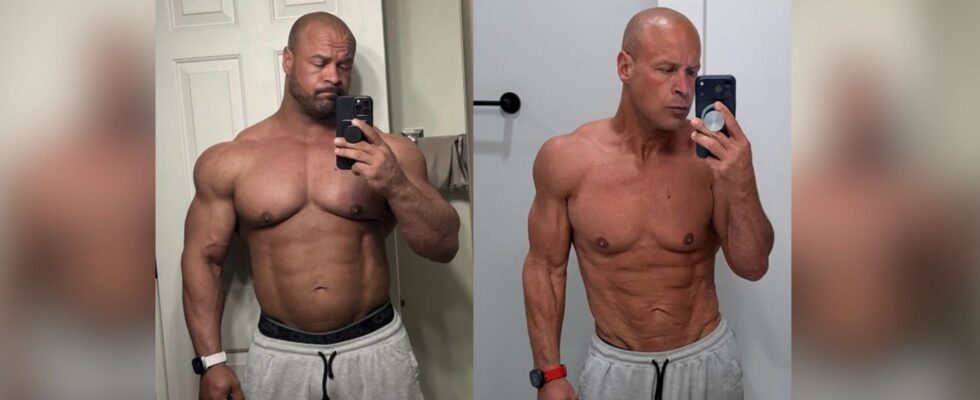
Chase Irons was once one of the most massive physiques on the internet, tipping the scales at 270 lbs (122 kg) while running what he described as up to 10 grams of gear per week.
Three years later, he weighs 200 lbs (91 kg) and looks like a different person entirely. The before-and-after photos have sparked significant debate online, but fitness coach Greg Doucette argues the transformation is cause for celebration, not criticism.
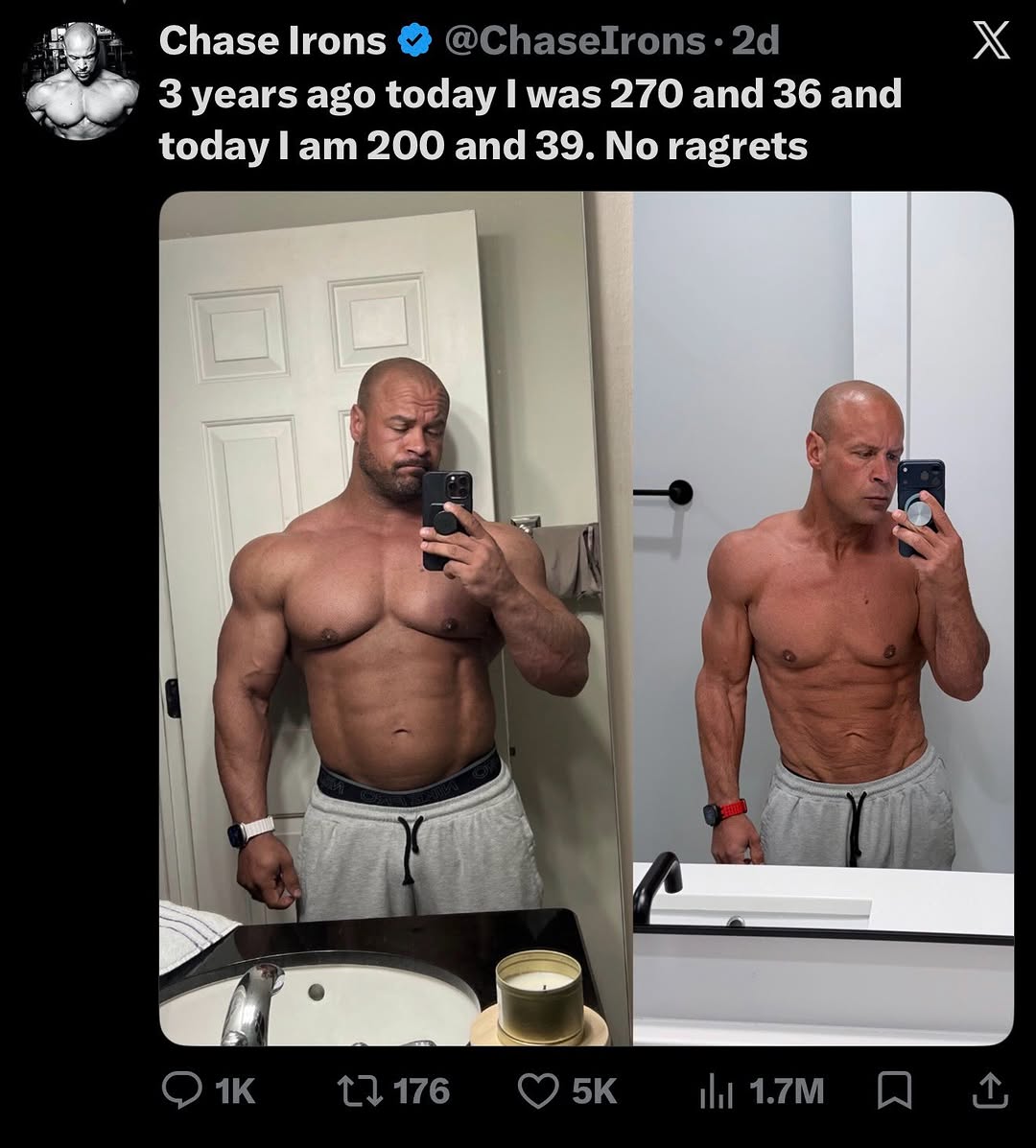
“If I just showed you this photo on the right and never told you anything about him whatsoever, you would say he has an amazing physique,” Doucette said in a recent video. “He’s shredded. He’s got abs. He’s got muscles. He looks amazing, but in comparison to the photo on the left, he looks like he’s lost a half of a person.”
That half a person amounts to roughly 70 lbs (32 kg) of muscle, shed over three years as Irons stepped down from blasting to a TRT dose of 250 mg per week. He reports his testosterone levels currently sit around 1,000 ng/dL. Doucette, who himself transitioned off blasting in his 40s, sees the move as overdue but commendable.
The online reaction has been predictably harsh in some corners, with comments calling it a “downgrade” and comparing Irons to a melting ice cream cone. Doucette pushes back on that framing directly.
At 5’10” (178 cm) and 200 lbs (91 kg) of lean mass, Irons is by any reasonable standard still a large, muscular man. The distorted perception, Doucette argues, is a direct consequence of years spent at an unnaturally inflated size.
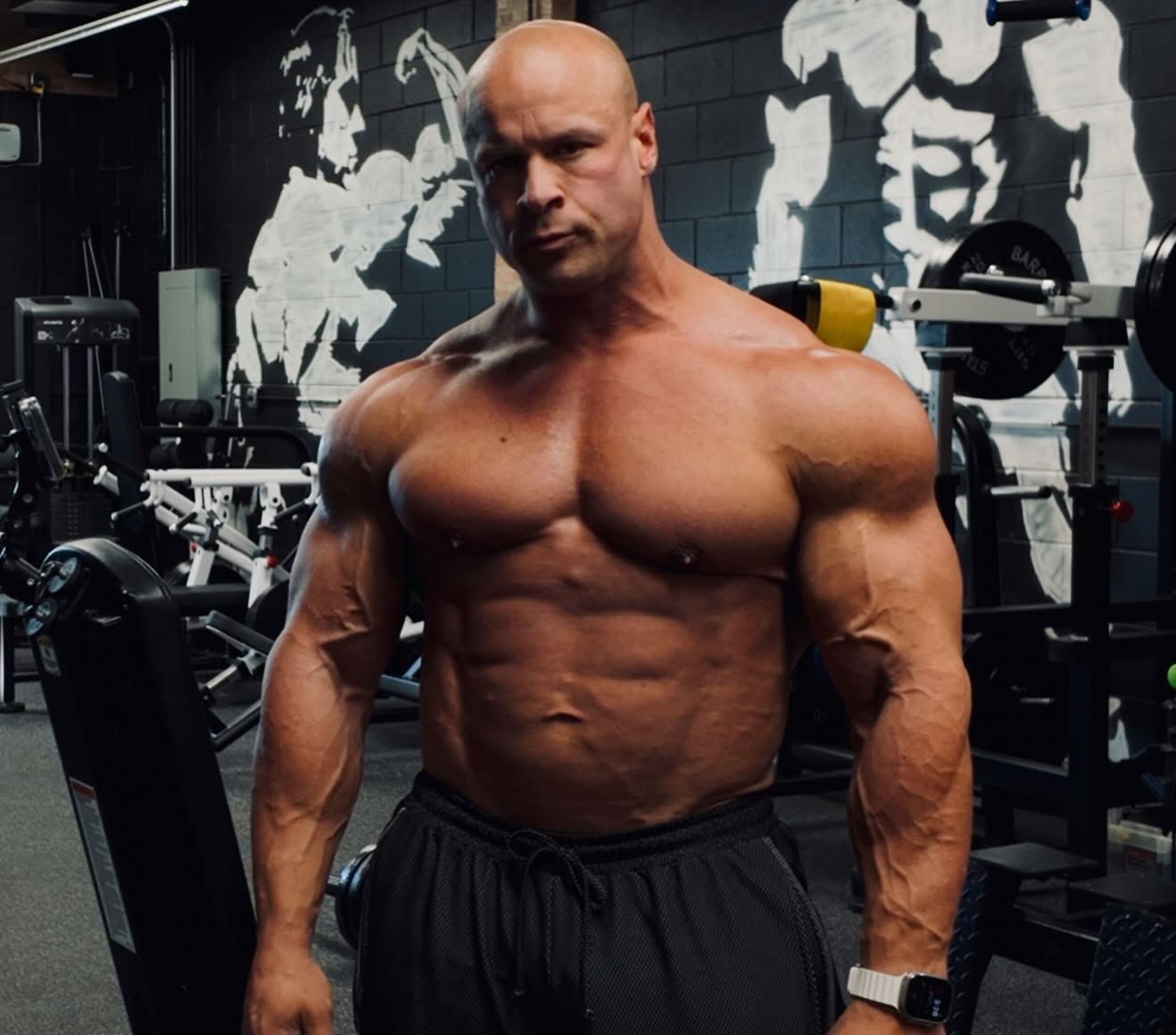
He said, “Don’t do roids in the first place because if you do, you’re always going to remember that bar. The bar was moved so high up, you can never keep that standard.”
One unavoidable side effect of the transformation is the appearance of loose skin and a somewhat older look. Doucette explains this is simply physics. When large muscles deflate, skin that was once stretched taut has nowhere to go.
He said, “I would rather him look older, which admittedly he does, but to be younger on the inside. Imagine how much younger his heart feels, not having to pump blood to 270 lbs (122 kg) and now only 200 (91 kg).”
Irons himself has framed the change in straightforward terms.
“My goal is to get back to a natural size,” he said, noting that TRT is “holding me effortlessly right now here at 200.”
He started training at 160 lbs (73 kg) at age 23, meaning he has still added 40 lbs (18 kg) of muscle over 15-plus years, a legitimate and impressive natural-range result that gets overshadowed by his previous peak.
Doucette’s message is aimed at younger athletes who see the current generation of mass monsters and feel compelled to follow.
“Eventually that desire to be the biggest, the strongest, it doesn’t outweigh your desire to live,” he said. “Don’t let your physique be the most interesting thing about you.”
