
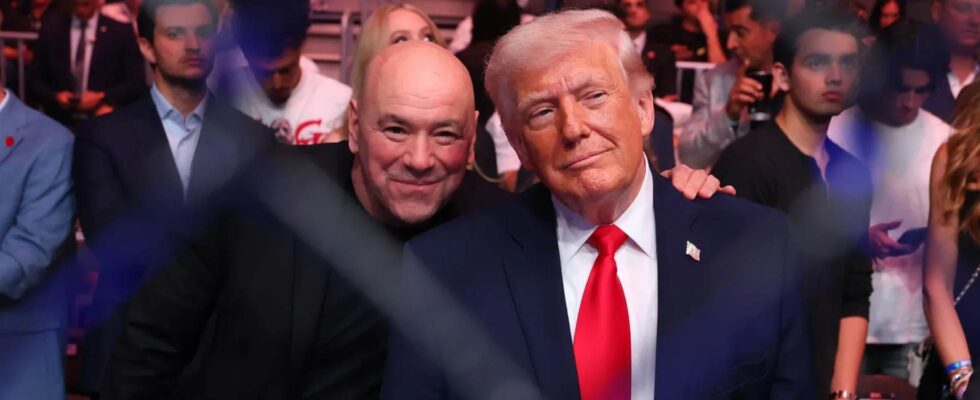
At Republican National Conventions, Dana White has repeatedly delivered an emotional speech about how Donald Trump helped save the UFC during its most difficult years. According to White, when athletic commissions refused to sanction the sport and arenas would not host events, Trump was one of the few people willing to take a chance on mixed martial arts.
It is a compelling story, but veteran MMA journalist Luke Thomas argues that the historical record does not support it.
Speaking on the Pablo Torre Finds Out podcast, Thomas pointed to what he sees as a glaring inconsistency. If Trump’s role in the UFC’s survival was truly as important as White now claims, why was it never mentioned publicly for years?
“If you can find an article in the media prior to 2016 of Dana White acknowledging in any circumstance whatsoever the role that Donald Trump played in helping their business, I would love to see it,” Thomas said.
He then emphasized just how closely he followed the sport during those years, adding, “I lived in it. It doesn’t exist.”
The timing, Thomas suggested, is difficult to ignore.
Trump launched his presidential campaign in 2015 and became a dominant political figure in 2016. According to Thomas, that is also when the narrative about Trump’s importance to the UFC began to emerge publicly.
Before then, White was constantly appearing in interviews and media coverage throughout the 2000s and early 2010s, especially after the UFC secured its landmark television deal with Fox in 2011. Yet, Thomas says Trump’s role was never part of the conversation.
Perhaps the strongest piece of evidence comes from filmmaker Bobby Razak, who has spent years documenting the history of mixed martial arts.
Razak uncovered footage from around 2009 in which White was asked about wealthy figures attempting to enter the fight business. Rather than describing Trump as a key supporter or benefactor, White lumped him together with other outsiders who lacked an understanding of the sport.
“You got the Trumps, Cuban, t-shirt guys, whoever it is that have some money that want to get into it,” White said in the clip.
The comment stands in stark contrast to the praise White would later offer Trump on national political stages, where he described him as a crucial figure in the UFC’s early survival.
For Thomas, the UFC’s rise can be explained without placing Trump at the center of the story.
“Let me be as clear as I possibly can,” Thomas said before addressing the claim directly. “Donald Trump plays absolutely no role in any of it.”
Thomas was referring to the UFC’s major growth periods, including the success of TUF, the rise of Ronda Rousey, and the superstar era of Conor McGregor. In his view, the narrative portraying Trump as a foundational UFC figure was created much later because it became politically and financially advantageous for both men.
The context, Thomas argues, only reinforces that interpretation.
Today, the UFC is preparing to stage an event on the White House lawn. The promotion has entered a memorandum of understanding with the State Department under Marco Rubio, and the sitting president owns stock in TKO, the UFC’s parent company.
The company is also selling commemorative coins, while site fees from foreign governments have long influenced where UFC events are held around the world.
Given those realities, Thomas believes it is a mistake to treat promoters as objective historians.
