
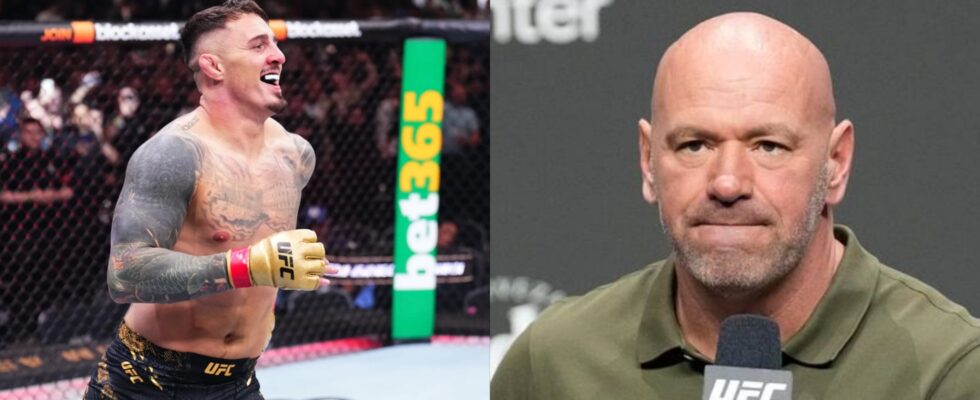
UFC heavyweight champion Tom Aspinall sat down on a podcast with Tony Bellew and talked about the pay in the UFC, explaining when he first began questioning the financial structure of the sport and what ultimately matters most to him.
Speaking about the financial reality of being sidelined through injury, Aspinall made it clear that time away from competition comes with a serious cost.
“If you’re not competing, you’re not earning,” Aspinall said. “So like I’m not sitting here for fun. I’d love to be competing. I love to be on these big cards and these big nights.”
He added that competing at the highest level was always the goal from a young age. “I didn’t work since I was 10 years old to sit on the sideline,” he said.
When Bellew asked at what point he began thinking differently about compensation, Aspinall explained that money was never his primary motivation during his rise through the UFC ranks.
“To be honest, it’s hard because I was always focused on just being the best in the world,” Aspinall said. “That’s what I wanted to do. I wanted to get in and show everybody and show myself as well.”
He said his drive came from proving himself as an athlete above all else.
“Mainly the best fig hter in the world. I am better than everybody else,” he said. “That’s what I wanted to do.”
Aspinall explained that his perspective only began to shift after spending more time around professional boxers and seeing the financial gap between the two sports.
“I never really thought about it much until this boxing thing started and then started being friends with boxers and stuff,” he said. “And then I’m like, ‘Oh, like they are making a lot more money than we are.’”
Still, Aspinall emphasized that his concerns are more about respect than chasing massive paydays.
“But I’m still not like hung up on the money thing,” he said. “It’s more like I think you should be respected financially. It’s not about like making tens of millions and stuff like that.”
He said the sacrifices fig hters make should be reflected in how they are compensated.
“It’s more about like this is what I put my body through,” Aspinall said. “I want respect for me and my family because of it.”
Despite acknowledging the pay disparity, Aspinall insisted wealth has never been the driving force behind his career.
“By no means am I like money hungry or anything,” he said. “For me, it was always to be the best. That’s what I wanted.”
The conversation also turned to the long-discussed matchup with Jon Jones that never materialized. Aspinall said the matchup represented something much bigger than money or personal rivalry.
“All I wanted to compete Jon Jones for was to prove that I’m the best,” Aspinall said. “That’s it. That’s all I wanted.”
He stressed there was never any personal animosity attached to the potential bout.
“Never anything personal,” he said. “It wasn’t about money. It was about nothing. I just wanted to fig ht the best ever, but I didn’t get the chance.”
Even with financial considerations becoming more important as his career progresses, Aspinall said his core ambition remains exactly the same as it was when he was a child.
“My goal was always and it still is, the goal hasn’t changed,” he said. “I am the best heavyweight in the world, right? And I’ve been wanting to say that since I was 11 years old.”
Bellew, listening throughout the interview, summed up the broader issue surrounding UFC pay. Referencing reports that Aspinall could earn around one million dollars for his next match, Bellew argued that figure still falls far short of what a champion at Aspinall’s level generates for the promotion.
“In Tom’s profession, it is so far off the mark,” Bellew said. “It is truly frightening. It’s actually borderline sad.”
