
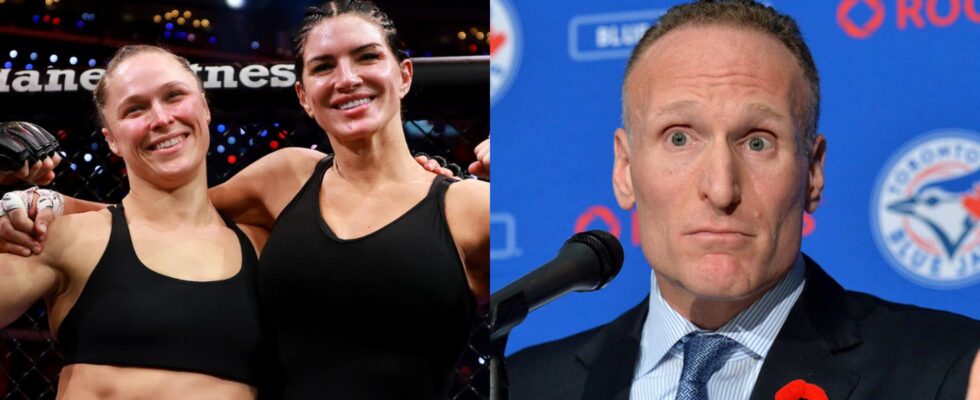
TKO President and COO Mark Shapiro appeared at the JP Morgan Global Conference this week and addressed the Ronda Rousey vs. Gina Carano matchup that ultimately aired on Netflix. He portrayed UFC’s decision to pass on the matchup as a move made in the best interest of MMA.
Speaking at the conference, Shapiro explained why UFC declined to move forward with the matchup.
“It was pitched to us beforehand and we did turn it down,” Shapiro said. “That’s to take nothing away from it. That’s to take away from Netflix. When we looked at this potential matchup, keep in mind that there’s a real art and skill to matchmaking.”
He went on to say that both Dana White and Hunter Campbell believed the matchup would be extremely one-sided.
“When you ask Hunter Campbell and Dana White what they think about that matchup prior to the fight happening, the answers we got back, and I mean Ari Emanuel and myself, was that match will be over in 20 seconds,” Shapiro said. “They were off by a few seconds.”
Shapiro also argued that the outcome of the bout could have reflected poorly on MMA, particularly because of Netflix’s massive audience.
“I don’t believe that a match like that, just the way it played out, is really good for MMA because, especially because it’s Netflix and they have such an incredible global audience, for them to then go to that match and then think that’s what MMA is, I don’t believe is good for the sport long term,” he said. “For us, it was more of a stunt than a meaningful MMA event.”
That explanation drew an immediate response from veteran journalist Dave Meltzer of the Wrestling Observer, who disputed the idea that UFC rejected the matchup on principle. According to Meltzer, UFC was actively interested in promoting the matchup before negotiations fell apart.
Meltzer pointed out that Dana White had publicly hyped the proposed matchup in late 2024, saying, “you would never believe the match that fell into our lap” after hearing about the potential matchup.
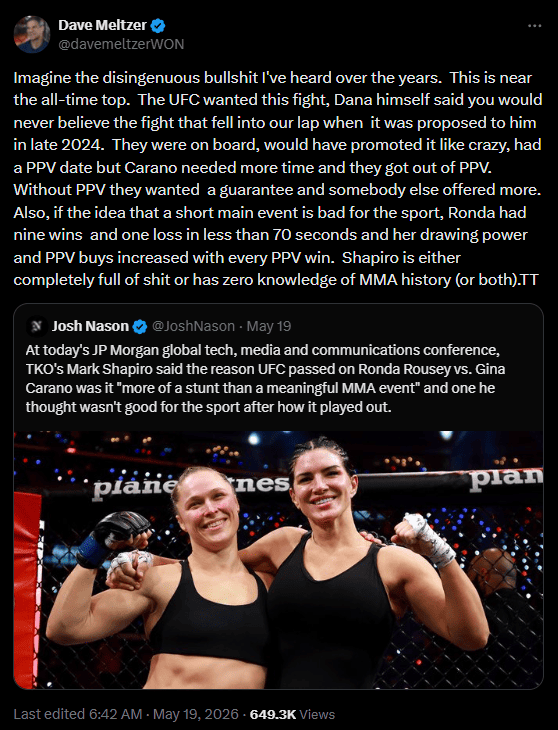
According to Meltzer, UFC fully intended to promote the bout and even had a pay-per-view date attached to it. He explained that the deal only unraveled because Gina Carano needed additional time to prepare, which pushed the bout away from the original PPV window.
Once that happened, Carano’s side reportedly sought a financial guarantee, and another party eventually outbid UFC for the event.
Meltzer also pushed back on Shapiro’s argument that a quick finish would be damaging for the sport. He noted that Rousey built much of her star power on dominant, rapid victories.
Rousey had nine wins and one loss in her MMA career, with most of those victories ending in under 70 seconds, yet her pay-per-view numbers consistently increased throughout that run.
Meltzer further highlighted the success of the Netflix event itself, noting that it reached the top of Netflix’s movie rankings in the United States, Canada, and Mexico on Saturday. By Sunday, it remained number three in the United States and number two in Canada. In contrast, he added that UFC posted a record low rating on Paramount that same weekend, finishing 13 percent below what a comparable card would normally draw.
Rousey also weighed in on the situation through Ariel Helwani, criticizing the direction UFC has taken since moving deeper into the broadcasting era.
“Once UFC moved into the broadcasting model, it’s just not about putting on the best matches possible anymore,” Rousey said. “Dana is legally beholden to the shareholders and to maximize shareholder value. Unfortunately, now that they’ve taken the reins of the company away from Dana, it’s barely recognizable now.”
With those details now public, Shapiro’s framing of the situation as a principled decision to protect the integrity of MMA appears difficult to reconcile with the documented timeline of how the deal actually came apart.
