
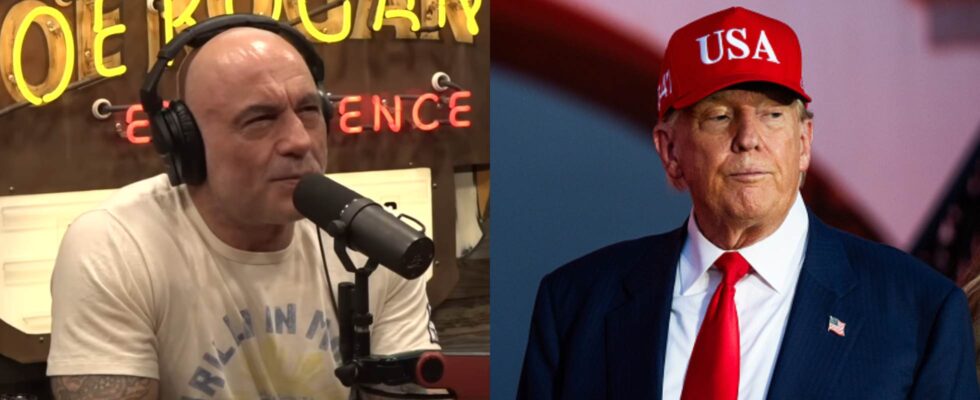
For weeks, Joe Rogan has been vocal about what he sees as one of Washington’s most brazen ethical failures: the ability of elected officials to trade stocks while sitting on committees that give them access to information the general public will never see.
His criticism has been pointed, his targets largely Democratic. Yet freshly released financial disclosures have surfaced a trading story that dwarfs anything Rogan has discussed on air, and the account at the center of it belongs to a Republican.
According to sources, newly filed documents submitted to the US Office of Government Ethics reveal that Donald Trump’s accounts logged somewhere between $220 million and $750 million in transactions during the first three months of 2026, spread across more than 3,600 individual trades.
To put that in perspective, it represents roughly twenty times the volume of trading activity that has fueled the congressional ethics conversation.
The filings show significant positions built in major technology and semiconductor companies, including Nvidia, Apple, Intel, Broadcom, and Boeing, with individual purchases reportedly falling between $1 million and $5 million each. On the sell side, positions in Microsoft, Amazon, and Meta were each valued between $5 million and $25 million.
The timing of several transactions has drawn particular attention. Nvidia shares were reportedly purchased ahead of a strong earnings release. Apple investments appeared to coincide with public speculation around upcoming product launches. Trades involving Microsoft and Amazon aligned with new developments in artificial intelligence and cloud computing, while Boeing shares changed hands before Trump’s visit to China, where large aircraft agreements were widely anticipated.
The Trump Organization has maintained that all trading takes place through fully discretionary accounts managed by outside financial institutions. According to that account, neither Trump nor his family selects individual investments or receives advance notice before transactions are completed.
That defense has not quieted critics. The sheer volume of activity in sectors directly shaped by White House policy decisions, covering trade, defense spending, artificial intelligence, and semiconductor regulation, has deepened concerns about conflicts of interest even in the absence of any proven wrongdoing.
Reform advocates who have long pushed legislation such as the Restore Trust in Congress Act and various versions of the ETHICS Act to restrict or outright prohibit stock trading by lawmakers are now calling for those rules to extend to the president and vice president as well.
On episode 2495 of The Joe Rogan Experience, Rogan sat down with Tennessee Congressman Tim Burchett and spent a significant portion of their time together questioning why congressional stock trading remains legal at all.
Burchett opened by noting that he had liquidated his own $11,000 mutual fund and introduced legislation that would bar members of Congress from holding individual stocks. Rogan’s attention immediately went to the returns some of their colleagues have reportedly seen.
“Imagine the average person out there making $170,000, and all of a sudden they make a hundred million in the stock market,” Rogan said. “Like, how?”
Rogan also cited a Twitter analysis by a user named Kevin Bass that had examined the trading history of California Congressman Ro Khanna. Rather than single out one lawmaker, Rogan saw it as a symptom of something far broader.
“It’s just all over Congress,” he said. “You have inside information. That’s what it is.”
Burchett also pointed out that the trading is frequently not conducted under the member’s own name.
He said, “A lot of times it’s not them investing, it’s their wife or their spouse, and we’ve seen cases of that where the 16-year-old kid is doing pretty well. And it’s the child of someone who has some inside information.”
Burchett also recalled a conversation with an ethics attorney about his handmade skateboards. He had been told he could not sell them while serving in office.
“So you’re telling me I can do insider stock trading, but I can’t sell a dadgum skateboard?” Burchett told the attorney. “And the guy said, that’s correct.”
Rogan’s reaction was immediate. “The fact that you could have insider trading and you can’t sell handmade skateboards is ridiculous,” he said.
What Rogan’s conversation did not address was the possibility that the most active trader in American government might not be found in the halls of Congress at all.
With more than 3,600 trades logged in a single quarter, the disclosures surrounding Trump’s accounts have introduced a scale to the insider trading debate that Rogan never addressed during his conversation with Burchett.
