

Bryan Johnson recently shared his findings in order to highlight cautions about peptide use. Johnson documented his experience with CJC1295, a growth hormone secretagogue that stimulates endogenous growth hormone production, and the results were far from what many in the peptide community might expect.
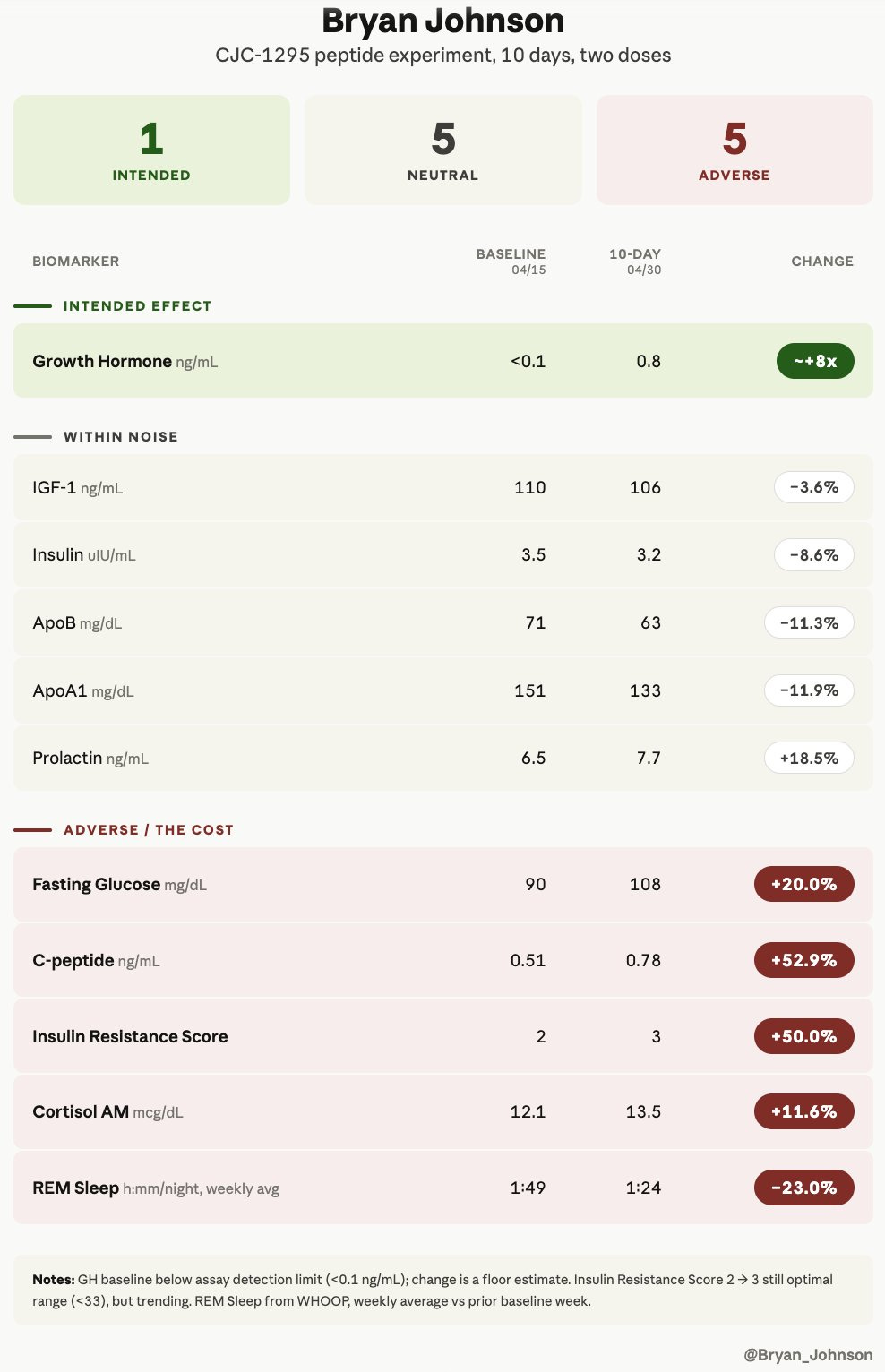
After extensive comparative lab testing, Johnson found that just two doses of CJC1295 produced significant negative biomarker changes. His fasted blood glucose rose by 20%, cortisol output increased by approximately 12%, and his REM sleep dropped by 23%.
Most alarming, his pancreas worked 53% harder and was still losing the battle with rising blood pressure on a daily basis. His insulin resistance increased by roughly 50% based on available biomarkers.
Reflecting on how severe the side effects became, Johnson wrote, “I stopped after two doses, without even reaching the intended target dose.” He also noted that the biomarker panel used in the experiment was limited, adding, “These were the most obvious side effects, and I only ran a very narrow panel for this experiment. So I’m sure there’s more.”
Describing the physical toll of the experiment, Johnson revealed, “48 hours after the first injection I was nearly comatose. It felt like severe jet lag, the type you’d feel after traveling nine time zones.” He added that his “sleep was wrecked” and that he “felt continuously awful” throughout the trial.
These were measurable, documented physiological changes after only two doses. That detail alone should prompt anyone considering peptide use to take a more careful approach.
Peptides are increasingly accessible through gray market channels, Discord groups, Telegram, and third-party websites sourcing products primarily from China. Standard certificates of analysis provided by these vendors typically only include HPLC testing, which measures purity percentage but cannot confirm whether the compound is actually what it claims to be. Liquid chromatography mass spectrometry testing, which measures molecular mass and compares it against a verified reference, is far more reliable but also far more expensive and rarely used by gray market suppliers.
This creates a compounding problem. A consumer may purchase a peptide believing the product is verified based on a purity number, when in reality the testing method used cannot confirm the compound’s identity at all.
Johnson’s experiment shows that even when a peptide is what it claims to be and used by someone with access to thorough testing and medical oversight, the compound itself can produce serious unintended consequences.
For the average person ordering from unverified online sources with no medical supervision, the risks are considerably greater.
