

Inside the forums, live video sessions, and comment sections where young men obsess over optimizing their appearance, a new fixation has taken hold: permanently changing the color of their eyes.
The subculture known as looksmaxxing, built around the relentless pursuit of male physical ideals, has increasingly turned its attention to a cluster of cosmetic eye procedures. Treatments like laser depigmentation has drawn the most intense interest among its members.
According to sources, looksmaxxing operates on the premise that attractiveness is a code to be cracked. Participants dissect facial geometry, chase specific body proportions, and debate which physical traits signal the highest social value.
Within these communities, light-colored eyes, particularly pale blue ones, occupy a near-mythical status. The desire to achieve them has pushed some members toward surgical options that most ophthalmologists would rather avoid endorsing as cosmetic treatments.
Three procedures have emerged as the main topics of conversation. Keratopigmentation, reportedly the only option legally available in the United States, alters the eye’s appearance by placing pigment into channels carved into the cornea.
Another option is iris implants, in which a thin silicone device is inserted inside the eye. Additionally, laser depigmentation works by destroying melanin in the iris, allowing lighter pigment tones beneath the surface to become visible.
This last option that has captured the community’s imagination, largely because of its promise to transform dark brown eyes into blue or gray ones.
Among the most prominent voices in the looksmaxxing world, an influencer known as Clavicular has spoken openly about his desire to undergo laser depigmentation.
He has said he wanted the procedure so he could “really mog” with light blue eyes, and has suggested it as an option for people with what he called “cooked” brown eyes.
In early 2025, he floated the idea of traveling to Barcelona to have the surgery, framing it as a “geomaxx,” or a trip abroad that combines self-improvement with lifestyle advantages.
“You can prob slay tons of hot chicks while ascending and living in a mog city,” he wrote in a forum post, adding, “I’ll do this eventually in my life.”
Clavicular’s interest in eye color traces partly back to a 4chan meme that spread in 2019 and became something of a foundational text in looksmaxxing circles. The meme arranged eye shades into a rigid hierarchy using color options drawn from a doll catalog, carrying openly racist undertones while positioning icy pale blue eyes at the very top. The lightest category, labeled A10, is treated as an almost unreachable ideal.
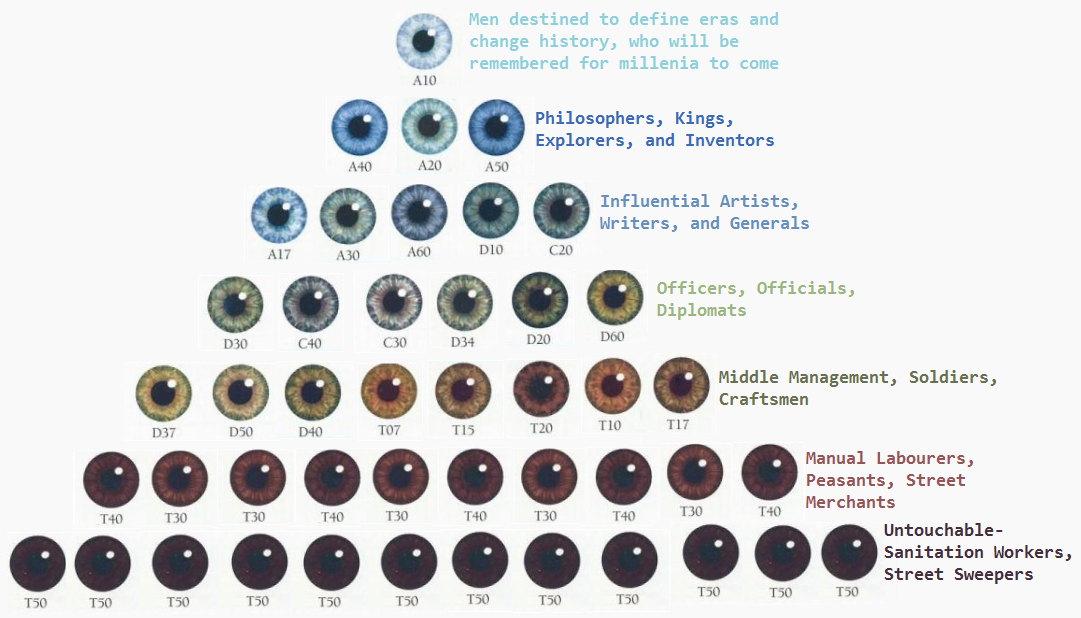
Clavicular has described the experience of encountering a woman with vivid blue eyes as genuinely arresting. “What makes someone’s coloring good is how striking they look and how their features contrast with each other,” he said. “So, having blue eyes and super-tanned skin, for example, or having super-light green eyes and blond hair, something like that.”
As of February, Clavicular said four people in his circle had undergone eye-color procedures, three through laser depigmentation and one through keratopigmentation. He described those who chose depigmentation as having found the experience “quite bru tal.”
One forum participant who claimed to have had the procedure posted a partial face photo in 2023 and wrote beneath it, “Nobody could imagine that underneath this sand, there was an ocean.”
Clavicular has reservations about keratopigmentation. He says the artificial pigment tends to look too reflective and unnatural. Referring to one friend who changed his eyes to light blue through that method, he said, “It’s very obvious looking that he had some work done,” adding, “The look that he went for wouldn’t exist in nature.”
He also believes many people seeking eye-color changes pick shades that are poorly matched to their complexion, and sees looksmaxxing culture as a corrective force. “That’s why looksmaxxing is something that’s culturally good, so that people don’t do stupid s**t,” he argued. “So they understand, like, phenotypes. They understand a little bit about aesthetics.”
Despite those concerns about surgical outcomes, Clavicular remains convinced that laser depigmentation delivers superior results compared to the alternatives.
“Even if you can’t control exactly what that looks like, even if you wind up on a weird part of the spectrum that’s a more gray color, that’s still objectively better than having brown eyes,” he said. “So it doesn’t really matter too much, in my opinion, what you end up with underneath, because it’s gonna be an improvement.”
The enthusiasm within looksmaxxing communities has not been matched by the medical establishment. Major ophthalmology groups have cautioned against cosmetic eye-color procedures, and laser depigmentation in particular has drawn scrutiny.
Unlike keratopigmentation, which can take roughly half an hour to perform, laser depigmentation may require several daily treatment sessions followed by additional rounds over time.
Spanish ophthalmologist Dr. Jorge Alió, who once explored the procedure before stepping away from it, has raised concerns about where destroyed pigment ultimately disperses in the body. He has also been candid about a core limitation of the treatment: “You cannot predict the outcome,” he said. “You cannot know which is going to be the final color.”
Clavicular himself has not altered his own hazel eyes and acknowledges that safety remains a genuine concern. Yet he believes the technology’s trajectory will eventually bring it within broader reach.
“Costs have to go down,” he said. “Technology has to improve. There’s a lot of things that need to happen just from a logistical standpoint before we get there, but we are headed there certainly, because there’s going to be more and more demand for it.”
