
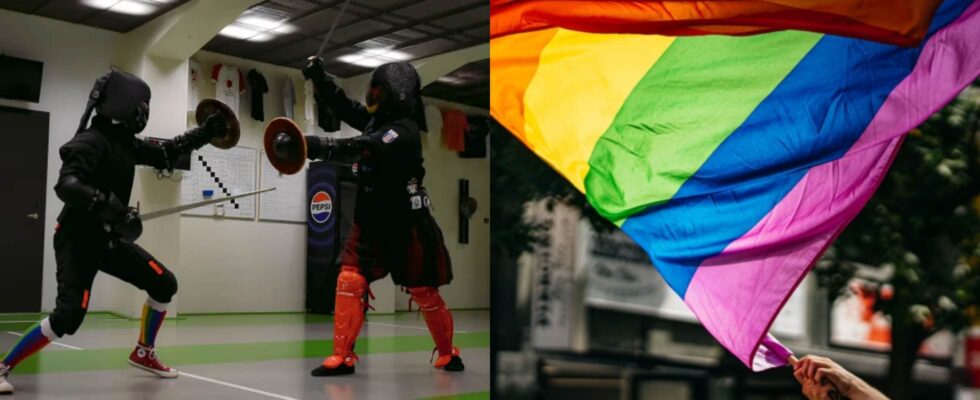
Historical European Martial Arts, or HEMA, spent its early years with a significant far-right infiltration problem. The sword-based reconstructive martial art, built around medieval fencing manuals dating back to the late 14th century, attracted white supremacists drawn to its explicitly European identity.
Eric Lowe, a HEMA practitioner with 13 years of experience and founder of Swordwind Historical Swordsmanship in Charlotte, North Carolina, appeared on a podcast to explain how the community turned things around.
The early days of HEMA were dominated culturally by a figure named John Clemens, described by Low as “if not an active neo-N*zi, at least the sort of person that attracts them.”
Clemens ran his organization with an iron grip, expelling members who cross-trained elsewhere or competed in unapproved events. The modern HEMA movement grew largely as a direct rejection of that culture.
The white supremacist appeal was understandable on the surface. Medieval European weaponry, Viking imagery, and Germanic combat traditions are obvious draws for people who romanticize an ethnically homogeneous past.
“If you are a prospective transgender martial artist, you’re going to check out that school and see, does this seem like it would be safe for a person like me?” Low explained. “If you are a swastika-tattooed neo-N*zi skin head, you’re also going to look at that school and ask, does this look like it would be safe for someone like me? And those people might not ever talk to you. They’re not going to come by for the free class. First, they check you out.”
That insight drove practical changes. Schools began displaying pride flags, transgender support patches, and “figh ters against racism” iconography visibly on websites, social media, and gym walls.
Lowe’s own school sells patches with a transgender flag that reads “I will fig ht by your side.” The Warriors of Ash, a Viking-focused HEMA school in Asheville, North Carolina, run by practicing modern Viking pagans, became a striking example of this approach.
Despite appearing visually exactly like what a white supremacist recruiter might hope for, they are upfront about nearly a third of their membership being transgender and close to half being women.
“They are forever turning people away from their school who are really disappointed to be told 30% of our membership is transgender,” Low said. “And if you’re not okay with that, then you have no place here.”
The signaling extended beyond flags. How instructors demonstrated techniques mattered too. An early female student at Swordwind pointed out to Lowe that he only demonstrated techniques with male students.
Her challenge was simple: bring a woman up to demonstrate when skill level is not a barrier, so other female students see themselves reflected in positions of value. That small change sent a clear message to anyone in the room who might not respect women as equal training partners.
Lowe is clear that none of this required abandoning what makes the art meaningful. “There’s real cultural artifacts here that are worth preserving,” he said. “You don’t have to be a white supremacist about it, but you can still preserve the thing.”
