
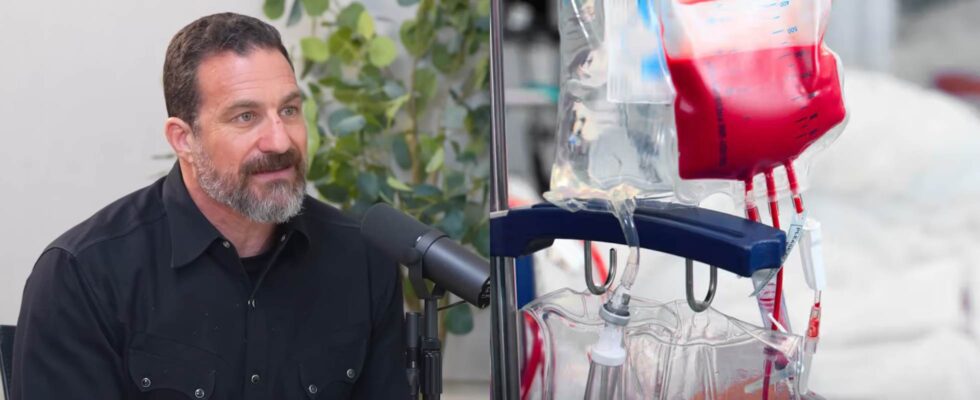
During a appearance on the a16z podcast, Neuroscientist Andrew Huberman made a striking personal health admission: he would bank his own blood to combat aging.
The conversation grew out of a discussion about longevity, young blood research, and what Huberman sees as genuinely promising science in the rejuvenation space. He pointed specifically to the work of Tony Wyss-Coray at Stanford, whose research explored factors in young blood and exercised blood that may rejuvenate the brain and body.
“Some of these factors that circulate after exercise are really beneficial,” Huberman said. “And yes, there are factors in younger blood that seem to be beneficial.”
From there, Huberman made his case for a surprisingly low-tech longevity strategy, one grounded not in advanced biotech but in the simple idea of preserving your healthiest self for your future self.
“If someone came along tomorrow and said, ‘Andrew, why don’t we collect your blood after exercising for the next six months and just bank your blood so that if you ever have an injury, you can get some really healthy blood of your own,’ I would do that,” he said.
His reasoning was straightforward. At 50, Huberman believes he is in better physical condition than he is likely to be at 70, which makes his current blood biologically more valuable to his older self than anything money could buy later.
“I’m healthier now at 50 than I’m likely to be at 70. I would love my own blood at 70. Just get an infusion once a week,” he said.
He also went further, pointing to research showing that blood infusions of exercise blood carry particular benefits, and cautioning that after a brain or bodily injury, pro-inflammatory compounds circulate through the blood in ways that harm all organs. His logic was that pre-banking healthy, exercise-rich blood could serve as a hedge against that biological decline.
Huberman was candid that this idea sits at the lower end of technological sophistication compared to what is emerging in longevity research. But he framed that as a strength, not a weakness.
“I’d do that before I’d get some like glutathione NAD infusion, which is probably fine, but I don’t know that it provides that much,” he said.
He described the concept as “a very low bar but useful technology,” suggesting that the simplicity of the idea is precisely what makes it appealing. No novel compounds, no gray market sourcing, no unknowns. Just your own blood, collected at your physical peak, held in reserve.
