
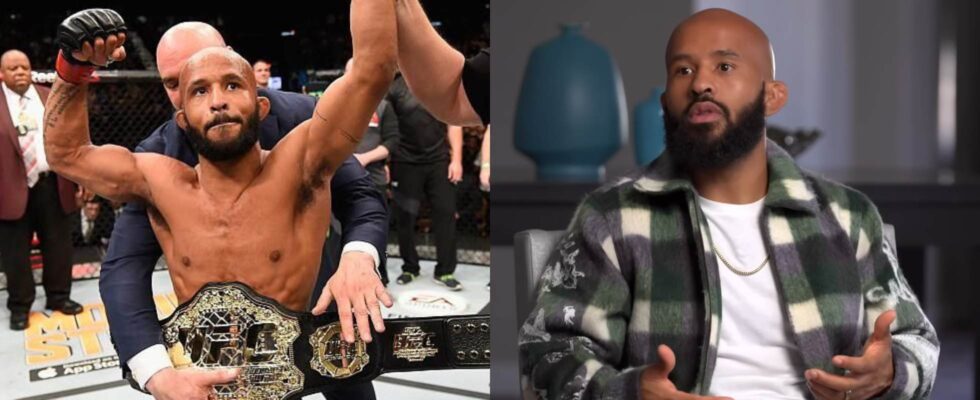
Demetrious “Mighty Mouse” Johnson recently sat down with Channing Crowder, Fred Taylor, and Ryan Clark on The Pivot Podcast and laid out what he earned as UFC flyweight champion and how he felt the organization treated him during his reign.
During the conversation, Johnson explained that when he first became champion, the base pay was far lower than many people assume for a UFC titleholder.
“When you become champion at that time, even at this time, it’s still maybe the same, but they just had a new deal. You’re making 350 flat. So, $350,000 flat,” he said.
He added that champions would only receive small increases with each win. “If you win, you go up every $10,000. So, 360, 370, 380. And then when I lost at that time at 380, your pay gets cut significantly in half,” he said.
According to Johnson, the pay drop after a loss could be dramatic even if an athlete had been performing at the highest level. “You might make 380. Next time you show up, do the exact same job, you’re going to make maybe 125 and 50. It just changed,” he said.
The pay structure became particularly frustrating during Johnson’s historic championship run. Despite racking up one dominant title defense after another, he said the compensation sometimes didn’t match the accomplishment.
“I won my eighth consecutive title defense and this guy comes in and he gets a $500,000 paycheck. Make that make sense,” he said.
When asked directly whether he felt disrespected during his time as champion, Johnson didn’t hesitate. “Oh, 1000%. There’s obviously no secret, I’ve always been outspoken about that,” he said.
Johnson also compared MMA’s pay structure with the systems used in major American sports leagues like the National Football League and the National Basketball Association, where unions and collective bargaining agreements help set clearer pay standards.
“When you look at the best running back in the NFL, he’s going to get paid. You look at the best basketball player in the NBA, he’s going to get paid,” he said. “Obviously, there’s more structure of a union where it’s okay, that’s what you’re going to get. But in mixed martial arts, that’s not necessarily the case.”
Johnson also spoke about the circumstances that led to his eventual move to ONE Championship. In his view, the UFC was waiting for an opportunity to move the division in a different direction.
“They were waiting for me to lose because obviously I was there for so long that they wanted a new face in the division,” he said.
He also offered a blunt assessment of how the organization operates. “They don’t care about having the best athletes in the world. That’s the truth,” he said.
Looking back, Johnson admitted that part of the issue may have been his own reluctance to promote himself outside the cage. “Did I sell myself enough? No. Because I felt my performance would do that,” he said. “Where I come from, you don’t talk s**t because you get your a*s beat. That’s just what you didn’t do.”
Still, he believes his performances inside the octagon should have justified greater recognition. “I can understand if I showed up and I had some boring a*s matches,” he said. “But I mean, knockout of the night, fi ght of the night. I was put on banger matches.”
