
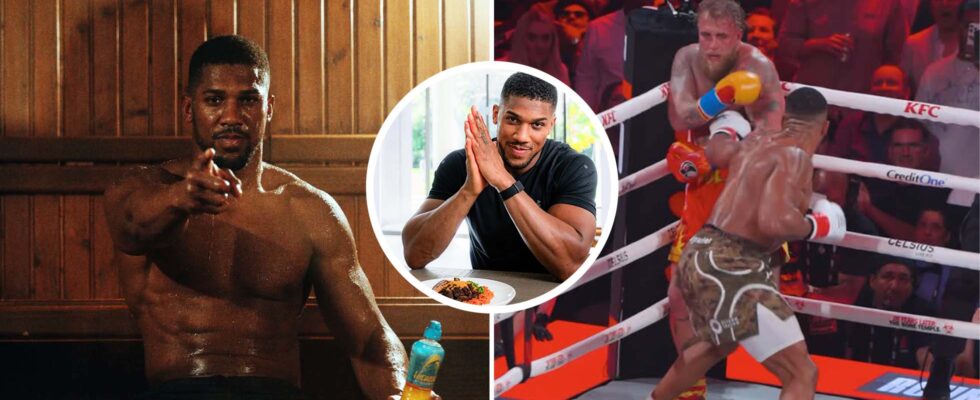
Anthony Joshua recently pulled back the curtain on these expenses during a candid discussion about what it actually takes to mount a legitimate training camp for a major contest. The two time heavyweight champion revealed figures that demonstrate why boxing operates as a business far beyond what happens inside the ropes. Anthony Joshua explained how preparation alone can rival the lifetime earnings of many combat sports athletes.
“In a training camp it’s expensive, maybe like half a million pounds. Then you’ve got your training partners’ apartments, then you’ve got the food that you eat through training camp, then you’ve got your training partners’ food that they eat through training camp, and you’ve got the cost of your actual trainers.”
The British star’s breakdown continued beyond the immediate training environment. Modern boxing promotion demands investment from the athlete himself, creating additional layers of expenditure that extend well beyond the gym.
“Then you’ve got the travel when you’re traveling to press conferences and back, videographers, so promotion of the flight. You’ve got to do your own personal promotion these days. You’ve got the event promotion, like Netflix are going to promote, but then also Anthony Joshua needs to promote himself as well. So yeah, it’s a lot just to rack up.”
This interview came shortly after Anthony Joshua‘s win over Jake Paul on December 19, 2025, a contest that generated a reported 93 million dollar purse for the Olympic gold medalist. Yet even that staggering sum faces substantial reduction once various obligations are fulfilled.
The United Kingdom resident encountered a complex dual taxation scenario stemming from the Florida venue. U.S. federal income tax at 37 percent claimed approximately 52 million dollars immediately. His UK residency then triggered additional obligations to His Majesty’s Revenue and Customs, demanding another 11.3 million dollars plus 2.8 million dollars in National Insurance contributions. Total tax payments reached roughly 66 million dollars, leaving Anthony Joshua with about 74 million dollars, representing just 53 percent of his original earnings.
Jake Paul‘s situation proved far simpler. As a Florida resident, he avoided both state income tax and UK taxation, facing only U.S. federal obligations and retaining a substantially larger percentage of his purse despite losing the contest.
The financial realities Anthony Joshua described highlight why many combat sports athletes view boxing as a more lucrative path than mixed martial arts. UFC lightweight Bryce Mitchell recently disclosed earning less than 1 million dollars throughout his entire professional career spanning over seven years with the promotion.
Bryce Mitchell recommends older manual transmission vehicles from the late 1990s with over 200,000 miles, often available for 3,000 to 5,000 dollars on platforms like Facebook Marketplace. He advises keeping an additional 3,000 to 5,000 dollars reserved for major repairs, arguing the total cost remains far below years of monthly payments.
The contrast between Anthony Joshua‘s training camp expenses and Bryce Mitchell‘s entire UFC earnings underscores fundamental economic differences between boxing and mixed martial arts. A single Anthony Joshua training camp at roughly 700,000 dollars represents 70 percent of Bryce Mitchell‘s total career earnings despite the UFC star’s seven years of professional competition.
Bryce Mitchell‘s financial discipline proves rare among combat sports athletes, many of whom spend beyond their actual means.
For Anthony Joshua, the 700,000 dollar training camp investment represents standard operating procedure for elite level boxing. These costs combined with his recent tax obligations illustrate why even nine figure paydays can transform into something considerably smaller once all expenses and obligations are settled.
