

Anne Isabella Coombes made headlines at a recent Cornwall County Masters Championship when she competed topless in protest of swimming regulations that forced her to compete against men despite being a transgender woman.
The 67-year-old Reading, England resident took her bold stand to highlight what she sees as discriminatory policies that specifically target transgender athletes. Coombes was required to compete in the men’s category but wore men’s swimming trunks like her male competitors, meaning she swam topless.
“I asked them what costume I was supposed to wear, as there are rules around how much fabric can be on your body,” Coombes told the Reading Chronicle. “They confirmed that I need to wear a female swimming costume despite having to compete with the men, which ‘outs’ me as a woman who is transgender.”
The contradiction in the requirements frustrated Coombes, who challenged the logic of the policy. “I explained to the person on the phone that they are not allowed to do that, and he didn’t have an answer,” she continued.
Coombes emphasized that her protest was designed to demonstrate that current policies are poorly conceived and unfairly single out transgender competitors. “I want to make it clear through this protest that trans people are not a threat when it comes to sport,” she said. “We aren’t winning everything, and if we started to, then I would be first in line to discuss other options. Right now, it is a non-issue.”
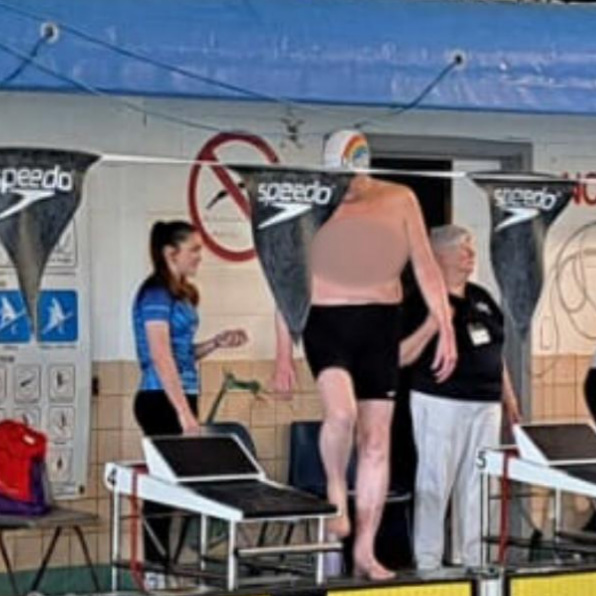
Her performance at the championship supported her argument – Coombes did not beat any men in the solo races she competed in.
The swimmer faces additional uncertainty due to subjective enforcement of dress code policies. According to Swim England regulations, referees have discretion to determine whether swimwear meets standards of “good moral taste.”
“Deciding on whether exposing my breasts is in ‘good moral taste’ or whether I need to cover them up so that ‘those involved in competitive swimming are appropriately safeguarded’ is an entirely subjective decision of the referee,” Coombes explained. “In other words, I could turn up to the competition and run the risk of not being able to compete in whichever costume I intend to wear. No other swimmer has this concern. These regulations also mean that Swim England is treating me as a male by default.”
This Isn’t Coombes’ First Brush with Publicity
British Swimming has updated its changing room policies after parents raised concerns about transgender pool official Anne Coombes using the women’s changing room during a teenage competition in Sheffield in 2023. Coombes, a 65-year-old trans woman, allegedly used the space as a walkthrough at the British Summer Championships, prompting complaints from parents who said their daughters felt intimidated. The organization now mandates that only competitors actively changing may enter the changing rooms, and volunteers have been reminded of protocol. This follows a separate incident just days earlier, where Coombes sparked backlash on social media after accusing a Sheffield hotel spa of discrimination for not granting her access to the female changing area. Her confrontational stance, including viral tweets and demands for staff training, drew criticism from figures like Sharron Davies and Julia Hartley-Brewer. Coombes, who has previously written about her refusal to use separate facilities, maintains she will continue asserting her identity despite opposition.
Coombes has been a dedicated member of Reading Swimming Club for three decades. She began her transition five years ago at age 62 and first applied to compete as a female swimmer in 2022.
Initially, there was hope for inclusion. After providing documentation about her transition, Swim England permitted Coombes to compete as a female at a 2023 Sheffield masters event, where she had a positive experience.
“Masters’ swimming is usually very inclusive. They do try and let anyone compete. I came second in that race,” Coombes recalled. “The woman who came first was a whole length ahead of me. She broke the European record; she’s an excellent swimmer. I’m trying to emphasize that this is not a trans person coming in and nicking places from other people.”
However, the landscape changed dramatically by September 2023 when Swim England implemented new regulations establishing two competition categories: “female” and “open.”
The policy clearly states that “only athletes who have declared a birth sex of female will compete in the ‘female’ category.” Meanwhile, the “open” category accommodates “athletes with a birth sex of male, trans or nonbinary competitors.”
Notably, the regulations do not specify which category should include transgender or nonbinary athletes who were assigned female at birth, creating additional ambiguity in the policy framework.
